Large vacant buildings should be transitioned into urban community centers

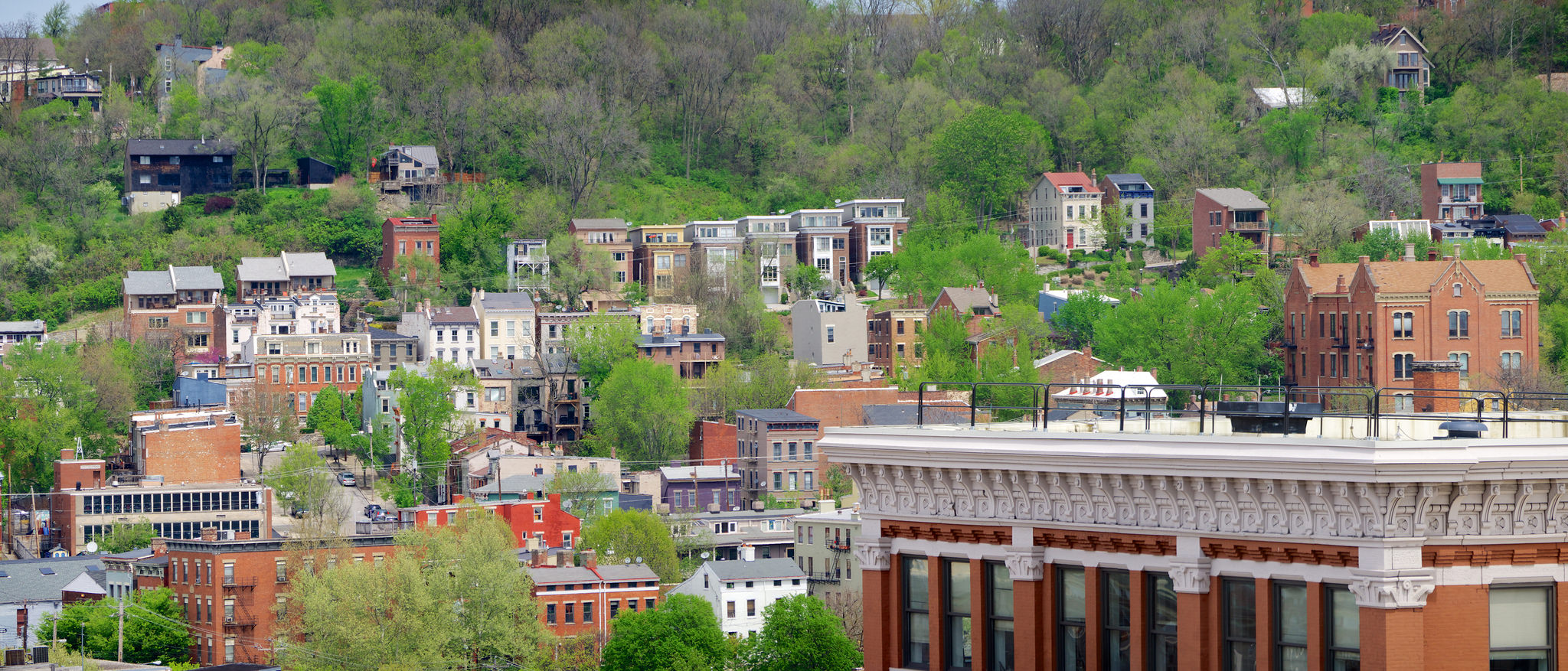
Could the Bartlett Building be transformed into something completely different? Photograph by Thadd Fiala for UrbanCincy.

Throughout the United States there are cities that have large vacant buildings and spaces in their central business district that could be utilized in a new efficient way.

In Cincinnati, the old School for the Creative & Performing Arts was recently auctioned off and is slated to be turned into apartments. In the CBD the Bartlett Building, Tower Place Mall, and Terrace Plaza Hotel remain empty or nearly empty and take up about one-fourth of a city block each.

Some think these buildings could be prime residential properties, but they could be that and more. A large vacant building, for example, could be developed into a mixed use community center.

My inspiration actually came from the Up To Speed story on UrbanCincy about a rock climbing gym in St. Louis. I thought to myself that Cincinnati can have something similar and better. Downtown Cincinnati and OTR/Pendleton are becoming destinations for young adults and families for both restaurants and bars.

Turning a large vacant building into a destination point for physical and social activity would add a whole new dimension to the city. The following ideas are what could go collectively into a large empty building:

  • Rock Climbing Gym – With the exception of the UC recreation center, all of the rock climbing centers are on the outer edge of the city.
  • Paintball Arena – This would be an extremely unique idea for the area as there are minimal indoor paintball facilities and could be a draw for different work or teambuilding groups.
  • Exercise Gym/Running Track – The gyms downtown are mostly old and do not offer enough space or have odd floor plans. Renovating a vacant building would allow plenty of space with tall ceilings and large windows that could allow natural light and have a large open space for exercise equipment. A downtown gym with enough space can offer a full menu of classes including Crossfit, spinning, yoga and Zumba, to bring in a broad range of people looking to exercise. A running track a fraction of the size of an outdoor track could be installed for those that do not like treadmill, but want to run indoors.
  • Basketball Court/Indoor Soccer – Large office buildings could utilize a few stories to carve out a basketball/indoor soccer surface and hold leagues and practices for area schools and AAU teams.
  • Batting Cages/Pitching Tunnels – The basement of a building could be an ideal area for batting cages and pitching tunnels for baseball and softball practice during the cold months. These cages and tunnels are easily moved and can be repositioned to make room for more activities inside the building.
  • Golf Simulators/Nets/Putting Green – This would be another unique addition to an urban area with little green space for golf. Workers could play a quick round during their lunch break or warm up before they go out to one of Cincinnati or Hamilton County’s public courses. This would also allow for urban dwellers a space they could walk to for golf lessons.
  • Offices – With additional amenities a building would become more attractive to businesses.
  • Apartments – To make the building a true mixed use development, apartments could be added as this would be a true “luxury apartment” with a real gym (unlike those found at too many apartment complexes that only have a treadmill and Bowflex and call it a gym) and the ability to walk to some of the most popular dining destinations in the city.

To compare a potential community center downtown with other recreational centers, the Recreation & Physical Activity Center at Ohio State University has a total of 570,000 square feet of space including the pools, while 25,000 square feet is fitness space for weights and treadmills. By contrast, the Campus Recreation Center at the University of Cincinnati has 202,000 square feet including its pools.

The options of what to include in these large, empty spaces are endless, but a truly mixed use development would be better suited for the community than simply offices, apartments, and art studio space. The gyms downtown are old and do not offer enough space, or have odd floor plans. Rock climbing and paintball would draw younger crowds, and the students in the area could benefit from having additional practice facilities.

A neighborhood needs young families as well as young professionals. This would be a good start to try and draw them to the core and keep them there.

Brian Valerio grew up in Cincinnati’s College Hill neighborhood and graduated from St. Xavier High School and Ohio State University where he studied finance and real estate. He currently works at Fifth Third Bank and lives downtown. Those interested in sharing their thoughts can submit guest editorials to UrbanCincy by emailing urbancincy@gmail.com. Please include a short bio with any submissions.

Report: Cincinnati’s five-year outlook for building demolitions may approach 8,000

Home demolition photograph provided by Price Hill Will.

In September, city officials stood in Price Hill alongside state officials to announce plans to demolish up to 700 vacant and blighted buildings in Cincinnati. The funding for the ongoing effort comes from a state-wide program called Move Ohio Forward, which gives demolition funding to cities from money the state won in a settlement with large banks last year over the home foreclosure process and lack of property upkeep by the banks.

City officials estimate that there are currently 1,300 vacant and blighted properties awaiting demolition. The $5.84 million grant, when matched with $5.34 million from the Hamilton County Land Reutilization Corporation and $3.49 million from the City, will provide enough funding to cover just over half of the total amount of demolitions mandated its own ordinances. The final amount of demolitions, officials say, will vary from neighborhood to neighborhood.

“The Moving Ohio Forward Grant Program provides unprecedented blight abatement opportunity for the City to clear dangerous, obsolete buildings from neighborhoods, make way for redevelopment, and eventually raise property values,” Edward Cunningham, Property Maintenance & Code Enforcement Division Manager, told UrbanCincy.

In an effort to further control what happens with the cleared sites, the City of Cincinnati will work with Hamilton County’s new Land Reutilization Program in order to acquire tax delinquent properties. Once the buildings are demolished, the City will determine if the land can be used as parks, community gardens or rehabilitated into new housing. So far, however, only enough funding for lot restoration on 200 parcels has been identified.

In cases where the lots are private properties, and are not able to be acquired, it will be up to the property owners of the vacant lots to decide the future of their property. According to Cunningham, property owners will be allowed to maintain the lots, create parks, parking or new infill construction.

More Comprehensive Plan for Demolitions Needed
Property demolition has been used by many cities including Cincinnati as a method of addressing problem vacant buildings that have been condemned because they are hazards to human health and unsafe to occupy. While the debate on the impacts of foreclosure and vacant property is far from over, some of these buildings are “too far gone” in the eyes of building inspectors that they legitimately need to come down. And according to Cunningham, the buildings being demolished under this program are buildings that are beyond repair.

Once the demolitions are completed, one-by-one, it will create more land between occupied houses thus negatively impacting the completeness of the neighborhood’s form. Without a strategic plan, vacant and unmaintained lots could end up degrading neighborhoods in the same manner as blighted homes; however, vacant lots tend to be easier to maintain and do not pose as much of a risk as a standing structure.

Furthermore, demolitions made through this program on private land will place the cost burden on the property. Should the property owner not pay the assessment for the work, then the property could be foreclosed by Hamilton County, which would then open the land up to redevelopment. This process, however, does take a considerable amount of time and offers no guarantee of redevelopment.

Projected Housing Units in Five Year Demolition Pool by City for Ohio’s “Big Eight” Cities. Source U.S. Census Bureau.

The challenge of increasing amounts of abandoned and blighted housing is not symptomatic of Cincinnati alone, as many older industrial cities are facing the similar problems. A recent report from the Brookings Institute found that Cincinnati might have close to 8,000 buildings eligible for demolition in the next five years. The report also stated that while the demolitions have the potential to stabilize neighborhoods, excessive regulations and costs prevent cities from demolishing the amount of housing that should be demolished on an annual basis.

To overcome these hurdles the report makes a series of recommendations for cities to devise their own strategic demolitions plan.

“Planners, urban designers, and residents must together evaluate how demolishing a particular building will affect the texture of its block or area,” the Brookings Institute stated in Laying the Groundwork for Change: Demolition, urban strategy, and policy reform (2012).

Cities such as Cincinnati need to have a level of transparency in place that allows for neighborhood input on the reuse of the newly created vacant lots. It is not merely enough to encourage neighborhoods to help identify future uses for vacant lots as the city is doing now, it should be required.

As previously profiled on UrbanCincy, Cincinnati’s population decline is systemic and although vacant building demolition is more a testament to the large supply of housing versus demand, absent a strategic demolitions plan, the city should be mindful that stabilizing neighborhoods relies heavily on preserving existing housing or building new housing capacity and offering incentives or neighborhood upgrades that would attract new residents.

Cincinnati becomes first Ohio city to install green bike lanes

Construction workers installed bright green bike lanes at three conflict points along Ludlow Avenue yesterday. The new green bike lanes are a first for Cincinnati as it continues to work towards making city streets safer for area bicyclists.

According to the National Association of City Transportation Officials (NACTO), experimentations with specially colored bike lanes first took place in the mid-1990s. Then, between 1997 and 1999, the City of Portland worked with the Federal Highway Administration (FHWA) to mark 10 conflict areas with blue coloring and accompanying signage. Since that time, the FHWA has determined that green is a more appropriate color for bike lanes on public streets, so as not to be confused with accessibility parking.


The City of Cincinnati used NACTO’s standard design for a truncated bike lane through an intersection as the basis for its green bike lanes on Ludlow Avenue. The installation makes Cincinnati the first Ohio city with green bike lanes.

Green bike lanes have begun to appear in cities throughout North America in recent years to not only mark areas of conflict, but also delineate entire bike corridors. In the Midwest, Chicago has led the charge using green bike lanes for entire cycle track corridors, bike boxes at traffic signals, and at special conflict points.

According to city officials, Cincinnati’s first application of green bike lanes will mark Ludlow Avenue where it intersects with Old Ludlow Avenue, Central Parkway and a driveway entrance to Cincinnati State (map). City planners also say that there will be additional green bike lanes to come.

“We are considering using green markings where the Gilbert Avenue bike lane will intersect with the right-turn lane into the casino,” explained Department of Transportation & Engineering (DOTE) planner, Melissa McVay.

McVay went on to say that City is using NACTO’s design guidelines and specifications for these projects, and that going forward, green bike lanes will be considered at all high conflict areas where motorists must cross a bicycle path.

The idea behind the green markings is to improve the visibility of bicyclists, and in the process, improving safety.

“In this [Ludlow Avenue] case the green lanes help negotiate cars desiring a right hand turn through a bike lane that continues straight ahead,” said Frank Henson, President, Queen City Bike. “By giving the bicycle lanes a different color, motorists realize that, in making their turn, they are crossing into another travel lane reserved for cyclists, and that they must yield to bicycle traffic in order to complete the turn.”

The City of Cincinnati Bicycle Transportation Program has installed 35.8 miles of bicycle facilities to-date, with an additional 289.9 miles planned in a citywide bicycle network.

And when asked about what could be done to continue to improve safety for Cincinnati-area bicyclists, Henson concluded that, “The best thing the City of Cincinnati can do to improve safety for street cycling is to continue to carry out the Cincinnati Bike Plan, improving the network of bike routes, lanes, trails, and paths in the area. Better education and enforcement of traffic law for both cyclists and motor vehicle operators is also necessary.”

We sat down with Melissa McVay on Episode 8 of The UrbanCincy Podcast to discuss Cincinnati’s bike culture – where we stand, how we got here, and what needs to take place next. You can stream that podcast online for free, or subscribe to The UrbanCincy Podcast on iTunes so that you don’t miss an episode.

In Ohio, Columbus and Cincinnati exceed national average for college graduates

As the economy of the United States continues to become more knowledge-based, it is important to have a well-educated work force. The new data, released by the U.S. Census Bureau, shows that Columbus (32.9%) and Cincinnati (29.6%) come in above the national average (28.5%) when it comes to the percent of individuals who are 25 or older with a bachelor’s degree. More from The Business Journals:

The U.S. Census Bureau, which keeps track of everybody’s progress, has just issued its latest update on educational attainment. These are its estimates for the 206.5 million Americans who were 25 or older as of last year. 177.4 million (85.9 percent) hold high school diplomas, and 58.9 million (28.5 percent) also hold bachelor’s degrees…It’s common to find areas where at least 90 percent of all adults have high school diplomas.

Remaking a Columbus suburb for the creative class

Dublin, Ohio, the affluent suburban city northwest of Columbus, has studied a radical remaking of its built environment aimed to attract young professionals and empty-nesters. Kaid Benfield examines plans for Dublin’s Bridge Street Corridor: mixed-use buildings, walkable streets, and light rail in place of typical suburban sprawl. What suburban neighborhoods in Cincinnati could, and should, be taking similar approaches? More from Switchboard:

From talking to residents, businesses and community leaders, Goody, Clancy found that Dublin is facing increased competition from downtown Columbus, other suburbs, and other parts of the country for the young talent needed to supply the diverse, skilled workforce sought by modern employers…and recognized that it will be important to build in a way that creates and strengthens neighborhoods, not just adds to them; that development should strengthen, not diminish, the town’s historic district and character; that transportation choices and more complete streets would be required; that the community’s greenway and open space network can grow.

The firm believes that the Bridge Street Corridor is an appropriate place to focus, with significant redevelopment opportunity due to the presence of several large parcels of land under single ownership (including commercial properties well past their prime), and several property owners seeking higher-value uses for their land. Focusing on the corridor would also present opportunities for increasing connectivity and transportation access, while avoiding impacts on the community’s single-family neighborhoods, which mostly lie outside the study area.

Cincinnati officials are looking for design ideas as they work to cap urban highway

Billions of dollars of public and private investment has transformed Cincinnati’s central riverfront over the past decade. What was once a flood-prone industrial center turned unusable waterfront property, is now home to a new park, neighborhood, museums, and professional sports venues.

The investments made to date have been so successful, in fact, that they are creating spinoff investment in the Central Business District. A remaining hurdle, however, is the crossing of Third Street, Fort Washington Way (FWW), and Second Street.

The nearly 300-foot span of roadways was significantly reduced in width when Fort Washington Way was reconstructed in 2001, but the span remains a visual barrier for many of those in the Central Business District or at The Banks.

Cincinnati officials are looking to build off of recent success by capping Fort Washington Way. Photograph by Randy A. Simes for UrbanCincy.

The problem was expected by city officials, in the 1990s, during original planning efforts for the central riverfront’s transformation. As a result, city leaders worked to raise $10 million to construct pile foundations that could one day support a cap over the interstate highway running beneath street level on FWW.

The pile foundations are capable of extending 600 feet over the highway roughly between Elm Street and Main Street. According to engineers who worked on FWW’s reconstruction, the caps could support the weight required for a park, or built structures depending on height and building materials.

No specific development plan for the caps has been developed however, and now the city is launching a design competition called Connect the Blocks to establish a vision for space.

“The Banks is well underway, downtown is growing, and now we must begin thinking about what we as a community want to see over Fort Washington Way to connect downtown and the riverfront,” City Manager Milton Dohoney stated in a prepared release. “We must first have a common vision of what we want, then we can establish the roadmap to get there.”

The national competition is calling on architectural, engineering and design professionals to create and submit concepts and cost estimates for the caps that are to be built over FWW. According to city officials, three to five finalists will be selected and awarded stipends to further refine their designs.

St. Louis has dealt with similar issues as it has tried to bridge the divide created by I-70 between downtown and the Gateway Arch grounds. While I-70 will not be capped entirely, a one block portion is envisioned to connect Jefferson National Expansion Memorial with Kiener Plaza in the CityArchRiver 2015 plan.

In Ohio, the only similar example of such a project exists in Columbus where a $7.8 million cap was constructed over I-670 along N. High Street. It includes approximately 25,000 square feet of street-level retail and connects Columbus’ downtown with its Short North district.

The City of Cincinnati held the first of two public meetings, on the design competition, last Wednesday in Madisonville. The second meeting is scheduled to take place on Tuesday, October 9 at 6pm at the Main Public Library (map). The public is also invited to weigh in on the process by participating in an online survey going on now, and officials also say that the public will be invited back to view the finalists’ designs once they are selected.

Full details about how to participate in the eight-month design competition can be found on the project’s website. The implementation of any winning design, officials say, will be dependent upon the availability of funding.

New Enquirer format delayed until 2013, corresponding paywalls unphased

The Cincinnati Enquirer and Columbus Dispatch newspapers had planned to shift to a new tabloid-sized print version this fall, but both debut’s will now be delayed until early 2013. The Enquirer, however, will still move forward with its content subscription model, on its planned October 1 date, that will charge readers for access to its website, e-newspaper, tablet and mobile sites, and smartphone applications. More from the Cincinnati Enquirer:

The new edition had been scheduled for this fall; however, unexpected mechanical issues at Dispatch Printing in Columbus, where the new Enquirer will be printed, prompted the delay, Buchanan said.

The new format is 10 1/2 inches wide by 14 2/3 tall, is easier to manage for readers, will feature the same amount of news content, more color, and still have traditional sections. It will feature in-depth coverage of topics readers have said they’re passionate about, and more investigative stories. The paper also is revamping news and entertainment coverage.