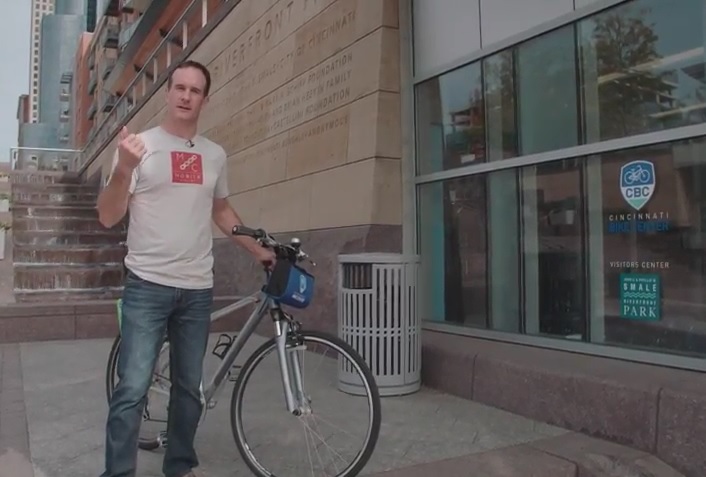
Standing Room Only Crowd Packed Metropolis & Mobility Event

On Friday, April 19, UrbanCincy partnered with the Niehoff Urban Studio and hosted an event that showcased student work and included expert analysis and discussion of urban mobility issues in Cincinnati.

Approximately 100 people showed up to the collaborative studio space in Corryville to view the student work, and learn more about the challenges facing Cincinnati today and in the future.

Metropolis & Mobility: Bus Rapid Transit and Bikeway Planning focused on five proposed bus rapid transit and three bikeway corridors throughout Cincinnati. Engineering and planning students were paired together in groups to examine the issues and propose implementation strategies for those potential projects.

Students examining bus rapid transit focused on the Reading Road, Downtown, Hamilton Avenue, Vine Street, and Montgomery Road corridors. The students studying bikeway planning, meanwhile, examined the Wasson Way and Western Riverfront Trail and Mill Creek Greenway.

The event also included an expert panel discussion between Southwest Ohio Regional Transit Authority (SORTA) CEO Terry Garcia Crews, Parsons Brinckerhoff senior transportation planner Tim Reynolds, and Cincinnati Bike Center general manager Jared Arter.

Those interested in listening to the panel discussion can do so by streaming it online, or by subscribing to The UrbanCincy Podcast on iTunes and downloading episode 19.

One of the student proposals was to activate the Riverfront Transit Center and utilize it as a station for BRT and commuter express routes. Just four days after the Metropolis & Mobility event, the Business Courier reported that Metro was interested in doing just that.

Those who attended the event were also able to vote on their favorite project, which will then be profiled right here on UrbanCincy.com in the coming weeks. In the meantime, please enjoy the video put together on the Metropolis & Mobility event by our contributing videographer Andrew Stahlke.

Metro Seeking Public Feedback on Proposed City-Wide Bus Enhancements

Following a year of ridership growth, the Southwest Ohio Regional Transit Authority (SORTA) will roll out a series of improvements to its Metro bus service this year. Agency officials say that the improvements will be rolled out in two phases.

The first round will go into effect this August and will include significant service enhancements at the new Glenway Crossing Transit Center on the west side.

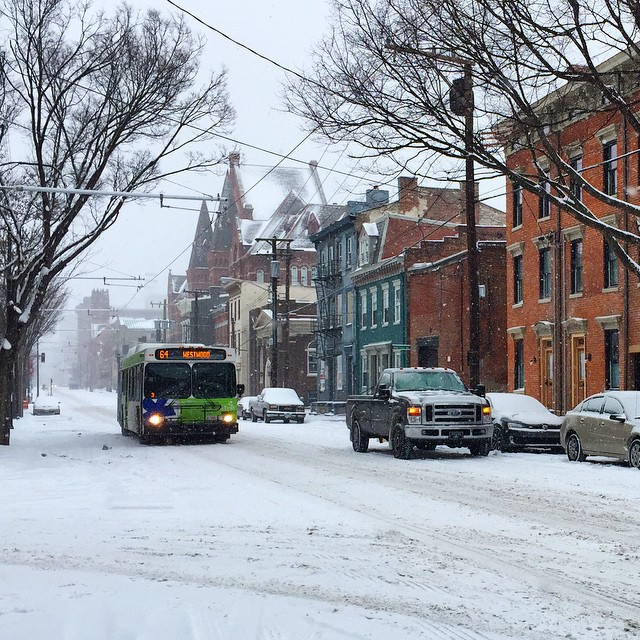
A new Route 32 will provide all-day service between Price Hill and Downtown, a modified Route 64 will connect Westwood with retail on Ferguson Road and the transit center, and new connections will be offered to Route 38X to Uptown and Route 77X to Delhi. Additional service will also be added to Route 19 along Colerain Avenue and Route 33 along Glenway Avenue.

Metro Plus Bus
New Metro*Plus buses were revealed to the public this week, and will be in operation by August. Image provided.

New direct crosstown services, from the Glenway Crossing Transit Center, will take riders to Oakley via the new Mercy Health West Hospital on Route 41, and to the new Uptown Transit District and onto Hyde Park via Route 51.

The transit agency will also begin operating the new pre-bus rapid transit (BRT) service, called Metro*Plus, between Kenwood and the Uptown Transit District this August.

Officials envision Metro*Plus as offering faster service through fewer stops and enhanced visibility through uniquely designed buses and more robust bus stops. The service will initially connect Uptown with the Kenwood area via Montgomery Road, but will be judged for consideration along another six corridors throughout the region.

Attend our free event this Friday from 5pm to 7:30pm at the Niehoff Studio in Corryville on bus rapid transit and bikeway planning that will include an expert panel discussion and open house.

The improvements are a result of SORTA’s 2012 planning efforts, and will be reviewed to determine whether or not the changes should stay in effect.

“Last year, we listened to the community’s suggestions and, as a result, are proposing a number of service changes to better meet our customers’ needs and attract new riders,” Terry Garcia Crews, Metro CEO, stated in a prepared release. “We’re ready to go forward with improvements that will make Metro more efficient, more convenient, and easier to ride.”

Potential Cincinnati BRT Corridors

Officials say that the second round of enhancements will be rolled out this December and will include added service to Route 20 along Winton Road, Route 78 along Vine Street, Route 31 crosstown service, Route 43 along Reading Road, and faster service on Route 1 between the Museum Center and Eden Park.

It is also expected that the four transit boarding areas, that form the $6.9 million Uptown Transit District, will also be complete by the end of the year, and taking on the additional service to the region’s second largest employment center, and one of the city’s fastest growing population centers.

SORTA officials emphasize that the changes are all short-term in nature, and that they would like public feedback on the adjustments. Officials also state that the improvements are being made within Metro’s 2013 operating budget, and will not require fare increases.

Metro will host a public meeting on Wednesday, May 1 from 8am to 5:30pm at the Duke Energy Convention Center (South Meeting Room 232). Officials say that visitors can come anytime during those hours, and that presentations will be offered every hour on the hour.

Comments can also be submitted online, by email at routecomments@go-metro.com, fax at (513) 632-9202, or mail to 602 Main Street, Suite 1100, Cincinnati, OH 45202. The deadline for public comments is May 1, 2013.

Rookwood Pavilion offering upscale outlets an urban destination

Believe it or not, Rookwood Commons and Kenwood Towne Centre once were in a heated battle over which shopping destination would become the region’s premier stop. Due to a number of factors, including a messy eminent domain case that prohibited Rookwood from expanding, Kenwood has taken firm control of that title. Rookwood hasn’t died, however, and it may be looking to become a destination for unique retailers entering urban markets. More from the Business Courier:

The Nike factory store now under development at Rookwood Pavilion is part of a larger plan to reposition the 20-year-old retail center as something you’ve probably never heard of: an urban infill outlet. The architect of that strategy, Mark Fallon, says outlet retailers pay higher rents, attract fashion-conscious shoppers and are looking to expand into urban areas.

“This opens us up to 200 quality tenants in the future,” said Fallon, vice president at Jeffrey R. Anderson Real Estate Inc., which handles leasing for the 257,000-square-foot Rookwood Pavilion in Norwood. “It offers (outlet tenants) an urban infill location, as opposed to being out in the hinterlands.”

MetroMoves: A Decade Later

The election held earlier this month marked the 10-year anniversary of MetroMoves, the Hamilton County ballot issue that would have more than doubled public support for the Southwest Ohio Regional Transit Authority (SORTA). Specifically, a half-cent sales tax would have raised approximately $60 million annually, permitting a dramatic expansion of Metro’s bus service throughout Hamilton County and construction and operation of a 60-mile, $2.7 billion streetcar and light rail network.

MetroMoves was SORTA’s third attempt to fund countywide transit service – sales tax ballot issues also failed in 1979 and 1980.


The 2002 MetroMoves plan called for five light rail lines, modern streetcars, and an overhauled regional bus system. Image provided.

Bus System Expansion
According to John Schneider, who chaired the MetroMoves campaign, SORTA planned to expand bus service immediately after collection of the tax began. In 2003 Metro’s schedule would have been reworked with more frequent service on every existing bus line, including more late night and weekend service. By 2004, with the arrival of newly purchased buses, Metro planned to link a dozen new suburban transit hubs with new cross-town bus routes.

The Glenway Crossing Transit Center, which opened in early 2012, is an example of the sort of suburban bus hubs planned as part of MetroMoves. The 38X bus, which began service when the transit center opened, is an example of the sort of new routes that MetroMoves would have funded.

Modern Streetcars & Light Rail Lines
In 2003 design work would have begun on a modern streetcar line and the first of five light rail lines. The streetcar line was planned to follow a route nearly identical to the line currently under construction in Downtown and Over-the-Rhine. The modern streetcar line was planned to have traveled up the Vine Street hill to the University of Cincinnati, then turn east on Martin Luther King Drive, cross I-71, and meet a light rail line on Gilbert Avenue.

Construction would have begun in 2004 and operation would have begun by 2006 or 2007.

The start date for light rail construction was less certain because the MetroMoves tax revenue was to be used as the local contribution for a large Federal Transit Administration (FTA) match. This process became standard practice in cities throughout the country since federal matching began in the early 1970s.


Modern streetcars, similar to those used in Portland, OR, could have been in service as early as 2005 had Hamilton County voters approved MetroMoves in 2002. Photograph provided by John Scheinder.

The first light rail line to be built was the system’s “trunk”, a line connecting Downtown and Xavier University on Gilbert Avenue and Montgomery Road. At Xavier, three suburban light rail lines were planned to converge on a trio of abandoned or lightly used freight railroad right-of-ways.

The first to be built would have been the northeast line through Norwood to Pleasant Ridge and Blue Ash. It was expected that the second line would be one incorporated into a rebuilt I-75; however that highway project has now been pushed back past 2020, meaning the Wasson Road line to Hyde Park likely would have been built soon after the line’s abandonment in 2009.

Renovating the Central Parkway Subway
Lost in the rhetoric employed to defeat MetroMoves was perhaps its most intriguing feature: a plan to renovate and at last put into use the two-mile subway beneath Central Parkway. This tunnel was built between 1920 and 1922 as part of the Rapid Transit Loop, a 16-mile transit line that would have connected Downtown with Brighton, Northside, St. Bernard, Norwood, Oakley, and O’Bryonville. Construction of the Rapid Transit Loop ceased soon after the Charterite ouster of the Boss Cox Machine and never resumed.

Three subway stations at Race Street, Liberty Street, and Brighton were to have been renovated and put into use as part of the 2002 MetroMoves plan. North of the subway’s portals, the line would have traveled on the surface to Northside, then entered I-74’s median near Mt. Airy Forest. Park & Ride stations were planned in the I-74 median at North Bend Road and Harrison Avenue/Rybolt Road in Green Township.

A fifth light rail line, requiring construction of four miles of new track, was planned to connect Northside and the Xavier University junction. Trains on this fifth line would travel from the far West Side to Hyde Park on the I-74 and Wasson Road corridors.

MetroMoves failure at the polls
MetroMoves was placed on the November 2002 ballot by SORTA in anticipation of a new federal transportation bill in 2003. What became known as SAFETEA-LU, a $286.4 billion measure, was not passed until 2005. Although SORTA’s board had the authority to place a transit tax on Hamilton County’s ballot in the years before the federal transportation bill was passed, MetroMove’s 2002 defeat was so lopsided (161,000 to 96,000 votes) that the regional transit authority choose not do so.

When speaking with those affiliated with the 2002 MetroMoves campaign, the failure of the ballot issue is usually attributed to four key factors:

  1. Anti-tax mood caused by the 1996 stadium sales tax and ensuing cost overruns
  2. 2001 Race Riot
  3. The MetroMoves campaign was thrown together quickly during summer 2002. SORTA’s board did not vote to place the issue on the ballot until August 20.
  4. A dirty opposition campaign comprised of Hamilton County Auditor Dusty Rhodes (D), Commissioner John Dowlin (R), Commissioner Phil Heimlich (R), and Congressman Steve Chabot (R).

The opposition campaign was led by Stephan Louis, who in late 2002 was reprimanded for false statements made during the campaign by the Ohio Elections Commission. Nevertheless, as a reward for his work in opposing MetroMoves, he was soon after appointed to SORTA’s board along with fellow public transit opponent Tom Luken in 2003.


Opponents to the 2002 MetroMoves campaign were accused and found guilty of using unethical campaign tactics. Newspaper image taken from a 2002 issue of CityBeat.

In 2006, Louis came under fire for having written racist and anti-public transportation emails and was forced off the board soon after. He reappeared to campaign in support of COAST’s anti-streetcar Issue 9 in 2009 and Issue 48 in 2011.

Another MetroMoves?
In 1972 when Cincinnati voters approved the .3% earnings tax that enabled creation of a public bus company, it was expected that city funding would be temporary and Hamilton County would eventually fund the region’s public transportation. Instead, nearly 40 years later, Cincinnati’s bus company is still funded only by the city and therefore provides only limited service outside city limits.

Ten years after the defeat of MetroMoves, despite a tripling of gasoline prices and the viability of transit systems proven by an increasing number of mid-sized American cities, it seems unlikely that a similar effort stands a chance of passage in Hamilton County in the immediate future. Many of the same public figures who opposed MetroMoves ten years ago have acted repeatedly in the past five to obstruct Cincinnati’s current streetcar project.

Furthermore, since the election of President Barack Obama (D) in 2008, the Tea Party has fomented an irrational suspicion of local government, and local anti-tax groups have authored intentionally misleading ballot issues. Meanwhile our local media, especially talk radio, continues to harass public transportation at every opportunity.

The way forward for the Cincinnati area has, since 2007, been the City of Cincinnati by itself. Despite the efforts of politicians, anti-tax groups, and utility companies to stop Cincinnati’s streetcar project, it broke ground in early 2012 and track installation will begin next year. Along with ongoing demographic shifts within Hamilton County, the success of Cincinnati’s initial streetcar might persuade the county’s electorate to approve county funding of public transportation for the first time.

Cincinnati moves forward with land use study of Wasson Railroad Corridor

On November 14, Cincinnati’s Department of City Planning & Buildings held a public hearing on its upcoming land use study for the disused Wasson Road Railroad and adjacent properties.

Norfolk-Southern Railroad ended service on the line in 2009, and in 2010 the City of Cincinnati’s Department of Transportation & Engineering (DOTE) identified the right-of-way as a future off-road bicycle path in its planned 400-plus-mile network of bike lanes and trails.

Local bicycle advocates have since built public support for construction of a paved rails-to-trails bicycle path between Xavier University and Fairfax as part of a project called the Wasson Way Trail.


The proposed Wasson Way Trail would use the Norfolk Southern Railroad right-of-way to create a bike trail from the Little Miami Trail to Xavier University. Image provided.

On Wednesday, however, city officials were quick to mention that the upcoming land use study is just that – a determination of how the Norfolk Southern property and its surroundings might be rezoned in order to protect the right-of-way up until and after the right-of-way is purchased by Cincinnati – not a determination of what should be built in its place.

Already, Norfolk Southern has leased some of its railroad property for other uses. In 2011, a shopping center at Wasson Road and Edwards Road created a gravel parking lot on the disused tracks and another business near Paxton Road is looking to do the same.

Although Federal regulations prohibit railroads from subdividing their disused properties until they complete an “abandonment” process, Wasson Way Trail advocates are concerned that revenue from additional leases might discourage Norfolk Southern from selling the right-of-way to the City of Cincinnati at a future date.

Michael Moore, Director of the City of Cincinnati’s DOTE, stated that appraisals of the Norfolk Southern property fall close to $2.5 million. He cautioned, though, that this appraisal should not be thought of as a sale price, as the terms of the City’s purchase of the property cannot be known at this time.

Multi-Modal Use of the Corridor
At the November 14 meeting, city officials also made a point of stating that the title of the upcoming land use study has not been determined but that it will make no explicit mention of bicycle paths, light rail transit, or multi-modal use of the corridor.


Members of Queen City Bike joined Cincinnati City Councilmember Laure Quinlivan (D) and former MetroMoves chairman John Schneider for a walk along the Wasson Railroad Corridor in May 2012. Photograph by Jake Mecklenborg for UrbanCincy.

Construction of a double track light rail transit line in the right-of-way was first identified by the OKI Regional Council of Governments in the late 1970s. Then in 2002, the Southwest Ohio Regional Transit Authority (SORTA) planned to build a light rail line in place of the Wasson Road freight railroad as part of its MetroMoves plan and failed sales tax referendum. If the ballot issue had passed, construction of a light rail line would have almost certainly commenced soon after Norfolk Southern ceased freight service in 2009.

The width of the Norfolk Southern right-of-way varies wildly as it travels between Xavier University and Hyde Park. It is typically at least 30 feet wide, but in a few places widens close to 100 feet.

In May 2012 members of Queen City Bike walked the right-of-way with John Schneider, who had previously chaired the MetroMoves campaign. At that time, the groups agreed that conflicts between the proposed bike path and light rail line can be avoided if the two are planned as a unified project.

Further complicating the issue is that small sections of the Norfolk Southern property fall under the jurisdiction of the City of Norwood. These sections are all north of the line’s main tracks, for example the railroad’s former yard tracks near Montgomery Road. As Norwood is not involved in Cincinnati’s upcoming land use study, and Cincinnati of course has no influence in its affairs, whatever zoning changes Cincinnati applies will not affect bordering Norwood properties.

The Department of Planning & Buildings will complete its land use study in summer 2013, but with no immediate plans to enter into negotiations with Norfolk Southern, there is no timeline for construction of the Wasson Way Trail.

Cincinnati’s Wasson rail corridor should not be converted into recreational trail

In the post-industrial United States cities all across America have been left with an abundance of rail right-of-way that once served industrial properties. Cities have since struggled to find a use for these rail corridors.

In many cases the rail right-of-way either gets built over, or makes room for some other use – most typically a park or trail of some sort. The most famous, and perhaps most unique, example of this is New York City’s Highline which converted an abandoned freight rail corridor into an elevated park. In most cities, however, much simpler trails are developed in order to cater to bicyclists and pedestrians.

These are great projects, but in the cases where rail right-of-way is needed in order to introduce rail transit, they should not be done. The acquisition of right-of-way can be one of the most difficult hurdles to clear when developing rail transit, so if you have a prime corridor intact, you should do everything in your power to preserve it for future rail transit.


Map of the proposed Wasson Way Project.

The reason this is particularly important in Cincinnati right now is because on March 6, advocates of what is being called Wasson Way Project will present their ideas for converting the Wasson Corridor into a bike/ped trail to City Council’s Strategic Growth Committee.

The idea is not a bad one on face value, but should it proceed it would eliminate one of the most valuable rail corridors in the city. A corridor that could connect neighborhoods like Hyde Park, Oakley, Evanston, Norwood, Mt. Lookout, Fairfax and Mariemont with light rail and eventually connect those neighborhoods to the region’s two largest employment centers – uptown and downtown – without much additional track or right-of-way acquisition.

“I know of no example in the United States where a former railway that has been converted to a bike/hike trail has ever been returned to passenger rail service,” explained Cincinnati transit advocate John Schneider (aka “Mr. Transit”). “Once it’s gone, it’s gone.”

Rail corridors that run through areas of limited potential transit ridership like the Oasis Line should be redeveloped into trails. It just makes sense. There is less automobile traffic and the riverfront trail provides a scenic ride for bicyclists and connects its users to a string of riverfront parks.

The Wasson Line, however, is ripe for light rail service with its densely populated neighborhood, vibrant business districts and key attractions along the line. The Oasis Line should become a bike/ped trail, but the Wasson Line should not.

Unfortunately the exact opposite is progressing for both of these lines in Cincinnati. Hamilton County officials continue to explore funding options to turn the Oasis Line into a commuter rail corridor, and a citizen-led group is strongly advocating for the conversion of the Wasson Line into a bike/ped trail.

While UrbanCincy supports conversion of some rail right-of-ways into other uses, we believe it needs to be done in a thoughtful manner that considers the future transit needs of the region. The Wasson Line is too valuable to convert into a bike/ped trail and should be preserved for an urban light rail line.

The upcoming committee meeting is scheduled to take place at 12pm on Tuesday, March 6 at City Hall (map). We would like to urge you to come out and support the future of regional light rail in the Cincinnati region, and request that the Wasson Corridor not be converted into a recreational trail.

CPA honors Cincinnati’s best preservation projects in 2011

Cincinnati Preservation Association (CPA) held their 47th annual awards ceremony this past weekend at Hughes High School. More than 70 people attended the ceremony that honored the best preservation projects throughout the Cincinnati region.

Eight awards were given out, in total, in the categories of rehabilitation and sustainability. According to CPA, two of the awards focused specifically on the restoration of public buildings and spaces.

“Cincinnati’s historic public schools represent civic architecture at its best,” said Paul Muller, Executive Director, Cincinnati Preservation Association. “We are proud to honor Cincinnati Public Schools’ brilliant renovation of Hughes High School and the City’s ongoing stewardship of City Hall, as expressed by the restoration of the beautiful Council Chambers ceiling.”


Ten historic structures along Vine Street were renovated as part of the Parvis Lofts development in Over-the-Rhine.

Projects receiving the remaining awards were distributed across the city. A 1926 home in Hyde Park and an 1896 home in North Avondale won awards for their stately renovations. Meanwhile the renovation of an 1870s structure in Northside won CPA’s sustainability award for achieving LEED Gold certification.

The United Way of Greater Cincinnati also won an award for the renovation of its 77,000-square-foot headquarters in Walnut Hills. CPA officials say that United Way’s structure dates back to 1933 and serves as a monument for the neighborhood.

In Cincinnati’s largest historic district, Over-the-Rhine, two projects won awards for their preservation of 13 total structures. Saengerhalle renovated three deteriorating structures built in the late 1800s into 32,000 square feet of office and commercial space.

A block east of Saengerhalle, the Parvis Lofts project renovated ten vacant buildings into 32 apartments which are fully leased. The $10.7 million development also received awards from the Ohio Historical Society and the Associated Builders & Contractors.

“We were fortunate to have a great team that developed Parvis Lofts,” Rick Kimbler, NorthPointe Group partner, told UrbanCincy. “Collectively, we took ten buildings and melded them into one great complex that the community immediately embraced.”