Take a ride on the Portland Streetcar

Photojournalist Jeremy Mosher traveled to Portland, Oregon to produce a video for Soapbox Cincinnati on that city’s modern streetcar system. In the video he spoke to long-time residents, business owners, new residents and visitors about the system.

“It [streetcar] definitely spikes business in the neighborhoods it goes through,” said restaurant owner Aaron Sweet. “Our restaurant is based right on the streetcar line and right on one of the streetcar’s stops. So we have a huge amount of business that comes in to our restaurant because of that streetcar stop. Without that stop this restaurant wouldn’t be half as successful.”

Others spoke about the convenience of having streetcars in combination with light rail and bus transit options, while some simply spoke about the social benefits of having such a system.

Portland’s streetcar system began operations in 2001, and is a 4.8-mile segment that serves more than 12,000 daily riders. Three half-mile extensions to the south were made betweem 2005 and 2007, and 3.3-mile eastern extension is currently being built and will go into operation in 2012. Additional expansions are planned, but have yet to progress beyond initial planning stages.

Cincinnati’s streetcar system will use similar vehicles and track design as Portland’s. Cincinnati’s system would include an initial 5.9-mile route from the riverfront to uptown, and is expected to serve nearly 8,000 daily riders. Under current estimates, Cincinnati’s streetcar is expected to become operational in 2013.

Putting the Food Cart Before the Horse

Yesterday, Cincinnati Enquirer editor Tom Callinan wrote an opinion piece about Cincinnati’s growing street food scene. The column discusses his past experiences with street food and elaborates on how Cincinnati’s street food scene has changed since he arrived in Cincinnati some eight years ago.

Personally I appreciate the comments shared by Mr. Callinan and his apparent enthusiasm for the Cincinnati Streetcar project he mentioned four times in his relatively short op-ed piece about street food. The reason for this response piece is not to challenge his experiences with great street food (I too love street food), or his passion for the Cincinnati Streetcar project (also a passion of mine), but rather to explore his explanation of cosmopolitan cities and experiences.

Mr. Callinan explained how the growing street food options are making Cincinnati a more cosmopolitan place much like the Cincinnati Streetcar will. This however is putting the food cart before the horse. Street food options are not a driver of cosmopolitan behavior, but rather the result of a city becoming more cosmopolitan and craving such offerings. Likening this to the Cincinnati Streetcar which will actually drive additional lifestyle changes that make Cincinnati more cosmopolitan is inaccurate.

For example, when people living at The Banks development along Cincinnati’s riverfront ride the Cincinnati Streetcar to Findlay Market for their weekly shopping needs it is not the businesses that sparked this behavioral change, it is the streetcar that enables this, as Mr. Callinan would put it, cosmopolitan lifestyle. The lifestyle changes influenced by the streetcar system will create additional demand for cosmopolitan offerings like the street food vendors Mr. Callinan details as more people, instead of cars, begin to populate our streets.

You could almost view something like street food as an indicator species for the liveliness of a city. William H. Whyte’s groundbreaking research in New York City examined the social behaviors and usage of public spaces, and he discovered that people do in fact have a tendency to cluster around street food vendors. This is for two primary reasons: 1) the street food attracts people to the vendor for the product, and 2) people are attracted to other people and have a tendency to self-congest. But without people on the streets to begin with, there is no demand for a street food vendor. So the question is really how to increase the number of people out on the streets if we are trying to figure out how to grow the number of street food vendors in a given area.

Cincinnati’s food carts vie for the heavy foot traffic areas in downtown Cincinnati. The locations for each vendor is determined by an annual lottery held by the City.

New York City has no shortage of people walking around the city where there is a proliferation of these fantastic street food vendors. And it is no coincidence that Cincinnati’s food carts fight over the spaces surrounding Fountain Square during the annual lottery that allocates food cart locations. Those food cart spaces are located in the highest pedestrian count areas of downtown Cincinnati where each of the nearby intersections boast between 4,000 to 7,000 pedestrians per hour between 11am and 2pm.

But what about street food vendors in Portland that is the oft-cited streetcar case study for Cincinnati’s contemporary proposal?

Marisa Robertson-Textor wrote for Gourmet Magazine that, “Portland’s bustling street-food scene may soon be rivaling the hawker centers of Singapore in terms of quality, scope, popular appeal, and value for money. In other words, the Pacific Northwest is doing for street food today what it did for coffee in the 1990s.” She went on to say that picking just eight venues out of the sea of stands, stalls, carts, trucks, trailers, and even bicycles was a tough job.

Portland’s street food vendors tend to cluster around the streetcar and light rail lines…especially so around line crossings.

I spent the last week in Denver where I visited one of America’s most famous street food vendors. I got to speak with Jim Pittenger, owner of Biker Jim’s Dogs, during that time about his gourmet hot dogs that have drawn national acclaim and recent praise from food rock star Anthony Bourdain himself. Jim’s loyal assistant explained the importance of a high foot traffic location to me, and said that their prominent location at 16th & Arapahoe streets in the heart of downtown Denver has been critical to their success.

In Cincinnati we need to continue to do things like remove the hideous and life sucking skywalks, build modern transport options like the Cincinnati Streetcar to give people greater options to get out of their cars and onto the streets so that we can continue to create additional demand for the wondrous street food vendors that help make cities great.

The "Other" Portland

On a recent vacation, I had the opportunity to visit Portland. No not the west coast Portland that everyone is talking about in regards to Cincinnati’s Issue 9, but rather the east coast Portland. During a week spent mostly in mid-coast Maine, I took some time to drop in on Portland to see what that city had to offer. With a metro population of 230,000 it is rather small compared to what we are used to here in Cincinnati, but it is home to one quarter of all residents in Maine. I honestly was not expecting too much, but was rather surprised by what I found.

Being a coastal town, I did think that this would be a city center full of shops and dinners that catered to Maine tourists and took advantage of their geographic location. I had pictured lobster flavored beer and lighthouses on doormats. But, much to my surprise what I found instead was a city block after city block of eclectic shops and independent restaurants. As I spent my evening wandering around shops and stopping off for dinner and drinks, I thought “this is exactly what OTR could be given a chance” and an UrbanCincy post was born.

The biggest thing that jumped out was that Portland seemed to have was a unified vision of what they wanted in this area. It could have been tacky t-shirt shops and chain restaurants. They could have promoted tear-downs and rebuilds to bring a more modern feel to the town. Instead funky shops, boutiques, and art galleries lined the street and used old buildings that had clearly been in downtown Portland for quite a while. While I was there on a Wednesday night in what is the start of the off-season, there was a good amount of people out and about enjoying themselves.

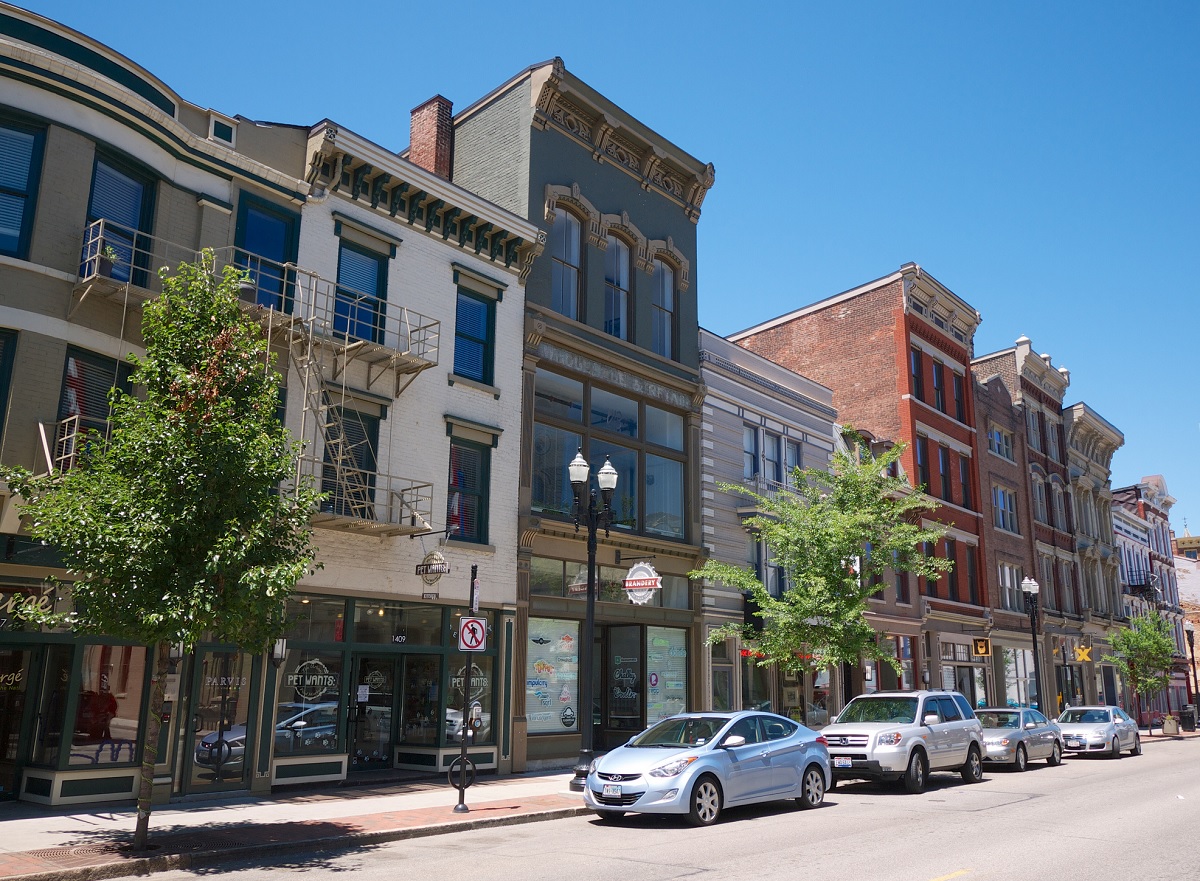
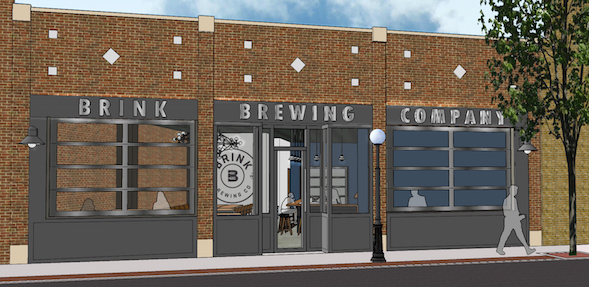
If nothing else Portland, Maine has an identity, and that is something that our area desperately seems to be searching for. It is my opinion that with a streetcar, a successful Banks project, and continued development on the river in Northern Kentucky we will have one that is appealing to long time residents, local college students, and outsiders that may consider Cincinnati as a place to live. The photos above are a small sampling of the establishments around downtown Portland.

Award-winning reporter Laure Quinlivan dives into Cincinnati’s transit debate

Award-winning investigative reporter and Cincinnati City Council candidate, Laure Quinlivan put together this incredible report on transit systems. Quinlivan visits Portland to speak with residents, businesses and community leaders about their modern streetcars, light rail, and walkable urban neighborhoods to see what a city similar in size to Cincinnati has achieved by embracing transportation options.

Quinlivan then goes to Germany to see how the leader in modern transport systems is working today. Streetcars, bicycles, pedestrian-only spaces, and streetcars are what most German cities are embracing to make their cities more livable. To my knowledge there has been no other report that dives into this issue as in-depth as Quinlivan’s report. Please take the time to view the video in its entirety and please share it with a friend or family member who may be looking to learn more.

Laure Quinlivan’s Streetcar Report from Laure Quinlivan on Vimeo.

Could it happen here?

Look. Cincinnati is not Portland. I know that. I know that streetcar supporters tend to lust after the transit system in Portland, and imagine a set of comprehensive transportation options here beyond congested highways. Others accuse us of trying to turn Cincinnati into Portland.

I’m not looking to turn Cincinnati into Portland, but I am looking to make the city more attractive, so that things like this can occur. Can you see this happening in Cincinnati? Neither can I. Not yet. Someday.

For the record, Dave Chappelle lives in Yellow Springs, Ohio. It about an hour away from here. He chose to do this in Portland. That’s Portland, Oregon. The one on the Pacific Ocean, three thousand miles away from Yellow Springs. Would having a streetcar here made Chappelle come to Cincinnati? No. But it would make the city more inviting for young people with options. That creates an environment in which impromptu performances by international superstars is possible. That’s all I’m sayin’.

“This has never happened in my entire career…I didn’t think this many people would show up.” -Dave Chappelle, speaking to the impromptu crowd of several thousand. Notice the dedicated bike lanes as he leaves.

A friendly reminder

This is a friendly reminder about why to vote against the Anti-Passenger Rail Amendment and support the Cincinnati Streetcar, 3C Corridor and Midwest Regional high-speed rail projects, and the Eastern Corridor project.

The Alliance for Regional Transit is taking another group to Portland to see a diversified transit system first-hand. The trip will be taking place from July 23 through 24 and is rumored to once again have another star-studded list of travelers. It must be a giant coincidence or one giant conspiracy that virtually everyone who has gone on the trip, or studied these systems themselves, are all strong supporters of the Cincinnati Streetcar and a larger diversified transit system for the Cincinnati region.

Could streetcars be manufactured right here in the Midwest?

On July 1 the United States celebrated the completion of the first American-made streetcar. Secretary of Transportation Ray LaHood was in Portland to celebrate the moment.

The Infrastructurist points out that Oregon Iron Works felt like they could be profitable producing the modern streetcars, and feel that they are already producing a superior product than what is being produced overseas. CincyStreetcar says that this event illustrates two important issues.

“The first is that public transportation is not a partisan issue; both sides of the aisle benefit from increased public transportation. The second is the progress other cities around the country are making with increasing their transportation options and the positive returns on their investments.”

When examining this news one could also speculate on what this could mean for Cincinnati as it develops one of the first streetcar systems in the Midwest region of the United States.

Last month when the City announced the selection of the development team that will help finance, plan, design, construct, operate and maintain Cincinnati’s modern streetcar system they also announced that Cincinnati Streetcar Development Team partner, Stacy and Witbeck Inc., will be opening a new office in downtown Cincinnati and will also be relocating their executives to Cincinnati specifically for this project.

First American-made streetcar in Portland, Oregon – image from United Streetcar, LLC

Could the same also happen in regards to the production of streetcar vehicles in a state and region that was built on manufacturing and could easily produce streetcars with the existing infrastructure and talent in place here?

Columbus and Cleveland have recently examined streetcar systems for their cities. Milwaukee recently received tens of millions of federal dollars to build a three-mile modern streetcar system in their city that is being seen as a started line to a much larger, city-wide system (similar to Cincinnati’s effort). St. Louis and Minneapolis currently boast light rail that has vehicles similar to streetcars and could potentially be produced on the same line. Indianapolis is working on a light rail system there that would also fit into this category.

With all of these existing and future systems in the Midwest, it would seem reasonable to have a manufacturer for those vehicles right here. Could Cincinnati or Ohio attract such a firm, or grow one of their own so that it starts producing streetcar and light rail vehicles in one of the many plants we have that used to produce automobiles?