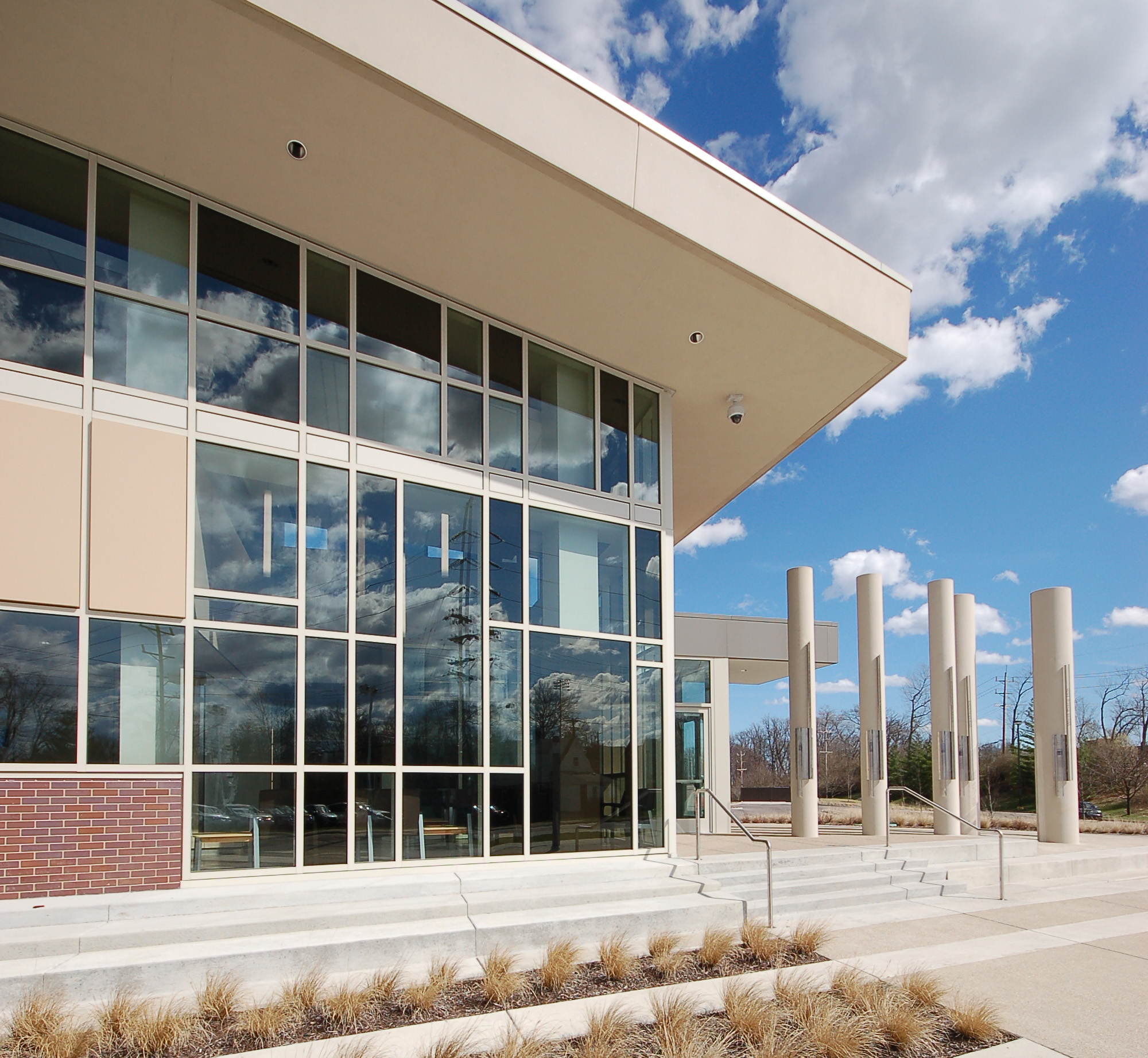
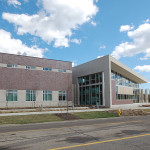
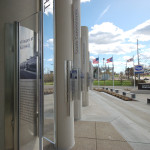
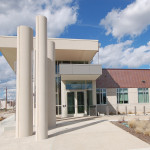
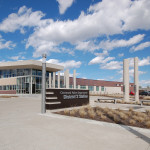
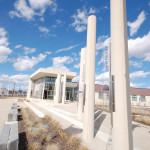
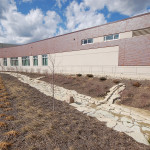
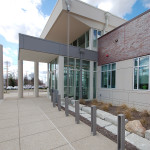
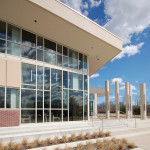
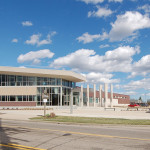
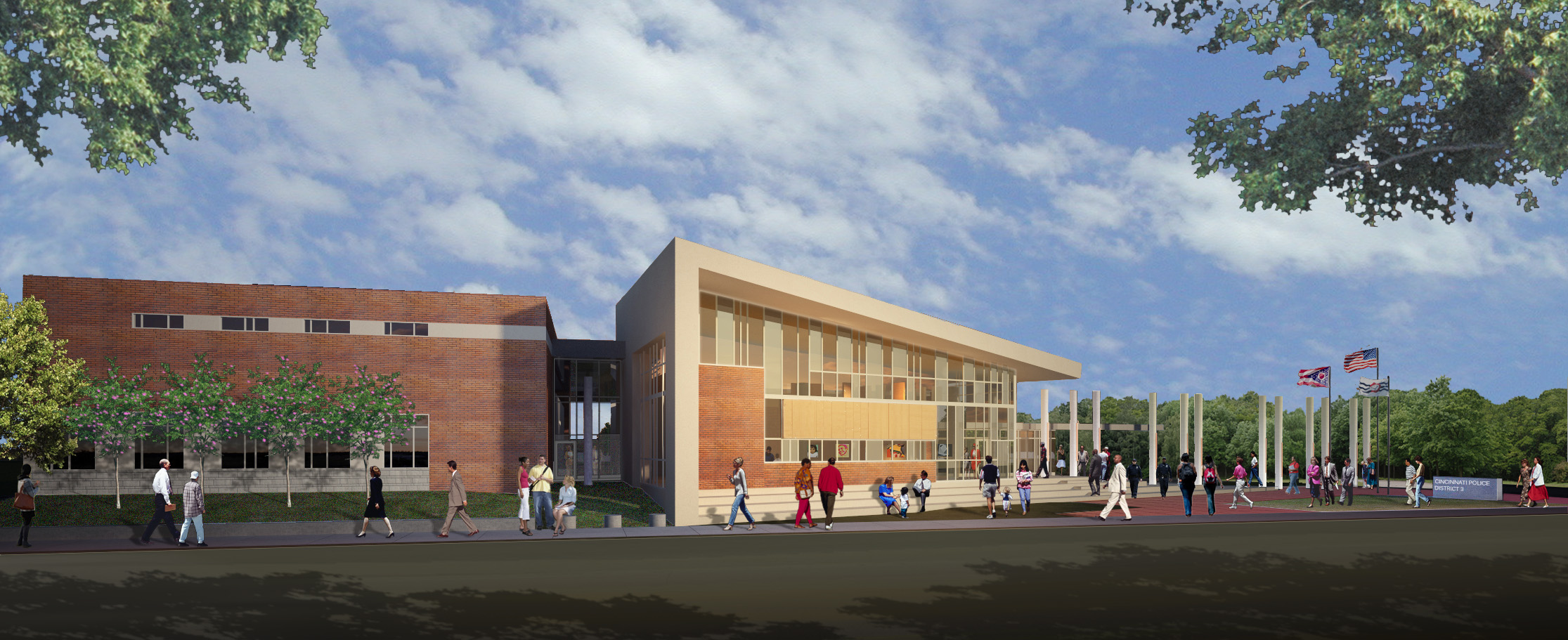
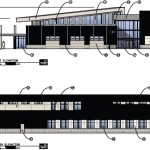
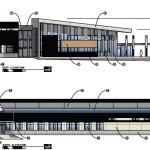
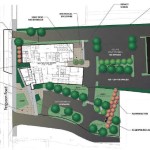
Last July the City of Cincinnati opened its first new police station in more than 20 years. Aside from updating and expanding the previous offerings inside a 107-year-old building, the new facility also aimed to create a new community gathering place for the city’s most populous neighborhood, while also achieving net-zero energy consumption.
The 36,000-square-foot facility was built for Cincinnati Police Department’s District 3, which serves 14 west side neighborhoods and some 95,000 residents. The $16 million landmark includes 40 geothermal wells, a 330-kilowatt solar panel system, and high-tech energy zones inside the building for system optimization.
Such investments have resulted in a LEED Platinum certification from the U.S. Green Building Council, the organization’s highest rating, and an energy usage coming in 20% lower than what was originally estimated for the environmentally sound building.
While the District 3 Headquarters is one of America’s most sustainable police stations, it is part of a growing trend where environmentally and economically conscience cities are looking to both reducing their carbon footprint, while also aiding their budgets through lower utility costs.
Glass Artwork
Cincinnati Police District 3 HQ
Cincinnati Police District 3 HQ
Cincinnati Police District 3 HQ
Main Entryway
Main Entryway
Cincinnati Police District 3 HQ
Neighborhood Landmark Poles
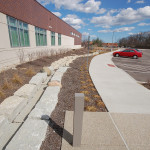
Stormwater Management System
Bicycle Parking Outside Main Entryway
Main Entryway
Stormwater Management System
Cincinnati Police District 3 HQ
EDITORIAL NOTE: All 13 photographs were taken by Eric Anspach on March 17, 2016.
Just think if a vacant lot near you could be turned into a solar-powered wi-fi hub and electric car charging station, a home for egg-laying chickens, or any number of other creative and productive uses. That is what a group of thought leaders are trying to accomplish with a new program they hope will gain traction at City Hall.
In an effort to promote vacant properties as entrepreneurial and sustainable turnaround opportunities, Lots of Tiny Exposition will be held this week in Over-the-Rhine.
The brainchild of local U. S. Green Building Council activists, LOT Expo is an upcoming free two-day open air exhibit in OTR to draw attention to the “sub-prime” real estate plaguing many neighborhoods.
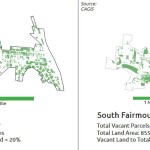
North and South Fairmount Vacant Properties [Provided]
Specifically tied to the tiny house movement, LOT presents exhibitors that showcase inventive, small scale installations for big, immediate vacant lot impact. Exhibitors will include a tiny house on wheels, vertical garden systems, solar and wind power operations, mobile mini-chicken coops, a 1950’s Airstream retrofit, and pervious parking pads.
Organizers say that they hope visitors bring property addresses for vacant lots that they believe have potential. At that moment, they say an on-the-spot professional laptop “green diagnosis” rating report will be produced. Designers who want to stimulate new ventures for abandoned property blight will be on the lookout for those projects brought to attention.
While the idea seems easy enough, vacant lot redevelopment can actually be a complicated, multi-faceted subject requiring professional knowledge.
As a result, the LOT Forum Panels at the Expo are meant to offer public and private sector professionals to bring expertise, experience, and skills to the vacant lot syndrome – the knowhow for sustainable success. Four different panels are convening under roof at a three-minute walk from the LOT Expo venue; and panel discussions will turn attention to vacant lot gridlocks and reinvestments that lessen public subsidy supports.
Individual Lots on Massive Scale
According to Vacant Lots: Occupied – a guide produced by a group of University of Cincinnati students with the help of Keep Cincinnati Beautiful, the City of Cincinnati Department of Community Development and Building Value – there are approximately 22,000 vacant properties in the City of Cincinnati. These properties are classified as land with or without a structure that have been abandoned by its owners. It is estimated that 8,000 of these are without any structures.
Keep Cincinnati Beautiful Clean Up [Provided]
Though not as dismal as some other American cities, vacant properties account for about 10% of Cincinnati’s parcels.
Keep Cincinnati Beautiful has successfully ‘cleaned and greened’ vacant lots throughout the city. This typically means cleaning up the lot before planting grass that then requires continued maintenance. Not satisfied with that approach, KCB collaborated with the University of Cincinnati Horticulture Program to develop Vacant Lots: Occupied. This award-winning manual established an analytical guide to select and transform abandoned lots.
While many individuals and families are already helping to stabilize lots in their community, 8,000 is a big number. Ryan Geismar, one of the professors that led the UC students, says the guide was originally intended for KCB and other organizations, but that it became clear that collective effort is needed to address the blight problem.
From a large-scale planning perspective, Geismar says the best approach is to “Identify assets within neighborhoods and use strategic investment catalysts that inspire others to take action.”
Return on Investments
Neighborhood developers are drawn to prime property, usually clear, open lots with existing infrastructure. There is a dire need to address the marginal, by-passed lots that are an economic drain on our city and region. Though numbers aren’t available in Cincinnati, the city of Philadelphia highlights the imperative of critical action. In 2010, their approximately 40,000 vacant parcels consumed about $20 million in city services (fire, police, maintenance, pest control, etc.) and represented $2 million in uncollected property tax revenue.
Vacant properties have always been around; their numbers surged after the recent recession and spike in housing foreclosures. Many large financial institutions faced lawsuits over fraudulent foreclosures or mortgages; and Ohio’s Attorney General settled a suit against five of the nation’s largest mortgage servicers over foreclosure abuses, fraud, and unfair and deceptive mortgage practices.
Blight or Bonanza
One of the few cities with data and a comprehensive approach to the problem is Philadelphia where a study concluded that blighting effect from vacant parcels reduced values by 6.5% citywide and by up to 20% in some neighborhoods. In order to counter this epidemic, Philadelphia officials responded by offering landowners adjacent to vacant properties the land for little to no cost.
Since not every lot is the same, solutions require resourceful, frugal and innovative investments. With depreciated property values and dwindling public dollars spread thin, small business opportunists may see vacant lots as overlooked economic potential or reframe the problem as an engaging community asset.
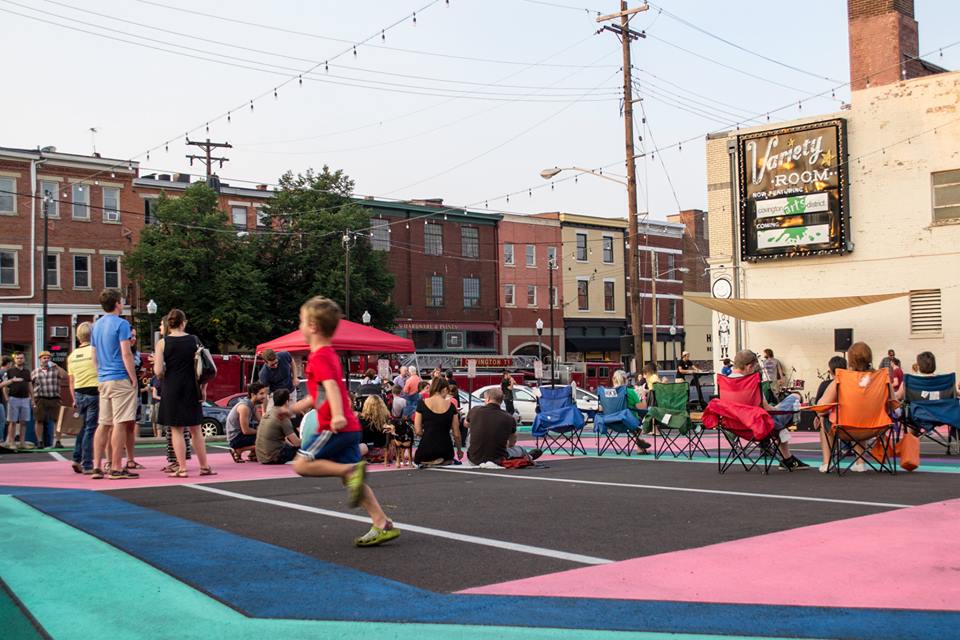
Covington MadLot [Provided]
Place from Space, a design competition to transform vacant underutilized spaces into vibrant places, awarded Renaissance Covington with a $1,000 prize to transform a parking lot into a performance space after business hours. This was achieved with financial and infrastructure support from the City of Covington, and a large amount of volunteer hours from committed citizens and professional designers. The performance space, now known as MadLot, has since hosted live music, movies, and other programming since opening.
Individual efforts should not go unnoticed. Whether guerilla gardening or picking up trash, these small steps help improve appearance and reverse the effects of the broken window theory. While the sheer number of vacant lots is large, the challenge is not insurmountable. It will take economies of thrift, practical knowhow and strategic thinking to execute solutions.
A tiny house on wheels, bocce ball court, performance stage or another enhancement might find a way to a lot near you. It might not be long before you find a goat chomping down honeysuckle next door.
LOT Expo will take place from September 19-20 from 10am to 4pm each day at the New Findlay Market Playground at 1814-1822 Elm Street. The Saturday forum panel will focus on tiny living and the Sunday forum will focus on vacant lots. Both will take place between 11am and 2pm at Rookwood Pottery Company around the corner at 1920 Race Street.
The event is free and open to the public, but organizers are asking for those interested in attending to register in advance online.
City officials and neighborhood leaders celebrated the ground breaking for Cincinnati’s new $16 million Police District 3 Headquarters on Monday.
Located in Westwood, the 39,000 square-foot facility will replace what city and police officials consider an antiquated 105-year-old facility in East Price Hill.
While the City of Cincinnati has built or begun construction on several new fire stations, including one nearby in Westwood, this is the first new police station built in the city since in more than four decades.
“It used to be that when cities built civic buildings like this, they were places the community could come together,” Mayor Mark Mallory (D) said. “With District 3, we’re doing that again. We want people to come here and feel comfortable coming here with their neighbors.”
According to city officials, the new police headquarters will serve 14 neighborhoods from a central location on the west side. A site that was specifically chosen due to the input provided during Plan Cincinnati.
To help further strengthen the concept of the police headquarters also serving as a community gathering place, city officials have ensured that the new facility will include community gathering space and public art. It is an approach to community building similar to what was done, with rave reviews, by Cincinnati Public Schools (CPS) when rebuilding its entire building portfolio.
The location is just a block away from Dater High School and Western Hills High School and sits in what was a vacant outlot of a suburban-style strip mall. Site plans show that the new facility will be built at the street and oriented toward the sidewalk.
While Cincinnati has been seen as a leader in green building when it comes to the rebuilding of CPS, its tax abatements for Leadership in Energy and Environmental Design (LEED) rehabilitation and new construction, and public building in general, this will be one of the Queen City’s greenest buildings.
The development team also says that it has designed the structure to achieve Net Zero Energy Consumption through its geothermal mechanical systems, high performance building envelope and solar panels. The new Police District 3 Headquarters will also reduce potable water consumption by 30% thanks to on-site bio-retention cells and strategic use of site design materials.
City leadership also expects the project will reach 36.2% Small Business Enterprise (SBE) inclusion. If such a number is achieved, it would make it the highest percentage of SBE participation on any city project to-date.
According to project officials, construction is expected to take about a year-and-a-half and could start welcoming members of the community as early as July 2015.
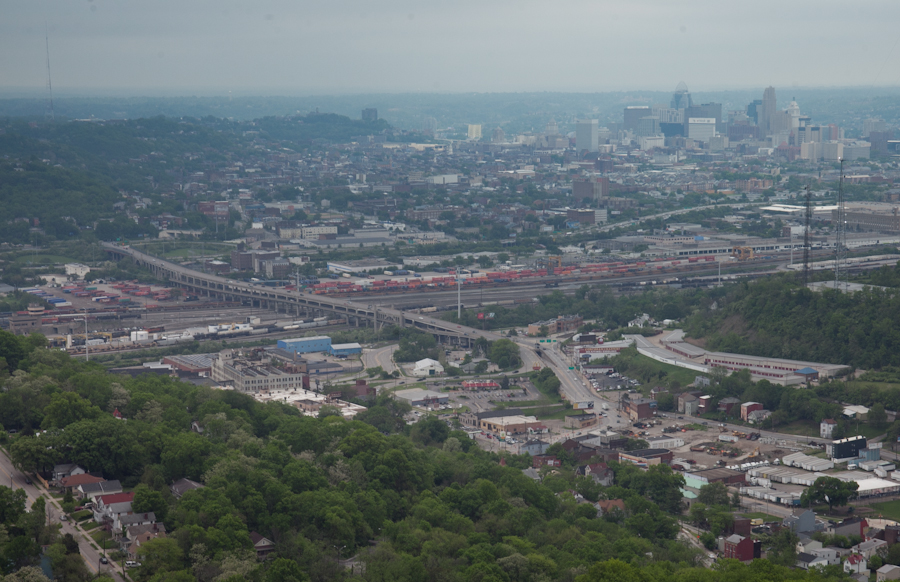
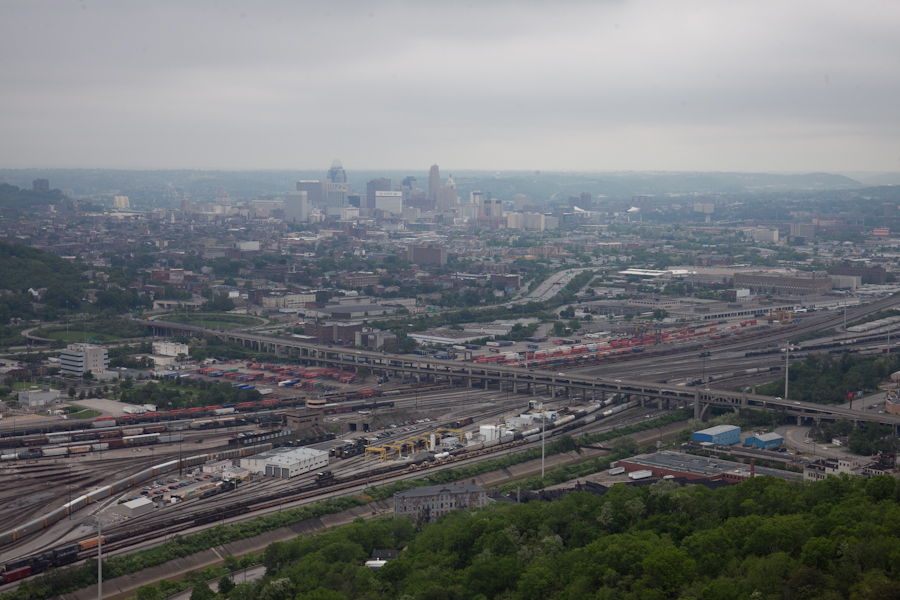
Over 55,000 vehicles traverse the storied Western Hills Viaduct. The iconic art deco era viaduct, constructed as part of the Cincinnati Union Terminal project in 1932 replaced the older Harrison Avenue Viaduct.
The viaduct last saw renovation in 1977, almost twenty years after the eastern section was demolished to make way for Interstate 75, but over the last few years a team of city, county and consultant engineers have been studying ways to repair or replace the aging bridge.
The city’s Department of Transportation and Engineering (DOTE), Hamilton County Engineer’s Office and URS are working together to determine the future replacement of the aging viaduct. The team will be hosting two public meetings on Thursday to engage adjacent property owners and frequent users of the bridge on the process of replacing the viaduct.
The Western Hills Viaduct is one of a few crucial road connections to the west side of the city. Photo by Jake Mecklenborg for UrbanCincy.
Because of the amount of repairs needed to maintain the existing viaduct, the team is not considering continuing the use of the existing viaduct. Instead the team is looking to build a new viaduct just south of the Western Hills Viaduct.
Richard Szekeresh, Principal Structural Engineer with DOTE told UrbanCincy that there are a number of other projects and factors that constrain the teams ability to determine a suitable relocation alignment; such as the rail yard operations below the bridge, the Metropolitan Sewer District’s (MSD’s) Lick Run Valley Conveyance System project, and Ohio Department of Transportation’s (ODOT’s) proposed new connection bridge from I-75 to the viaduct which is part of the Brent Spence Bridge project must be factored into the new location.
Additionally because of hillside grade issues at the McMillan and Central Parkway intersection a new alignment north of the existing viaduct would be extremely challenging and more expensive.
The team is studying whether to pursue another double-decker bridge or a single level span as the replacement alternative. Some private property will be affected along Harrison Avenue and Central Parkway along with the existing rail yard below the viaduct. Additionally, the team is looking for input on bicycle lanes and other transportation alternative improvements.
The design team hopes to have the engineering completed and a preferred alignment selected by 2014. The cost of the viaduct replacement would be an estimated $200 million. No funding has been identified and the project is not part of the Brent Spence Bridge project, even though it is in the northern edge of that section of the I-75 reconstruction project area.
Both of Thursday’s sessions will be at Cincinnati City Hall. One will be from 4pm to 5:30pm and the other from 6pm to 7:30pm. City Hall is accessible by the #1, #6 and #49 Metro buses.
Szekeresh concluded,“Typically, due to the size, complexity, and cost associated with a project of this nature it is not unusual for it to take ten or more years to bring them to construction. We are still at the beginning of a long process.”
Cincinnati is one of many cities struggling to fix their CSOs, which are caused by a combination of higher water runoff and sewer systems that were designed to accommodate both stormwater runoff and sewage. What it means in real terms is that when there are heavy rain events, the stormwater fills up the sewers and then mixes with the sewage.
According to the EPA, raw sewage contains pathogens that threaten public health, leading to beach closures and public advisories against fishing and swimming, and is a problem that particularly affects older urban area.
MSD’s plan to reduce 1.5 billion gallons of CSOs from the Mill Creek will include the transformative Lick Run project in South Fairmount.
As a result, under a 2010 consent decree, the MSD was required to either construct a deep-tunnel system under Mill Creek, or conduct further analysis and propose an alternative plan. What is unique about Cincinnati’s approved plan is that it deviates from the standard ‘gray’ tunnel solution, and instead proposes using green infrastructure fixes to reduce stormwater runoff.
“We are very excited to move forward with our innovative wet weather solution that not only provides highly cost-effective compliance with our Consent Decree but simultaneously sets the groundwork to enhance our communities,” James A. “Tony” Parrott, MSD’s Executive Director, said in a prepared release.
In addition to the environmental benefits of Cincinnati’s alternative plan, it is also expected to save taxpayers approximately $200 million upfront and remove 1.78 billion gallons of CSOs annually from the Mill Creek.
The savings come from not building a new deep-tunnel system to accommodate the excess stormwater runoff, and instead aiming to reduce the amount of stormwater flowing into the sewer systems during heavy rains.
The green infrastructure solution being pursued by Cincinnati is already being viewed as a national model for other cities looking to clean up their waterways.
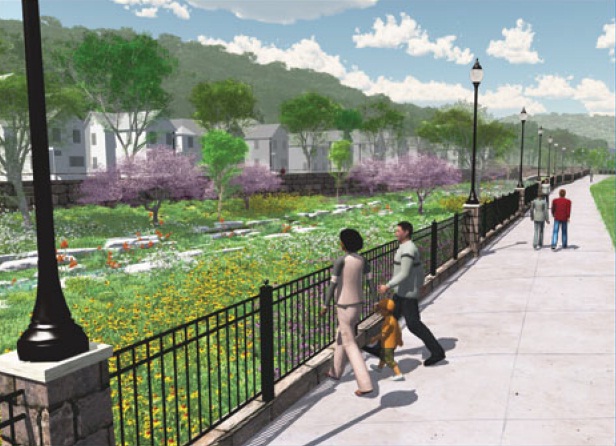
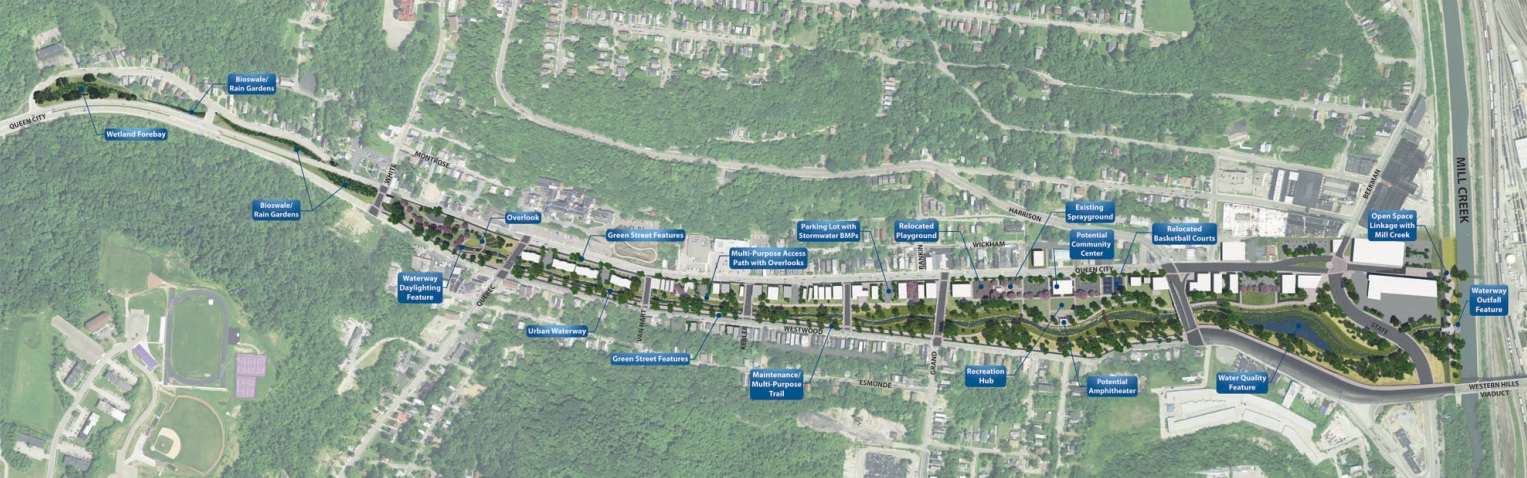
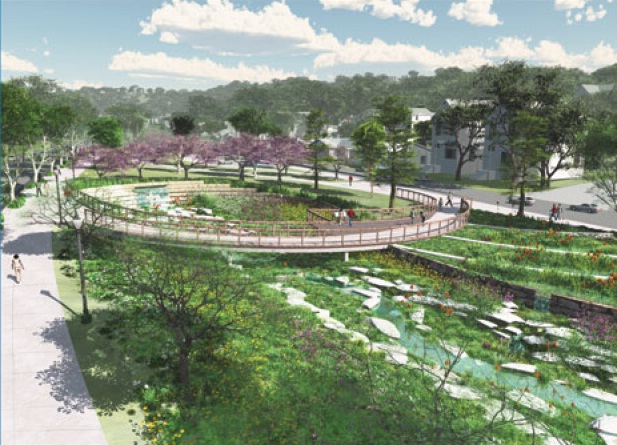
The $192M Lick Run project would create a linear park through South Fairmount along a newly ‘daylighted’ stream. Images provided.
The hallmark feature of the plan is the $192 million Lick Run Project, which will ‘daylight’ the former creek through the heart of South Fairmount and creating a linear park that officials say will convey stormwater and natural drainage to the Mill Creek. This project alone is estimated to reduce overflows into the Mill Creek, from the largest CSO in the system, by 624 million gallons annually.
“This plan is good news for the residents of Cincinnati and for communities along the Ohio River,” said Cynthia Giles, assistant administrator for EPA’s Office of Enforcement and Compliance Assurance. “Not only will this innovative plan ensure that significant volumes of polluted stormwater and raw sewage are kept out of local waterways, but it will also cost less than more traditional approaches, saving money for ratepayers and the city.”
In addition to the Lick Run Project, MSD’s phase one fixes will also include upgrades to the West Fork, Kings Run, and Bloody Run watersheds that will result in an additional 422 million gallons CSO reduction.
The combined phase one work is planned to take place over the next five years and is estimated to create nearly 1,000 full-time equivalent construction jobs.
MSD officials say that plans for phase two work will be submitted in 2017, and will aim to address CSOs in the Lower Mill Creek watershed. While the plans are not yet finalized, both MSD officials and regulators believe the final remedy will also use an integrated watershed plan approach.