Ohio Fails to Show Improvement in Latest Infrastructure Report Card

We take for granted that bridges, roads, highways, water treatment facilities and dams will function as expected and take us to where we need to go. But our nation’s aging infrastructure has long been in decline as money is diverted from maintenance to construction of new projects, many times for politicians eager for the photo op of a ribbon cutting event.

Recently, the American Society of Civil Engineers (ASCE) released its latest report on the current state of the nation’s infrastructure. The last such report, issued in 2009, had given the country a rating of D. This year’s report showed the nation’s rating had improved to a D+ grade.

“Our country’s association of civil engineers continues to do the yeoman’s work of sounding the alarm on our country’s infrastructure — the roads, rails and waterways that we depend on to move our goods from place to place and get us where we need to go each day,” James Corless, Director of Transportation For America (T4A), stated in a prepared release.

I-75 Reconstruction
Work on the multi-billion dollar repair and widening of I-75 through Cincinnati proceeds, but the project still has yet to receive the full funding it needs to be completed. Photograph by Jake Mecklenborg for UrbanCincy.

As the nation sifts through a backlog of infrastructure replacement projects, national policy has shifted away from funding such critical infrastructure needs as budgetary concerns linger.

The current transportation bill, Moving Ahead for Progress in the 21st Century (MAP-21), offers no new funding for investments in transportation alternatives to relieve congested corridors or encourage smart solutions to these complex problems.

“It’s a sad reality that little has changed since the last report card in 2009,” Corless continued. “Has anything in Washington changed to drastically improve the condition of our roads, bridges and transit systems in the four years since?”

Without new revenue sources, Corless says, the funding problem is only poised to get worse as revenues continue to decline from the federal gas tax, which has not been raised since 1993. Such a lack of necessary revenues may soon leave the federal government unable to perform basic infrastructure maintenance.

Local Implications?
In both 2009 and 2013, the ASCE gave Ohio a C- grade in their infrastructure report card. While the grade places Ohio ahead of the national average, it still translates to 2,462 structurally deficient bridges and approximately 42% of its roadways in “poor” or “mediocre” quality.

While the State of Ohio raised its gas tax in 2006, the extra revenues have not been enough to keep pace with the demand for larger transportation projects like the expansion of I-75 through Cincinnati, the  Brent Spence Bridge project, and the long-planned MLK Interchange project, which all currently stand unfunded or only partially funded.

“Some other states aren’t waiting for billions that are unlikely to come and are thinking about ways to make their dollars do more. Like Massachusetts, where the DOT director issued a goal of tripling the number of trips taken by foot, bike and public transportation — reducing the load on roads and bridges that are among the oldest in the country,” explained Stephen Lee Davis, T4A’s Deputy Communications Director.

Ohio Infrastructure

The City of Cincinnati has been working towards improving some of its worst-rated infrastructure since the last report card was issued in 2009. Since that time, Cincinnati’s Department of Transportation & Engineering (DOTE) has performed a $22 million rehabilitation of the W. Eighth Street Viaduct and is in the midst of a $55 million replacement of the Waldvogel Viaduct which connects the west side with the center city via the Sixth Street Expressway.

Additionally, Cincinnati’s 3,500-foot-long Western Hills Viaduct also is considered structurally deficient. Replacing a span that is nearly twice as long as the longest Ohio River span, and crosses the Midwest’s second busiest rail yard, will be one that is both difficult and costly.

Cincinnati officials say that they are currently studying whether a rehabilitation of the existing 82-year-old, double-decker viaduct or a replacement will be more appropriate.

“That is one of those kind of icons in the Mill Creek Valley that you like to look at,” noted Michael Moore, Cincinnati’s DOTE Director, on The UrbanCincy Podcast. “But we will need to be very cognizant of how we spend the public’s money in making sure we have a good safe mode to get across that area.”

Moore says that the department hopes to wrap up the study on how to fix the Western Hills Viaduct early this spring. Once that is complete, he says that there will be a good idea on how to accomplish that. Where the funding might come for such a large project, however, is still up in the air.

Work on Smale Riverfront Park Progresses Despite Lack of State, Federal Funds

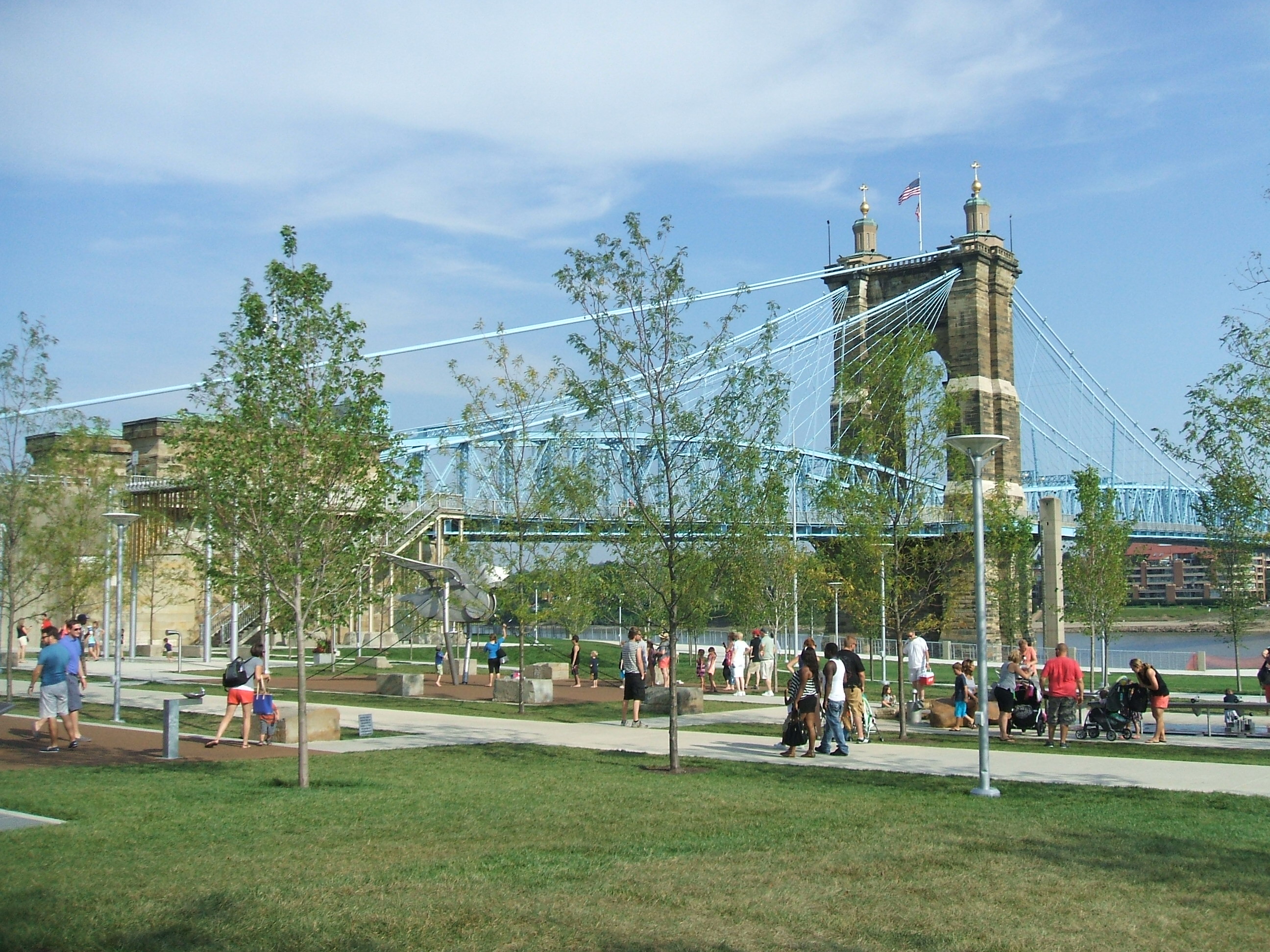
The $120 million Smale Riverfront Park will celebrate its next wave of progress two months from now when the Women’s Committee Garden and Duke Energy Garden are opened to the public – more than doubling the central riverfront park’s completed acreage.

According to officials from the Cincinnati Park Board, the project is still on-time and on-budget thanks to an influx of private contributions.

Originally, park officials had planned on approximately half of the project’s cost being covered by state and federal funds. While those funds flowed early in the project’s life, they have all but dried up over the past two years.

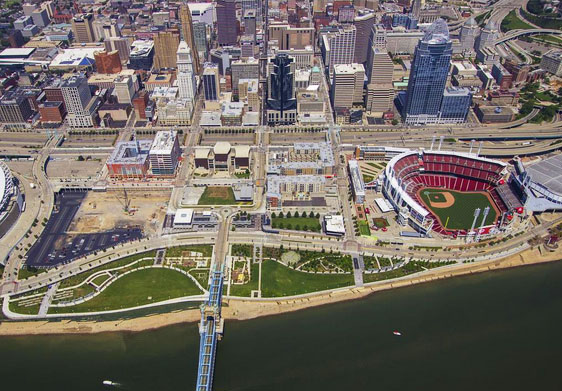
Cincinnati Central Riverfront Plan

“We got into this pretty aware of what the challenges were, but the biggest challenges thus far have probably been the state and federal funding,” stated Smale Riverfront Park’s project manager, Dave Prather. “It’s been a pretty big adjustment when half of the funding you were counting on hasn’t come, but thanks to the private funding we’ve been able to stay pretty much on schedule.”

Prather says that the city leadership understands the realities facing both their state and federal partners, but that without the private and local support the project would most likely be behind schedule.

He is, however, optimistic that things will turn around and says that the park board is working on other ways to get state and federal dollars. One such element that could be the beneficiary of such efforts is the planned 1,000-foot transient boat dock which may be eligible for up to $3 million in grants from the Ohio Department of Natural Resources (ODNR) Division of Watercraft.

Should such funding fall into place, Prather says that the boat dock could be operational as early as May or July 2015.

“We received $3 million in the State capital fund three years ago, and that’s what we thought we would get as we worked through the phasing plan,” Prather explained. “Hopefully the state will get back in the business of being able to help with significant capital projects.”

Not all of the funding news has been grim, as Prather noted strong support from Hamilton County, private sources, and the City of Cincinnati which includes a recent $4 million allocation from the proceeds of its recently approved Parking Modernization & Lease agreement.

That $4 million will go towards accelerating the construction timeline of phase four of construction work which will now include the PNC Grow Up Great Adventure Playground and carousel. According to Prather, both of these projects will now be completed by May 2015 – in time for the 2015 Major League Baseball All-Star Game.

One of the features that will be open in two months is the new riverwalk, of sorts, that will run from the Walnut Street Overlook approximately to Sycamore Street immediately south of Great American Ball Park. One of the key features of this riverwalk, Prather notes, is that the guardrails will be 48 inches in height instead of 42 inches so that both pedestrians and bicyclists can enjoy the pathway.

“Our observation has been that you can’t tell cyclists where to go,” said Prather who noted that he is an avid cyclist himself. “So we’re going to construct the closest to the river pathway to accommodate both pedestrians and cyclists – right where they both want to be.”

While much work is left to do, both in terms of construction and securing funds to continue construction, the project team maintains excitement for the transformation they are overseeing.

“I’ve been an architect and a planner for the city for years, and a lot of the time you spend a lot of time and energy on plans that don’t get built,” Prather concluded. “This one [project] is different…we’re just on a roll and it’s awesome to have ideas that everyone embraces, you feel right about what you’re building, and you get the resources to actually build it. We’ve gotten a lot of cooperation from the city and county, and I feel like we’re all rowing in the same direction.”

Officials hope to complete the 45-acre park in its entirety by July 2017, excluding improvements to the river’s edge that will need to be coordinated with the U.S. Army Corps of Engineers.

Cincinnati Central Riverfront Plan wins national award for excellence

In 1997 officials from the City of Cincinnati and Hamilton County set out on a path to transform the city’s central riverfront. What became known as the Cincinnati Central Riverfront Plan laid out a bold vision to accomplish just that, and has now been recognized by the American Planning Association (APA) for the implementation of the plan first laid out nearly two decades ago.

The APA will present local leaders with the National Planning Excellence Award for Implementation at its annual conference to be held in Chicago on April 16.

“The Cincinnati Central Riverfront redevelopment is an excellent example of plan brought to reality,” Ann C. Bagley, 2013 APA Awards Jury chair, stated in a prepared release. “The fact that this development happened during an economic downturn demonstrates the strength of the plan and the importance of the public commitment that brought it into being.”


Cincinnati’s central riverfront has shifted dramatically from its form in the 1980s [LEFT], to that of the 2010s [RIGHT].

Local leaders have taken an incremental approach towards implementing the vision laid out in the Cincinnati Central Riverfront Plan. Between 1998 and 2002, the first major investments included the reconstruction Fort Washington Way (FWW), and the development of Paul Brown Stadium, Great American Ball Park, and the National Underground Railroad Freedom Center.

The consolidated FWW opened up dozens of acres of waterfront property, and the development of two stadiums and a major museum were intended to serve as cultural and entertainment anchors that would draw Cincinnatians back to the riverfront.

These significant public investments laid a critical foundation that would enable the next phase of work, historically located in one of the most flood-prone areas of the city, out of the 500-year floodplain.

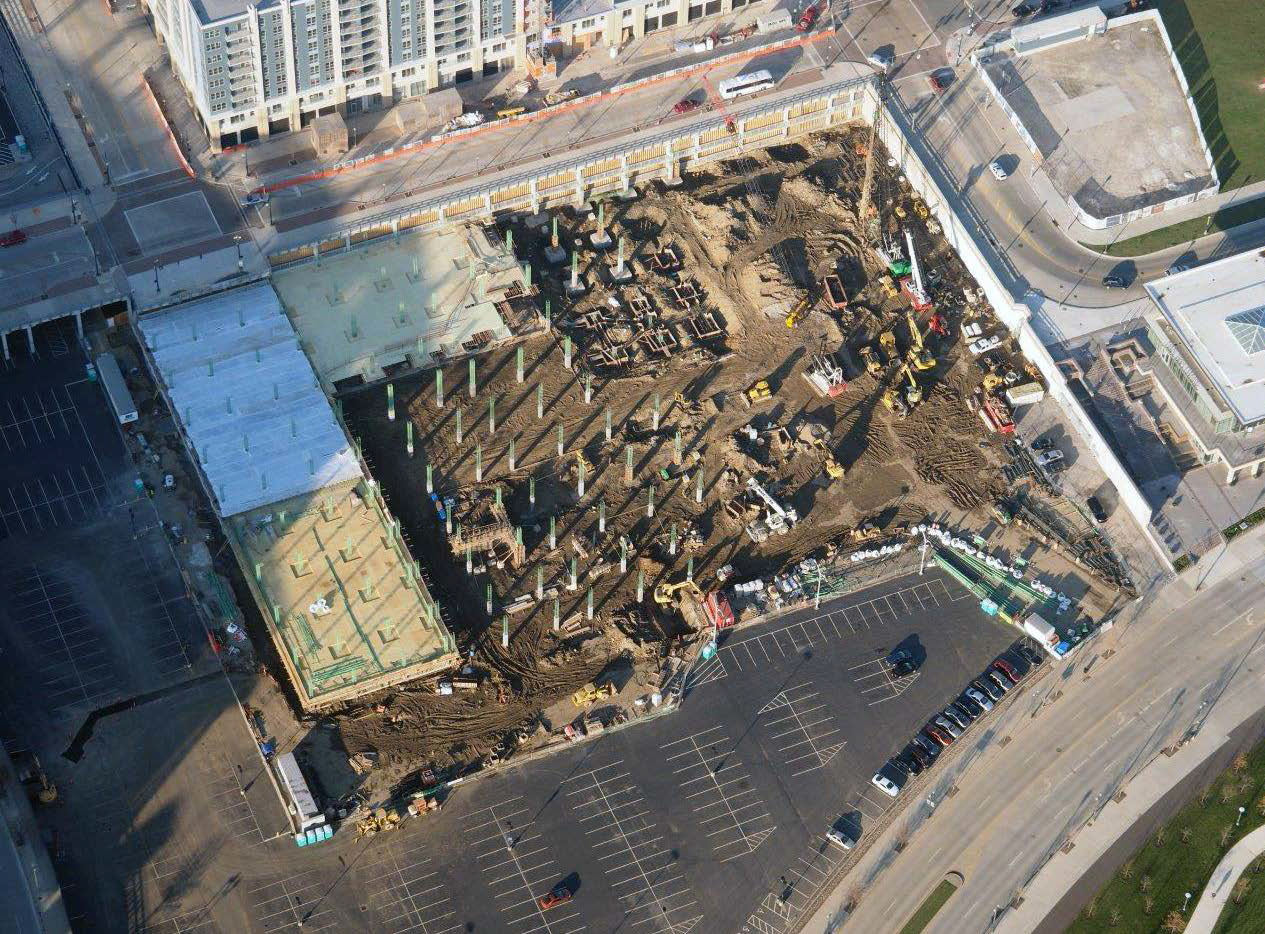
Once a private development team had been selected, the City of Cincinnati and Hamilton County began to work with Carter-Dawson on the construction of the plan’s most ambitious element known as The Banks.


Phase two of The Banks will deliver another 300 residential units along with more than 60,000 square feet of commercial space, and a future office tower.

The $91 million first phase of the mixed-use development began in 2007 and resulted in 300 apartments, 76,000 square feet of commercial space, and 6,000 structured parking spaces. Emboldened by the success of phase one, developers are set to break ground on phase two in the coming months which will include another 300 residential units and more than 60,000 square feet of commercial space.

Two office towers, a hotel and townhomes are still to come within the first two phases of The Banks. At ultimate build out, officials envision The Banks to result in $600 million worth of private investment and become the home for more than 3,000 residents.

Meanwhile, construction of the $120 million, 45-acre Smale Riverfront Park is progressing concurrently with the development of The Banks. To date, the first phase of the new central riverfront park has been completed and work is beginning on phase two. Future phases will be timed with future construction of The Banks, and as funding is allocated.

“In planning terms, a project that goes from a concept to implementation in less than 20 years is impressive to say the least,” stated Todd Kinskey, Executive Director of the Hamilton County Regional Planning Commission. “It is that much more impressive because, in this case, the implementation involved seemingly insurmountable physical, economic, and political barriers.”

The early discussions surrounding The Banks, however, were tumultuous at best as local leaders grappled with complaints about too much office space being introduced into an already competitive marketplace.


The original vision of the Cincinnati Central Riverfront Plan [LEFT] included more traditional types of architecture with greater use of natural building materials [RIGHT].

“The current plan to include 30-story buildings along the riverfront would harm downtown and violate the riverfront plans adopted by the community many years ago,” then Councilman Jeff Berding (D) told the Business Courier in 2007. “We need to remember that the plan adopted several years ago was not simply pulled out of the air, but was the result of intense public input and driven by professional urban planners.”

While design elements may not be of the same caliber as those originally envisioned, the urban form of the private investment appears to be as desired. But even more gratifying than that, for many of the early people involved in the planning, it is that the project has happened against all odds and skeptics.

“The successful implementation of the plan is the result of unprecedented cooperation between the city, the county and their partners,” exclaimed Vice Mayor Qualls (C), who was one of the original driving forces behind the development of the Cincinnati Central Riverfront Plan.

Her thoughts were further validated when Bagley concluded, “The fact that this development happened during an economic downturn demonstrates the strength of the plan and the importance of the public commitment that brought it into being.”

In addition to the future phases of the Smale Riverfront Park and The Banks, city leaders are now soliciting ideas for how to cap a 300-foot span of FWW. City and county officials say that the work to cap the short stretch of interstate will commence once a design is in place, and funding has been secured.

In 2010, UrbanCincy published an exclusive three-part series profiling the dramatic transformation of Cincinnati’s central riverfront over the past two decades.

PHOTOS: Downtown and Over-the-Rhine over the course of 2012

2012 has been a pretty terrific year for Cincinnati’s center city. And while I don’t get to spend as much time as I would like back home, here are 28 of my favorite images I captured throughout Downtown and Over-the-Rhine during the course of the year. Here’s looking to an even better 2013!

Rob Woodward showcases Cincinnati’s center city in new time-lapse video

Cincinnati-based photographer Rob Woodward has put together a collection of his time-lapse photography for a new video showcasing various scenes throughout the center city.

Woodward is a graduate of Cincinnati State Technical & Community College’s audio/video production program. Since then he has done video production work for the Cincinnati Reds, worked as an assistant camera operator for the failed Queen City reality show, and currently works full-time as a photographer for Fox 19, WXIX.

The video showcases scenes of Cincinnati’s skyline from Devou Park, views from the Carew Tower Observation Deck, Lytle Park, Mirror Lake in Eden Park, a bustling Findlay Market, the newly renovated Washington Park, Sawyer Point, Great American Ball Park, The Banks, Smale Riverfront Park, and various shots from the Ohio River.

Woodward says he hopes to expand upon this collection over the next year, but for now you can enjoy the nearly two-and-a-half minute video featuring music from Explosions in the Sky.

New time-lapse video captures movement of people and machines in Cincinnati

Friend of UrbanCincy and regular URBANexchange attendee, Andrew Stahlke, has produced a new time-lapse video of Cincinnati.

The video showcases construction work at the $400 million Horseshoe Casino, Little Miami Scenic Trail, Eden Park Overlook, boats on the Ohio River, circus training at Burnett Woods, freight activity at the Queensgate Railyards, construction of the new $66.5 million Waldvogel Viaduct, fans at Great American Ball Park, and many other scenes from around Cincinnati.

Stahlke is currently enrolled in the Masters of Community Planning program at the University of Cincinnati, and originally studied civil engineering at Case Western University.

The video, entitled Paths and Nodes: Cincinnati, attempts to capture the life of the city as people and machines move about, and was shot in early fall 2012. It is a nearly three minutes in length, and features music from Little People.

Cincinnati misses huge marketing opportunity with Western & Southern Open

The Western & Southern Open is taking place right now, and a men’s and women’s champion will be crowned this weekend in what has become one of the world’s top ten tennis tournaments.

Once finished, the tournament will have drawn hundreds of thousands of tennis fans to Mason, but more importantly, it will have given Cincinnati exposure to millions of television viewers around the United States and the world.

The tournament is a huge regional draw, and it gives the region an annual chance to make its pitch as to why people should visit, invest, or move to the region. This year, the Cincinnati USA Convention & Visitors Bureau decided to build off of Lonely Planet’s choice of Cincinnati as one of its top travel destinations for 2012. Unfortunately, however, the 30-second commercial does not come close to selling the narrative written by the independent travel guide.


There was no mention or view of the Contemporary Arts Center in the recent Cincinnati USA television commercial. Photograph by Thadd Fiala.

“Seen Cincy lately? The pretty city on the Ohio River – off the main cross-country interstates – gets bypassed by many road trippers, but it’s quietly transformed itself in the last decade into a worthy weekend getaway,” Lonely Planet wrote about Cincinnati. “Life centers around the river – much which can be seen by foot: river walkways are best on the Kentucky side, reached via a couple bridges including John Roebling’s Suspension Bridge (a prequel to his famous Brooklyn Bridge). Narrow, twisting (and steep) brick roads of the Mt Adams district lead past 19th-century Victorian townhouses and the free Cincinnati Art Museum, while the once-dangerous, emerging Over-the-Rhine, just north of downtown, is home to the Findlay Market and a sprawling collection of historic Italianate architecture.”

After reading that, someone unfamiliar with Cincinnati may be intrigued to visit the city to experience its architecture, waterfront, historic neighborhoods, and judge the stated transformation first-hand. What Cincinnati USA’s television spot showcases (see below), however, is the tried and true regional selling cards to families looking for an affordable weekend getaway.

There is nothing wrong with selling a good product to a captive audience, but if Cincinnati wants to start attracting new people and new interest, it will have to do something new.

If Cincinnati USA wants to build on the Lonely Planet mention, then they should sell the region on what Lonely Planet is pitching. Show the millions of tennis fans a scene from Over-the-Rhine on a Friday evening, Fountain Square on a Saturday night, the twisting streets of Mt. Adams, the University of Cincinnati’s Main Street, people biking across the Purple People Bridge, and shoppers at Findlay Market on a Saturday morning.

Fortunately, the Cincinnati USA commercial did pay attention to the National Underground Railroad Freedom Center which was prominently mentioned in the Lonely Planet write-up.

“Best, though, is the National Underground Railroad Freedom Center, open since 2004, on the banks of the river where many slaves escaped to freedom in the 19th century,” concluded Lonely Planet’s writers.

Cincinnati has always been an affordable place and a great place for families. This narrative has been perfected over many decades. This strong calling card should not, however, preclude the region from telling the world about a new narrative that has come to life over the past decade. It’s a story about a resurgent city focused on youthful energy, innovation, independent thought, music, and a unique urban core that is hard to match anywhere in America.