It’s the same nightmare every city neighborhood fears: a young child ends up in intensive care after being hit by a car. The media shows up to cover the community’s anguish, advocacy groups and city officials hold meetings, and – sometimes – announce long-term fixes.
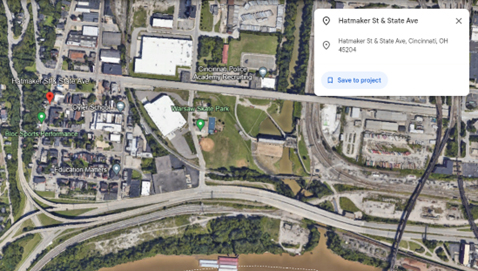
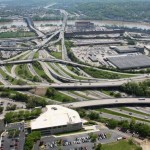
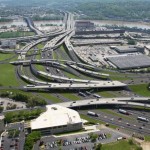
That’s what happened in Lower Price Hill, a Cincinnati neighborhood sandwiched between three urban highways. Click on this link and you’ll see that State Street is a major connector between three urban highways that surround the community.
The child was hit by a car turning off busy State Street onto the street housing the community’s only public school, Oyler Community Center. Oyler not only serves the community’s K-12 students; it also offers wraparound community services and outreach to the surrounding community.
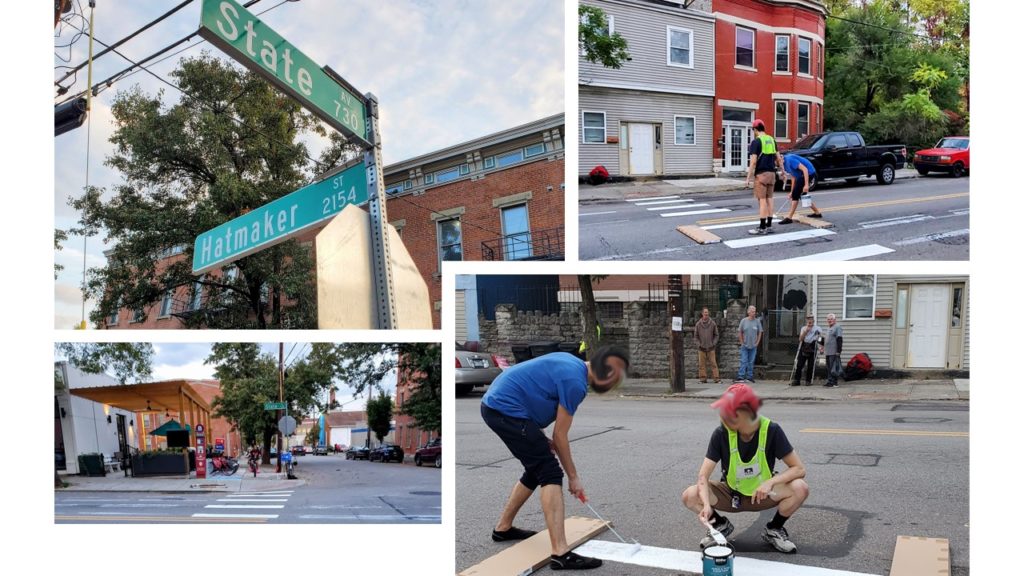
Our Local Strong Towns group, Civic Cincinnati, chose the intersection of State Street and Hatmaker for our first tactical urbanism intervention to draw attention to the dangerous conditions for people living, walking and biking in this community, most especially its children.
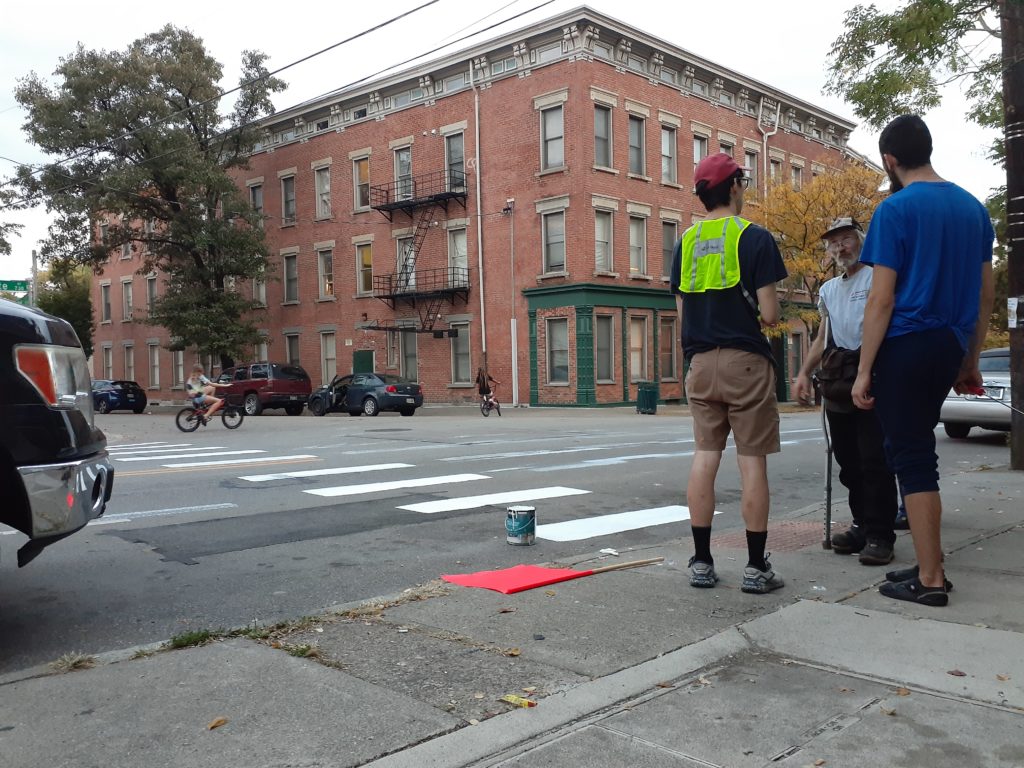
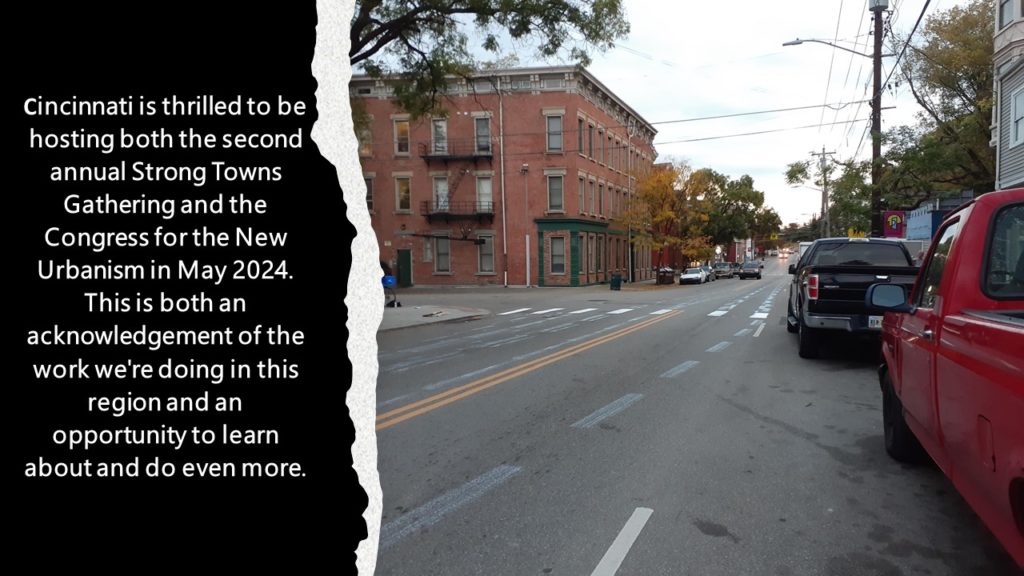
On a warm evening in late October 2023, a group of us showed up with a bucket of paint, a couple of rollers and makeshift stencils. This is one of countless areas around Cincinnati where curb cuts and ADA ramps were installed for crosswalks that never got built. So — technically a crosswalk.
Given Cincy drivers’ penchant for not stopping even at marked crosswalks, the goal was to give this unmarked crosswalk more visibility. Residents who gathered around to watch us seemed to appreciate the effort. Passersby in cars, on foot and on bikes stopped to ask what we were doing and chat about the problems speeding cars pose to the community.
Traffic was heavy and fast in this very vibrant neighborhood during the 6 PM hour. In addition to a Red Bike kiosk and Outerspace, a community gathering space for neighbors of all ages, the corner includes a popular market. We saw several kids, both on bikes and on foot, during our time there.
This is not a safe place for them right now. They deserve better.
In the past two years Cincinnati’s city council and administration have taken a more active role in making the city’s streets safer for everyone, especially for more vulnerable pedestrians and cyclists and in the city’s traditionally underserved communities. Efforts include enacting a Complete Streets ordinance, providing funding to create more protected bike lanes and expanding the city’s growing network of dedicated walking/biking trails.
These efforts include a plan for Lower Price Hill’s 8th Street corridor and State Street. The earliest construction will begin is 2026 due to work priorities for the city’s DOTE. Civic Cincinnati will continue looking for opportunities to fill in the gaps until there’s funding for more permanent fixes.
The following is a guest post by Indianapolis based planner Jeffrey Tomkins with a forward from Micah Paldino, Clifton Heights resident, and founder of creative storytelling agency, Fallon Thatcher. It has been edited lightly.
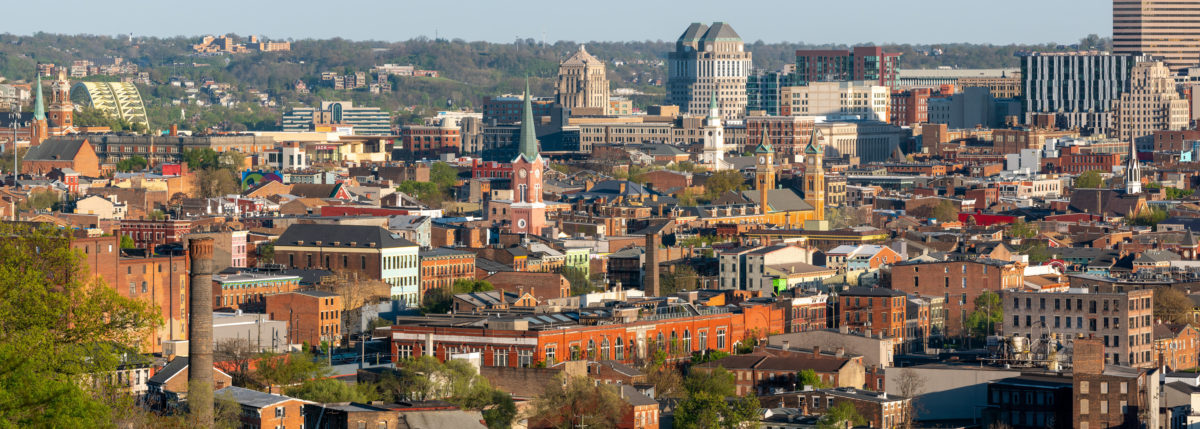
“With the area in and around Findlay Market expanding with new restaurants, bars, and lifestyle concepts, the neighborhood is primed and ready for a conversation around how we provide a safer and more beautiful experience.
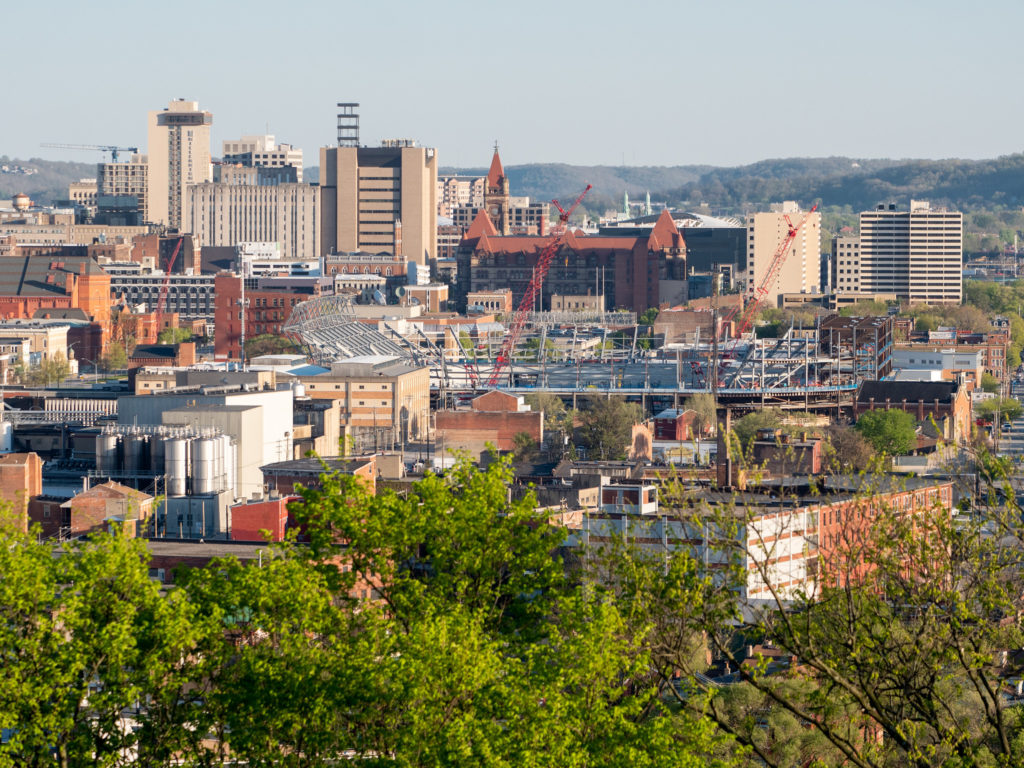
This is timed nicely with ongoing construction of FC’s stadium set to open in March 2021 that will bring even more focus on how pedestrians utilize this space. Visibility for pedestrians at this important, but rather troubling and cumbersome, intersection has always been a pain point when crossing the street and competing with cars.
In this reconfiguration designed by Jeffery Tompkins it lessens the risk for pedestrians by reducing the allowances of turns and creates a calmer environment. This is something we need more than ever as Over-the-Rhine and Clifton Heights become a more singular unit.”
Micah Paldino
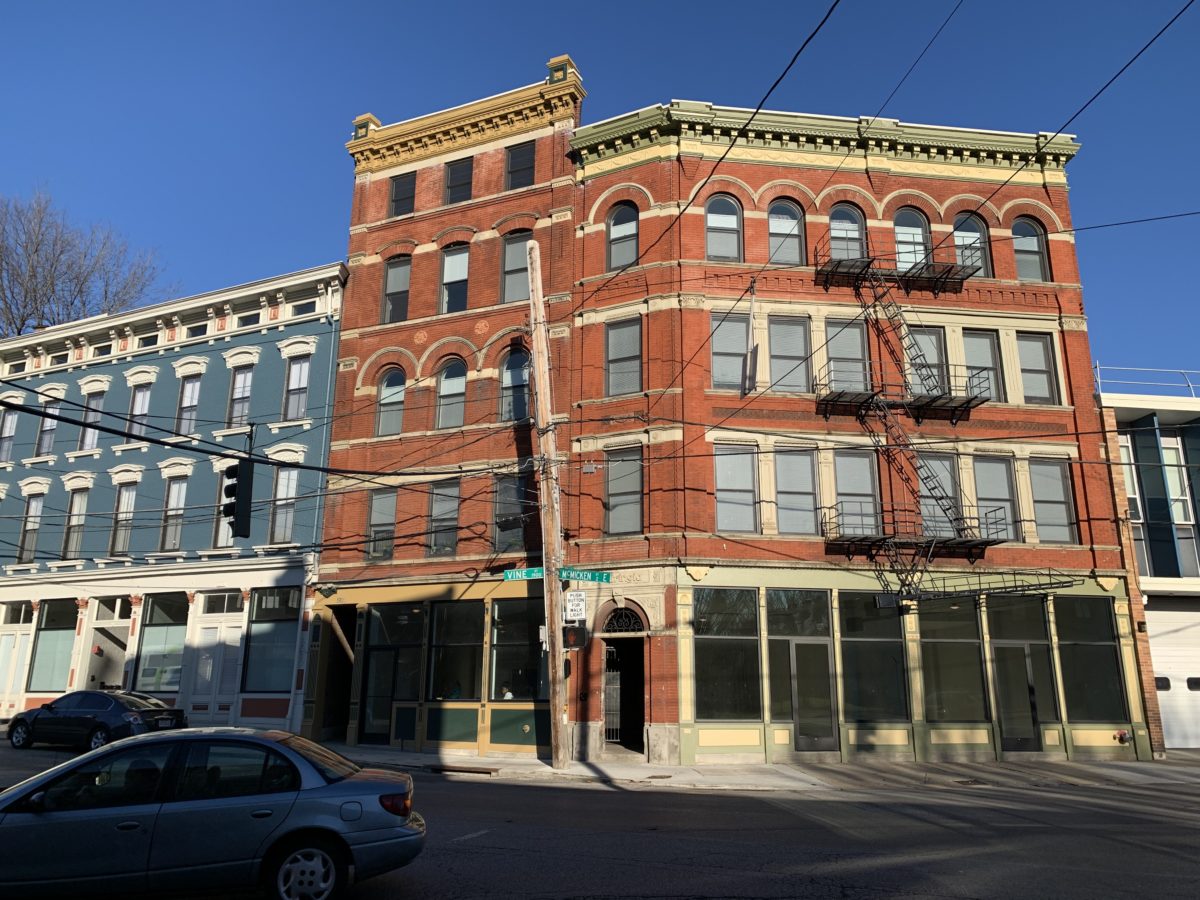
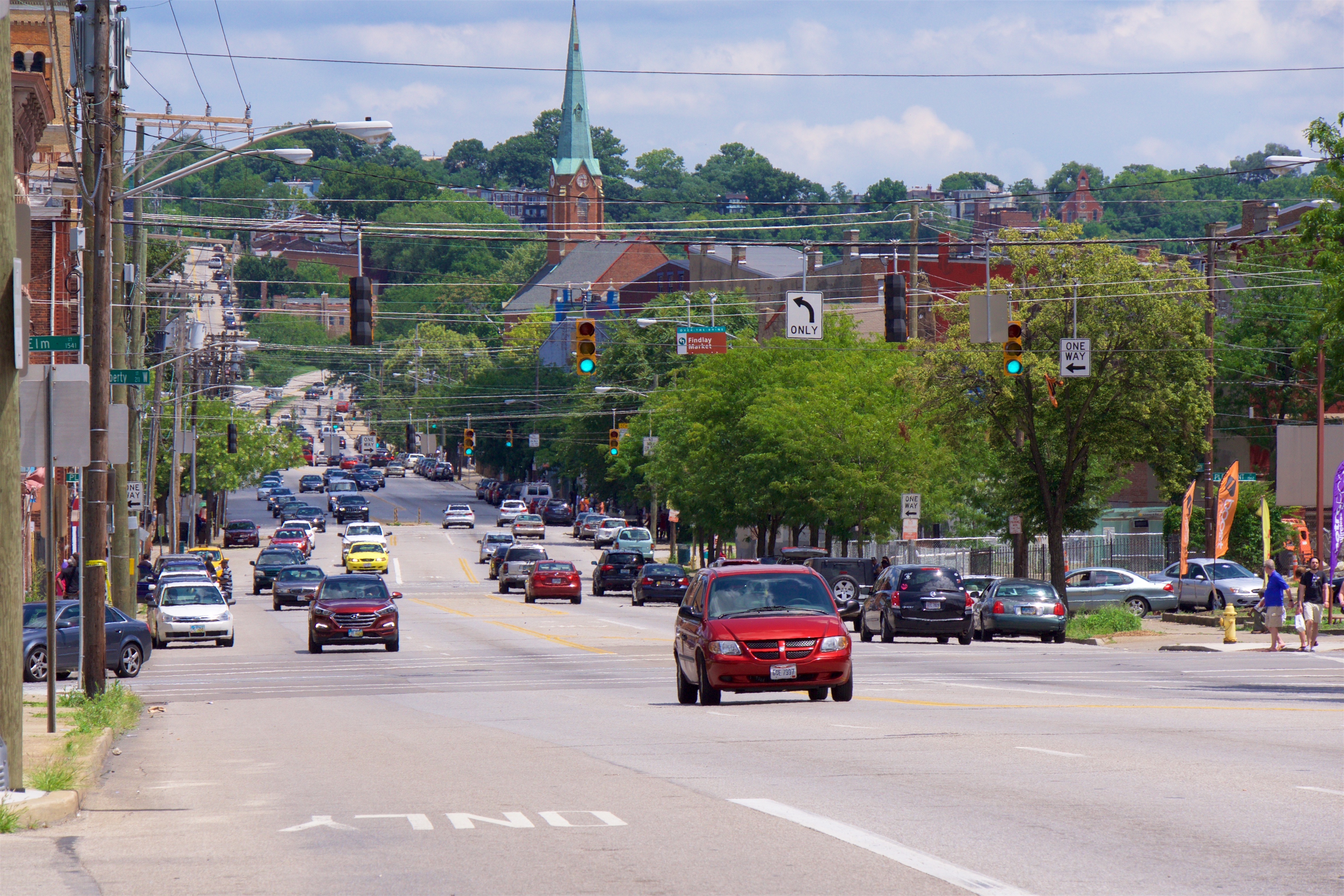
Vine Street and McMicken Avenue today. Photo by John Yung.
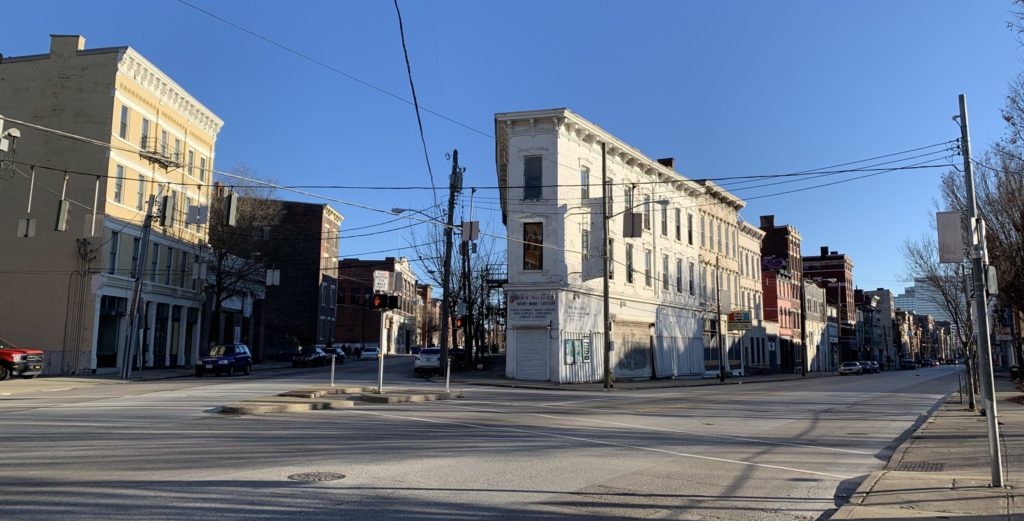
The intersection of Vine St. and McMicken St. is one of Cincinnati’s more complicated – and potentially more deadly. While it has been the subject of art, the first search engine result for the five-way intersection lists pedestrian deaths as its biggest story. And this is no surprise: complicated turn radii, low vehicle visibility from a wild angle of incidence, and an antiquated slip lane have created a logistical nightmare for cyclists and pedestrians hoping to cross the intersection.
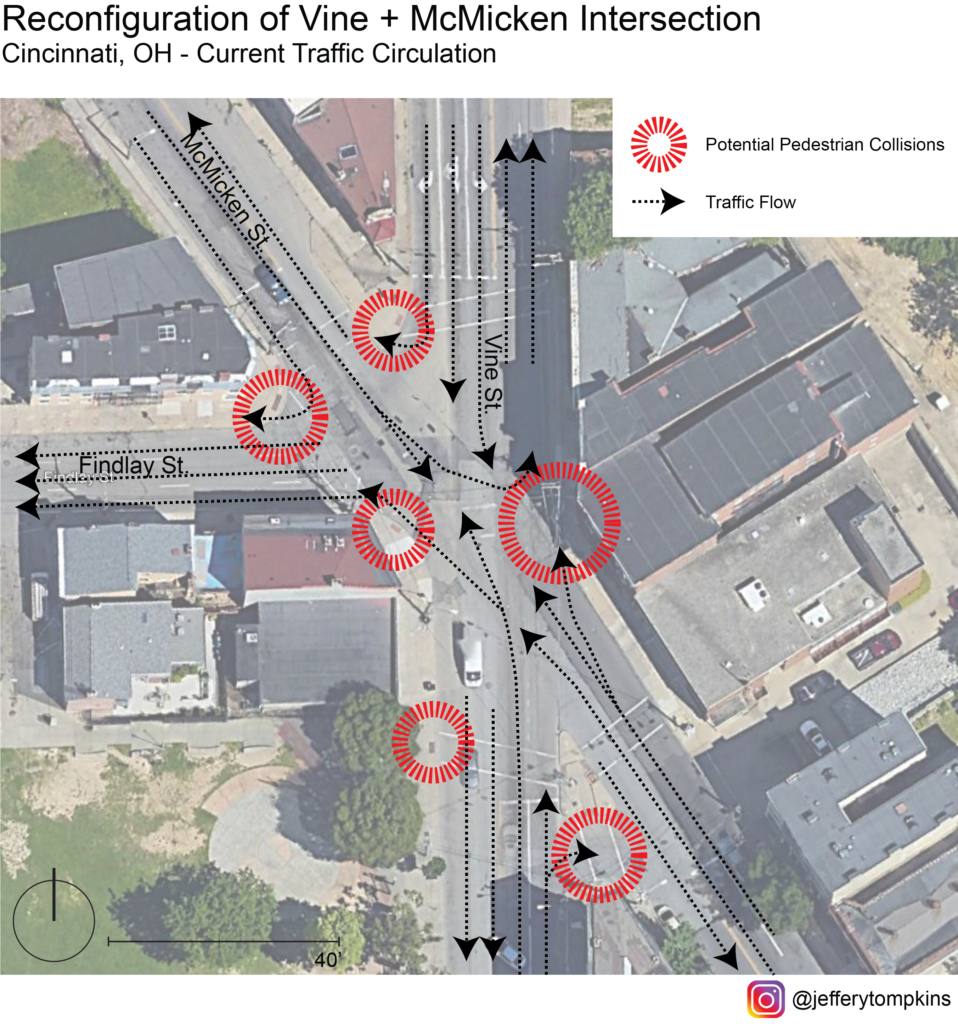
Current Traffic Circulation
Any design intervention hoping to calm traffic and improve mobility at this nexus should account for the district-wide significance of this crossing and, thus, must think in terms of the relevant traffic flow through Vine and McMicken corridors. As it stands, current traffic flow is overly complicated and caters almost entirely to automobiles rather than encouraging pedestrian interaction.
Seen from this map, the wide turn radii and allowance of multitudinous turning options fosters inhospitable conditions for peds, with several critical points ripe for accidents. On top of decreasing pedestrian safety, this wide array of turns also can negatively impact traffic flow and connectivity between adjacent neighborhoods. To fully reconfigure the intersection to allow for smoother traffic flow and safety, traffic flow of the corridor should be reanalyzed and possibly rerouted.
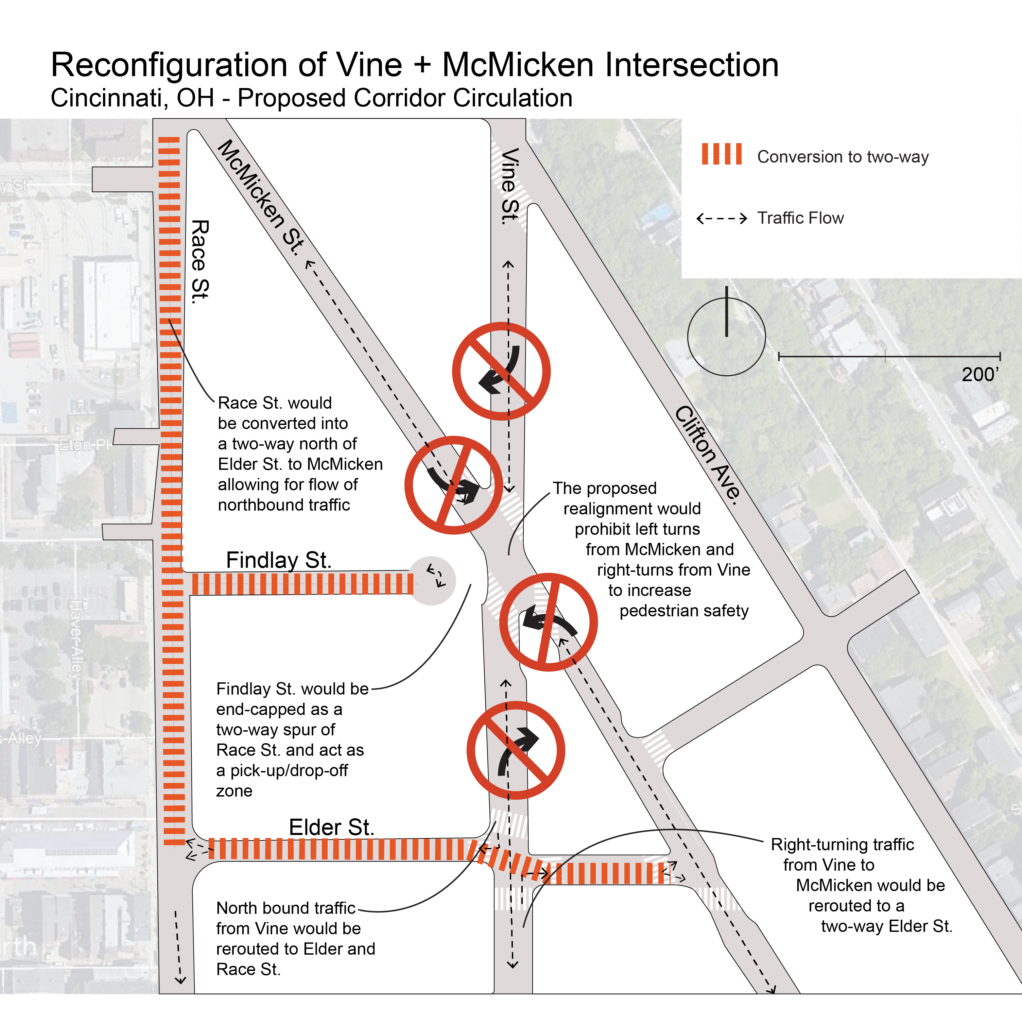
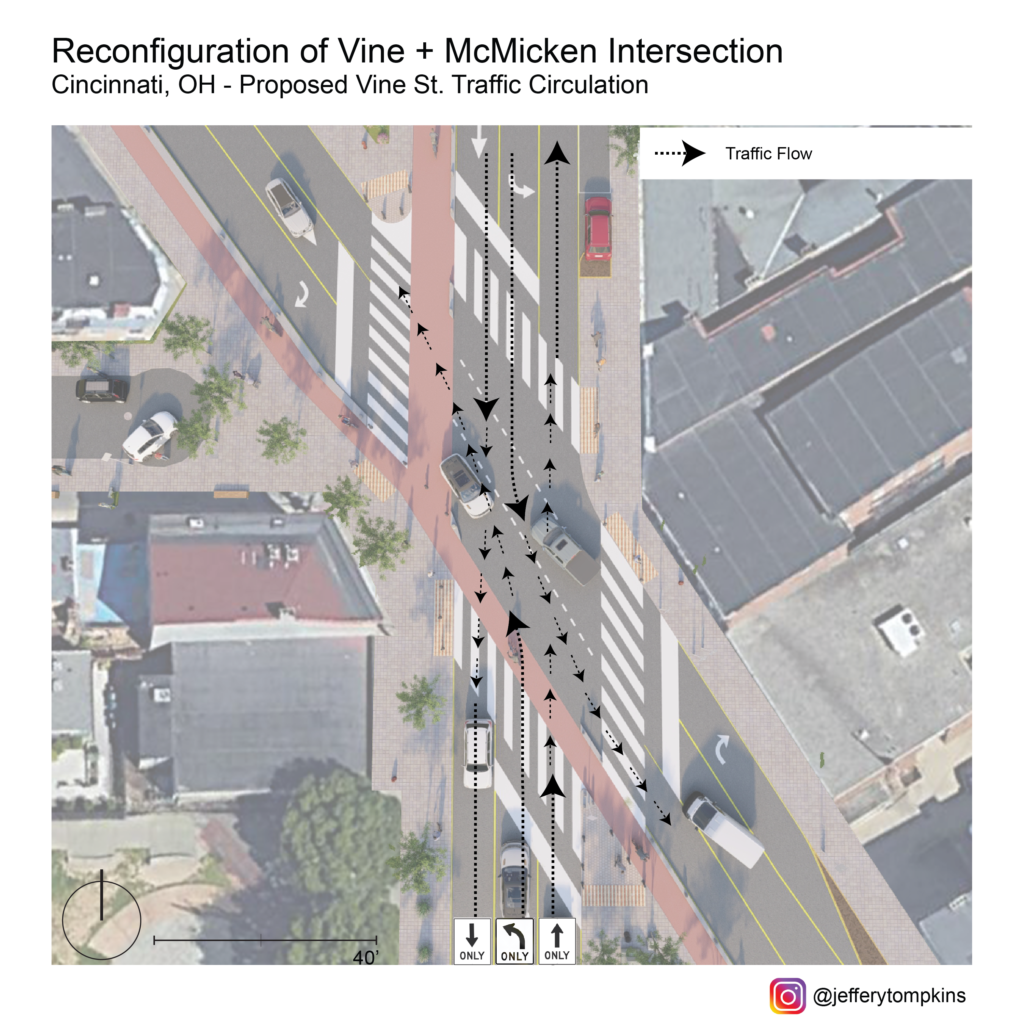
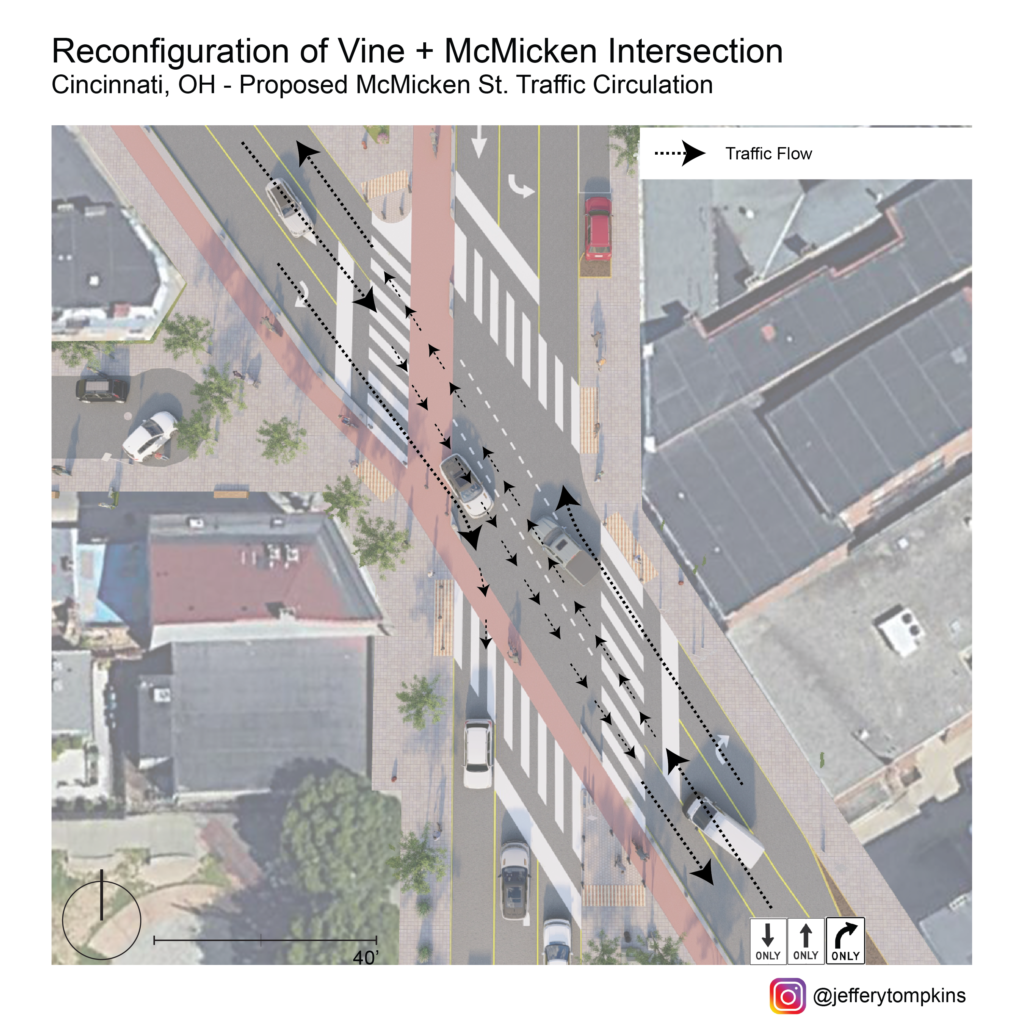
To allow for a complete-streets redesign of Vine/McMicken, my proposal eliminates left turns from McMicken onto Vine and removes right turns from Vine onto McMicken. North-bound traffic on Vine intending to turn right on McMicken would be rerouted to a new two-way Elder St. allowing for southbound travel. South-bound traffic on Vine intending to turn right on McMicken would instead be rerouted south to a two-way Elder and directed north-ward on a reconfigured two-way Race St. north of the Cincinnati streetcar connector, leaving the slip lane redundant. North-bound traffic from McMicken onto Vine would be routed south from Pace to Elder and then north on Vine. South-bound traffic from McMicken to Vine would instead utilize Elder as a conduit between the two streets. While this reconfiguration could create inconveniences for residents in the near-term, it is with a long-term eye toward saving pedestrian lives that makes it worth it. Atop this, the redesign hopes for slower traffic, improvements in overall traffic flow with elimination of one-ways, and a reduction in accidents.
Corridor Flow Map
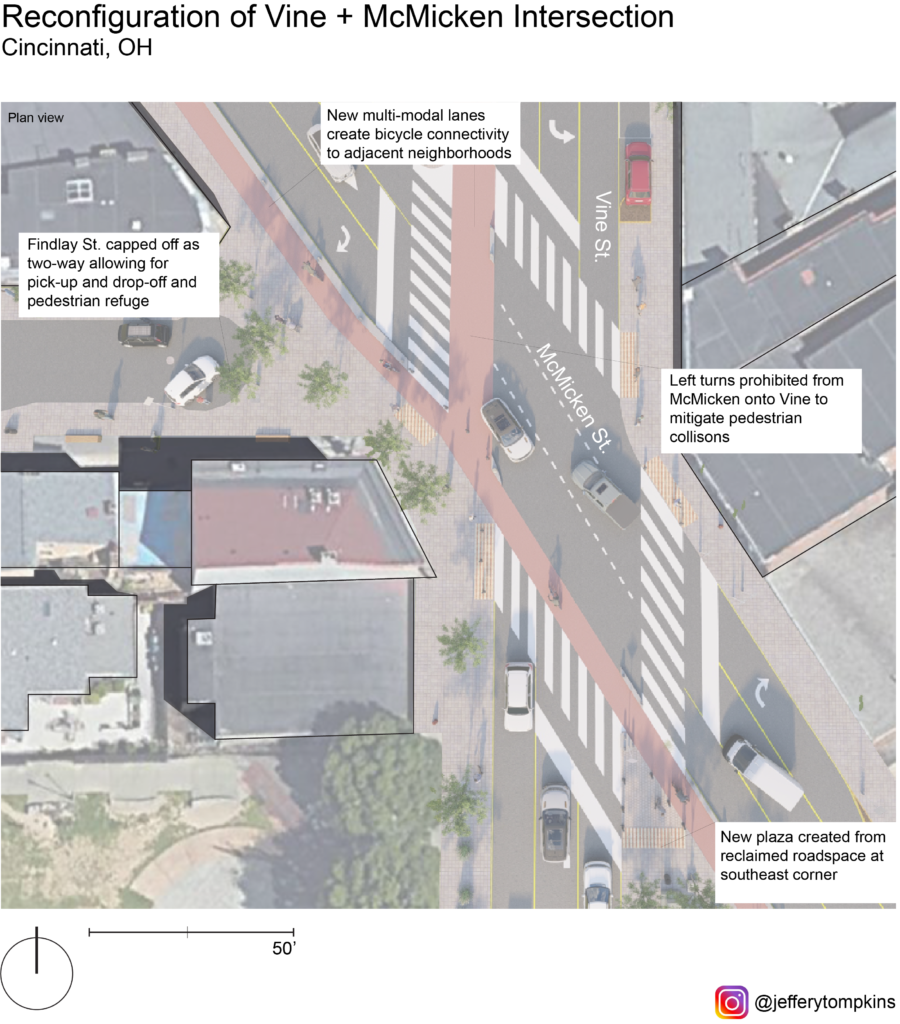
Aside from turn-regulation at the intersection, my proposal forVine/McMicken involves the capping of Findlay St. to eliminate the five-way and diminish incidence points. With this reclaimed space from the new configuration and removal of slip lanes, public space would be created, and pedestrian sightlines would be vastly improved at the new four-way intersection.
Plan View
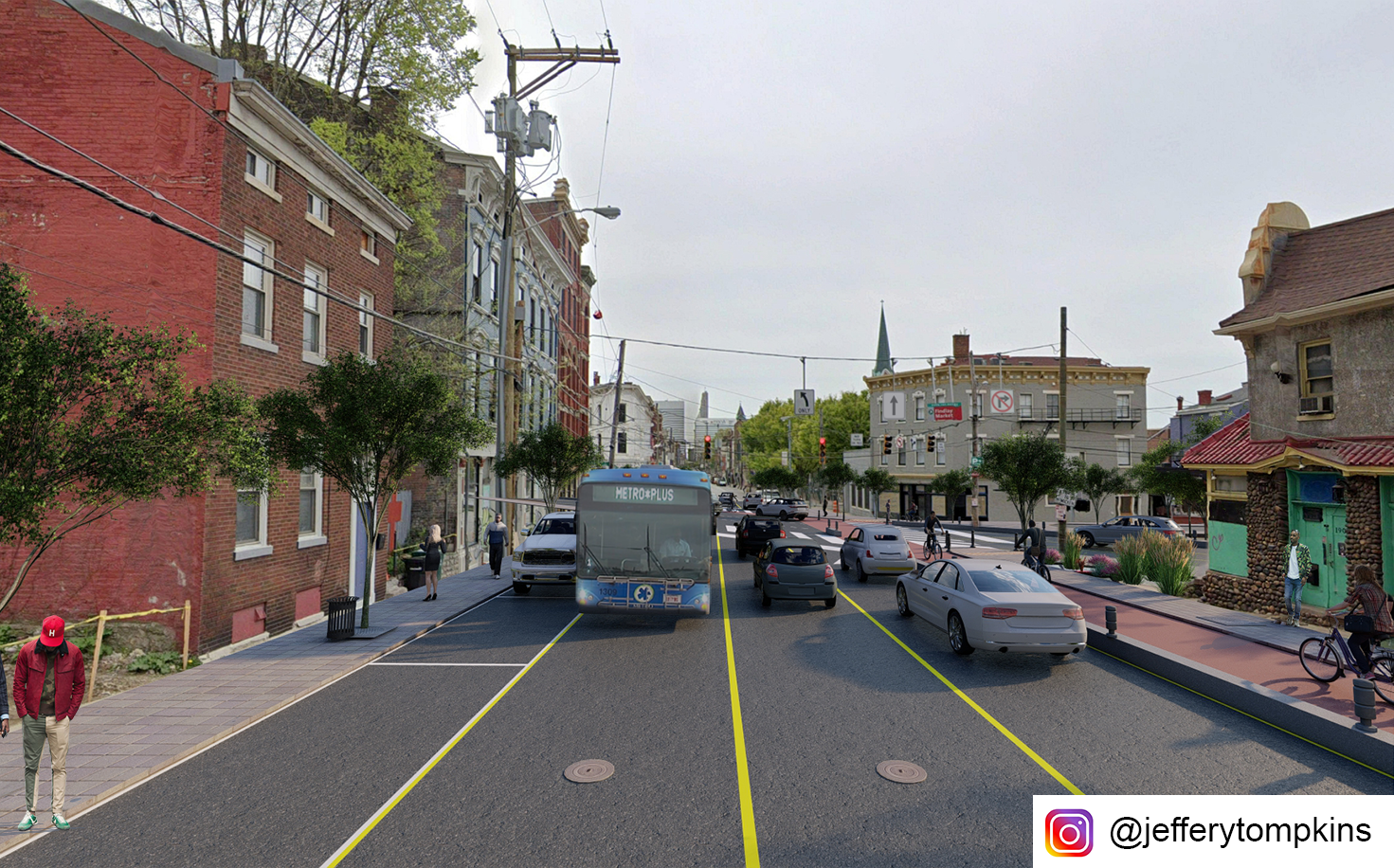
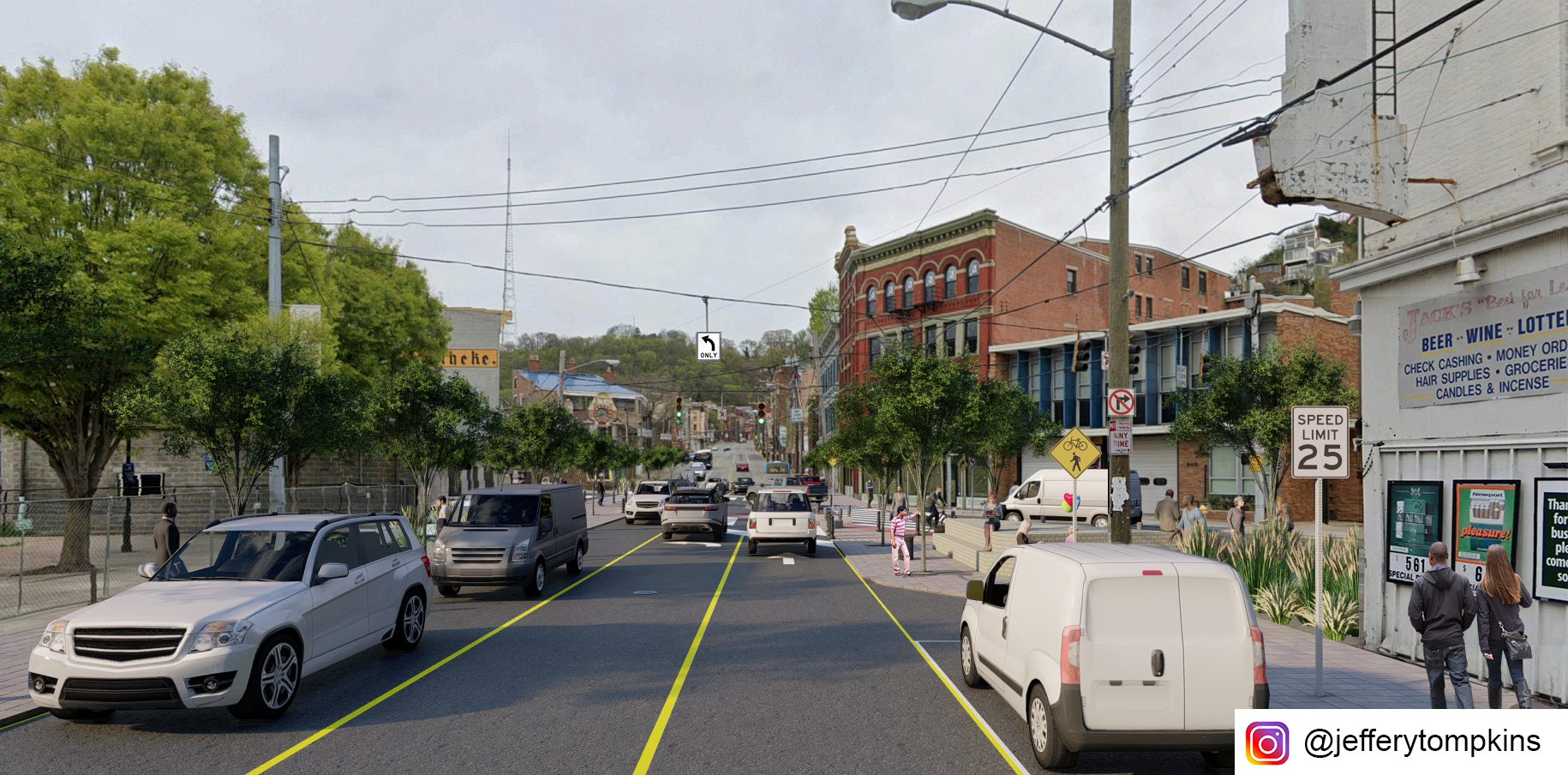
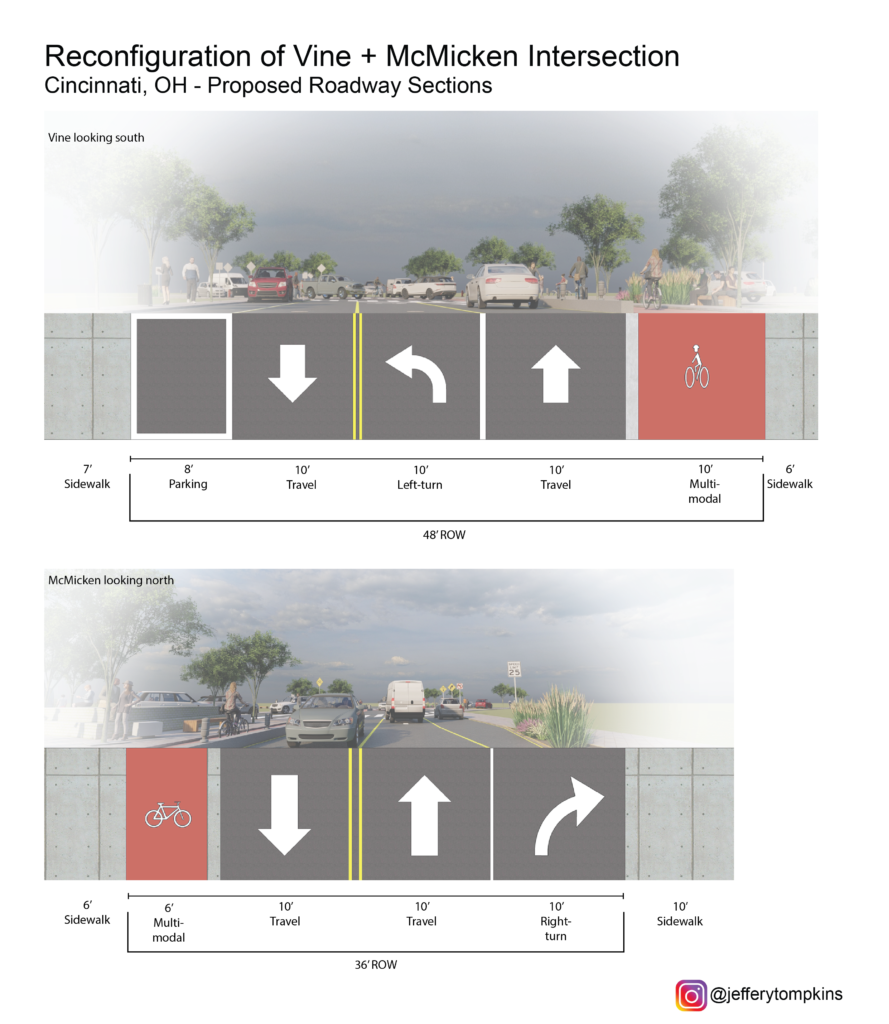
The new configuration calls for a reduction in vehicular space and the inclusion of multi-modal lanes catering to mid-speed travel (bicycle, scooter, powerchair, etc.) along Vine and McMicken. The reclaimed slip lane at the southeast corner would be reallocated as a public plaza and pedestrian sanctuary protected by bollards and activated by food carts or public art. A 6’ multi-modal lane along McMicken would improve connectivity for bicyclists along the corridor and offer a commuting solution for Over-the-Rhine residents. The 10’ multi-modal lane along Vine would take the place of the current right-turn lane and give a north-bound option for bicycle connectivity. One side of street parking would still be retained north and south of the intersection on both streets. The capped-off Findlay St. would become a possible pick-up and drop-off zone for rideshare and Uber/Lyft.
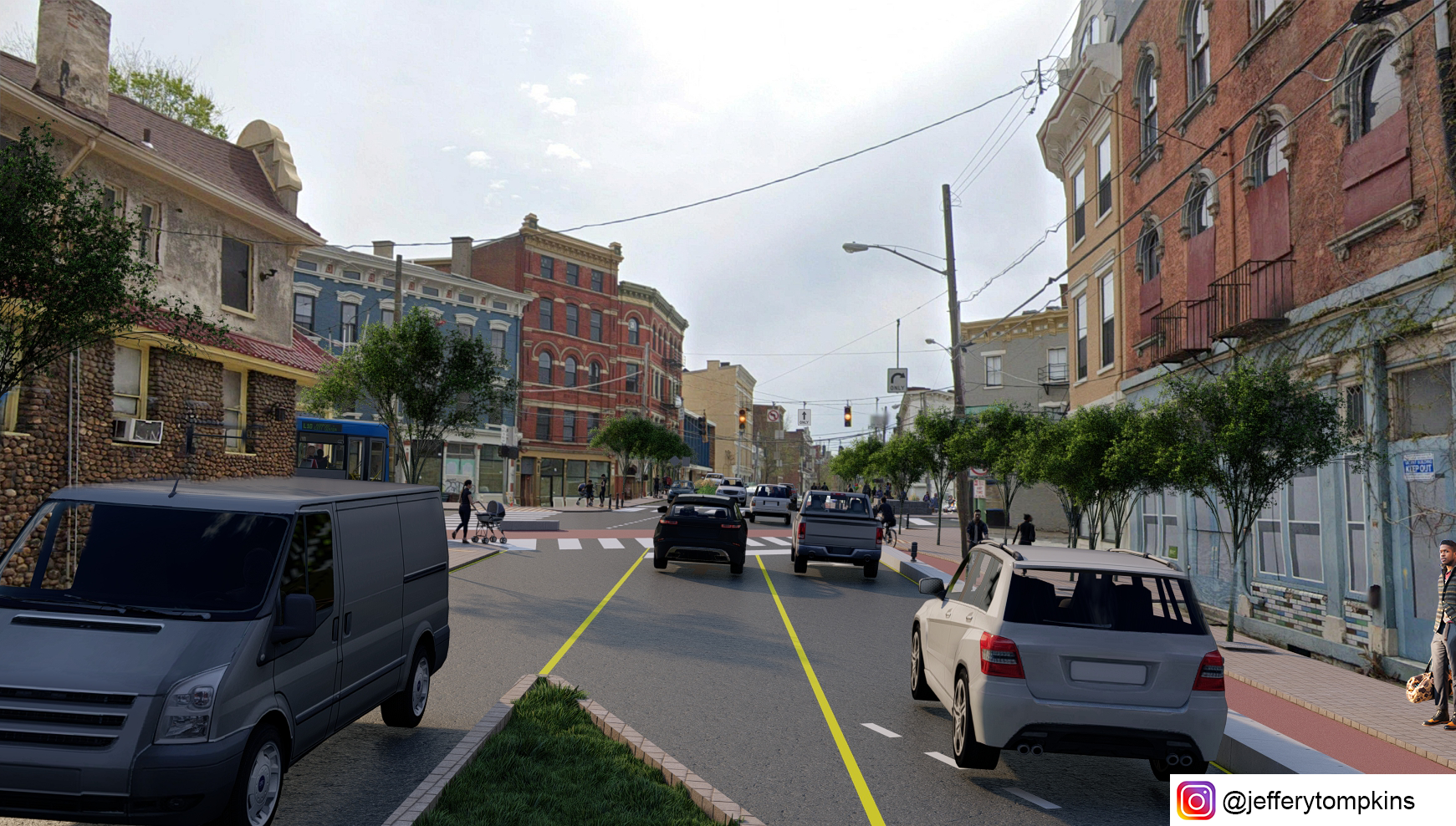
Looking southeast on McMicken Ave
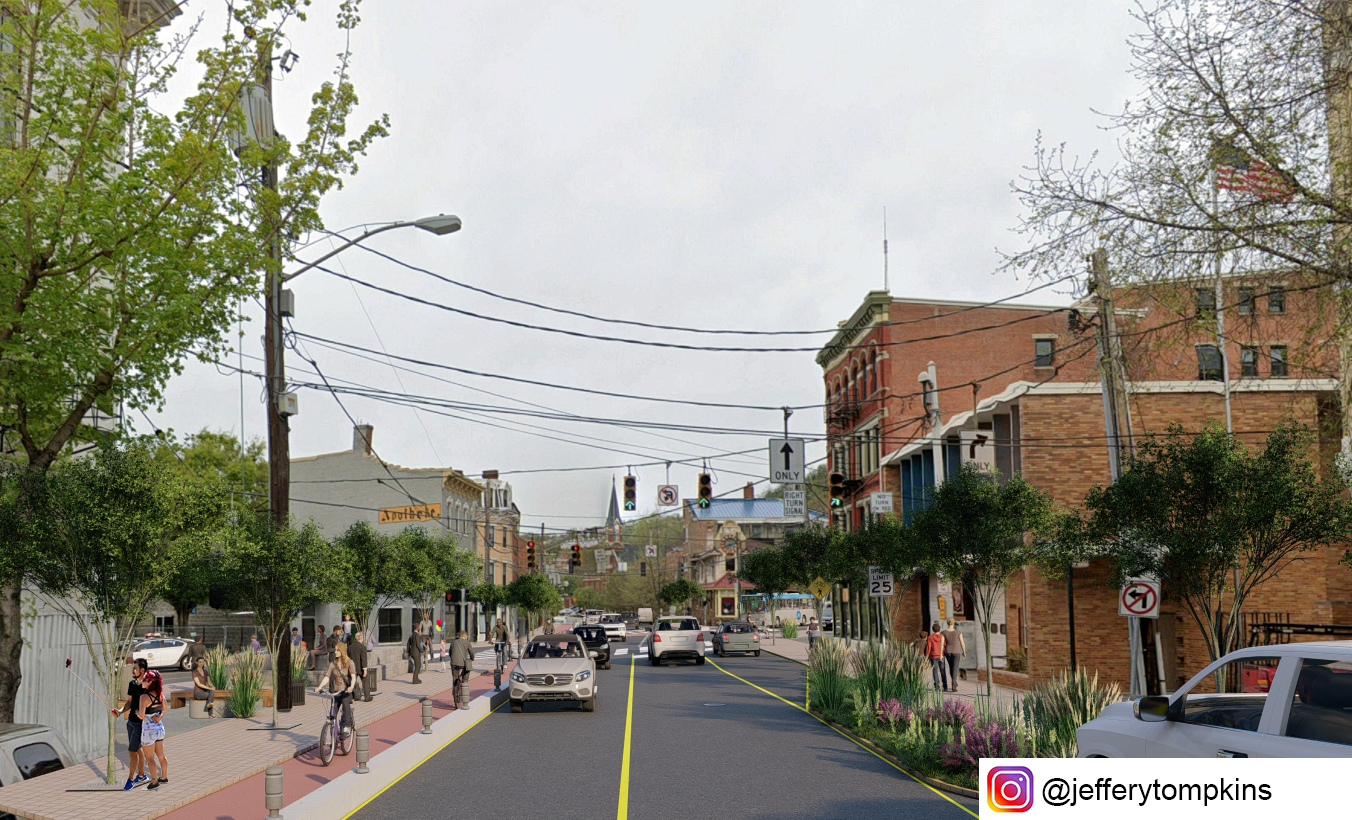
Looking northwest on McMicken Ave
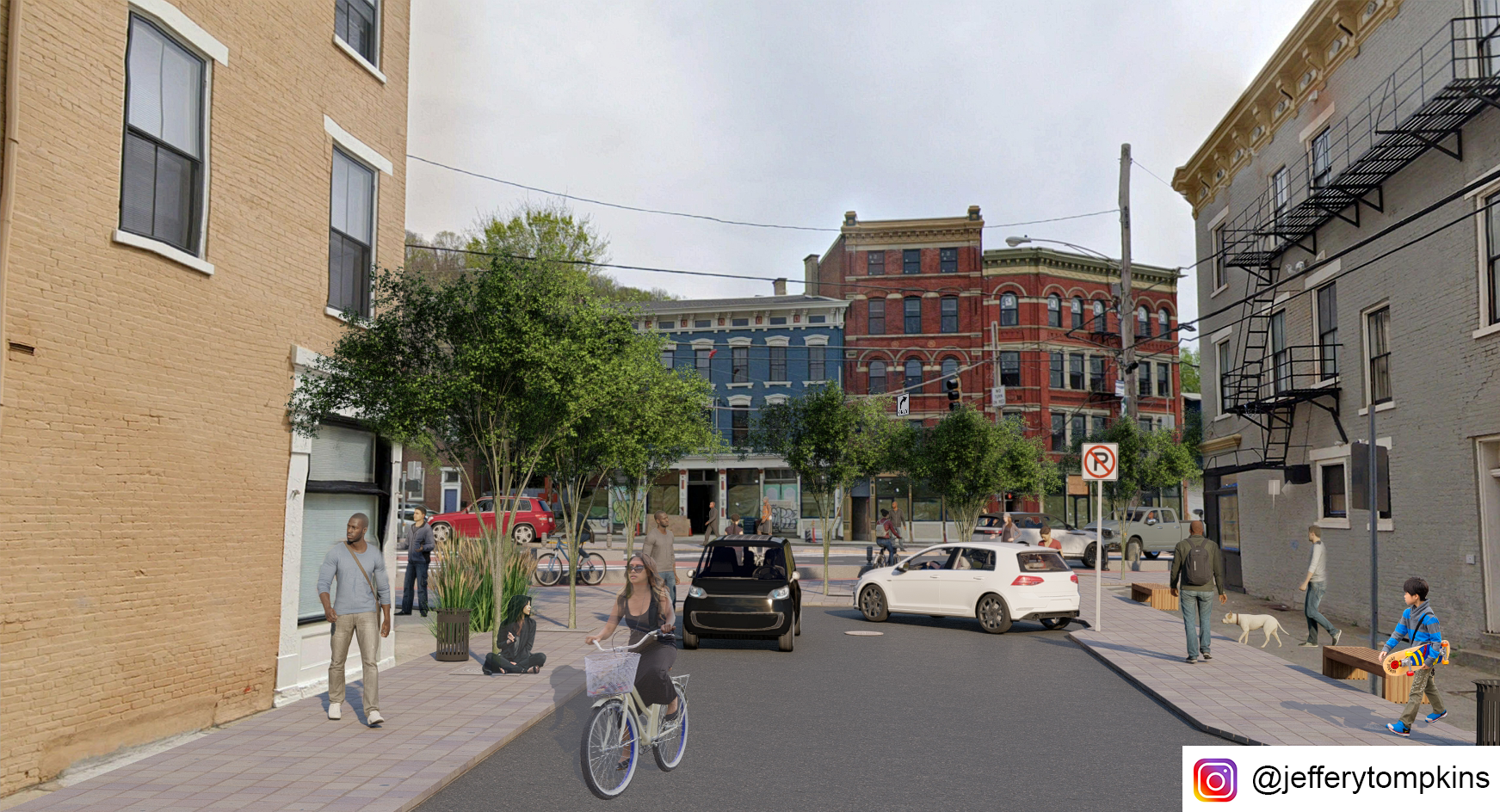
Looking east from Findlay Street
Looking south on Vine Street
Looking north on Vine Street
Render views of proposed intersection change. All illustrations by author.
Aside from fostering pedestrian safety and increasing bicycling viability, the redesigned intersection vastly improves overall traffic flow with its reduction in turns. This may offset future rates of accidents. While the reconfiguration would affect bus routes 46 and 78 currently turning from south-bound Vine onto Findlay to get to Race St. SB, the new configuration would allow for bus travel on the newly designated two-way Elder St, with traffic stop bars pushed back to allow for bus travel.
Vine Street Circulation
McMicken Ave Circulation
Street Cross Section
Overview and cross sections. All images by author.
If you would like to have your thoughts and opinions published on UrbanCincy, simply contact us at editors@urbancincy.com.
Well hello there! It’s been a year, what did we miss?
All kidding aside much has happened over the past year. While our team was alive and well, doing what we do, the site crashed. We can discuss how much effort we had to put into restoring the site from the archive but the long and short of it is that the back end server and hosting needed to be rebuilt almost entirely.
Thank you, Travis, for all your hard work!
In lieu of a broader update, we have decided to focus on catching up on some of the major developments in Cincinnati over the past year. Here’s a brief review of news from 2019 and early 2020:
Of course, we would be remiss to not mention the current COVID-19 crisis. We will continue to track its impacts on urbanism in Cincinnati and beyond. This Friday, the city will close 15 street sections in downtown and Over-the-Rhine to allow for expanded outdoor dining. Other areas may follow.
With the site back, we hope to become a public platform for urban thought in Cincinnati. With most of us now working full-time, we have less time to devote to the site. With that in mind, if you, our reader have an article you would like to submit or an opinion piece, please feel free to contact us at editors@urbancincy.com.
Since 2013, the number of pedestrians killed or injured in car crashes in Cincinnati has been on the rise. In 2018 alone, 428 pedestrians were struck by vehicles in the city, including 13 Cincinnati Public Schools students. One of those students, 15-year-old Gabriella Christine Rodriguez, was tragically killed while crossing Harrison Avenue on her way to school.
On January 18, Mayor John Cranley proposed $900,000 worth of pedestrian safety improvements across the city, including the addition of new crosswalks, improved signage, sidewalk bump-outs, and the conversion of some off-peak parking lanes into full-time parking lanes. Some of these improvements are located near schools where students are likely to be crossing the street. Others are located in neighborhoods like Pleasant Ridge where residents have been asking the city for traffic calming initiatives for years.
The southeast corner of Liberty and Race during the widening of Liberty Street
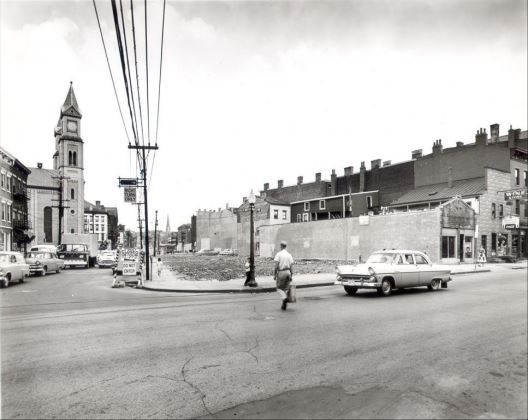
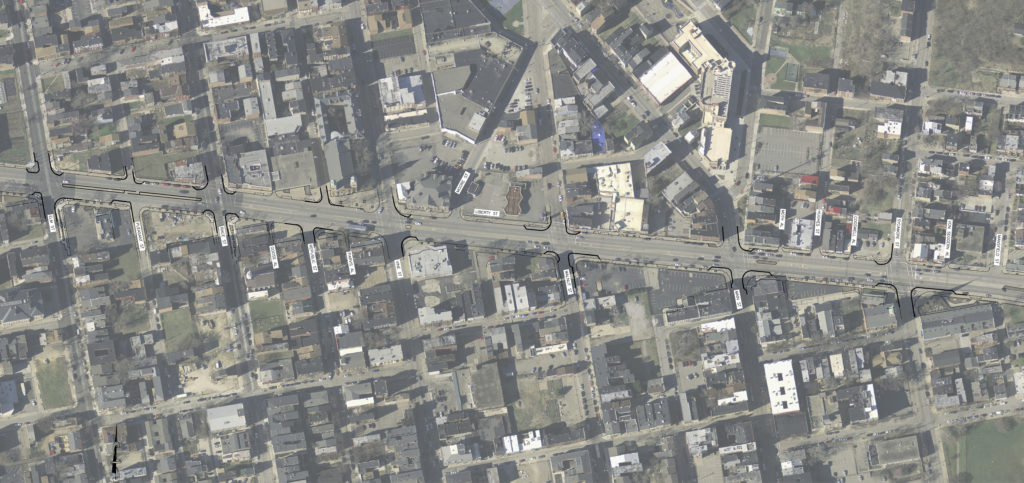
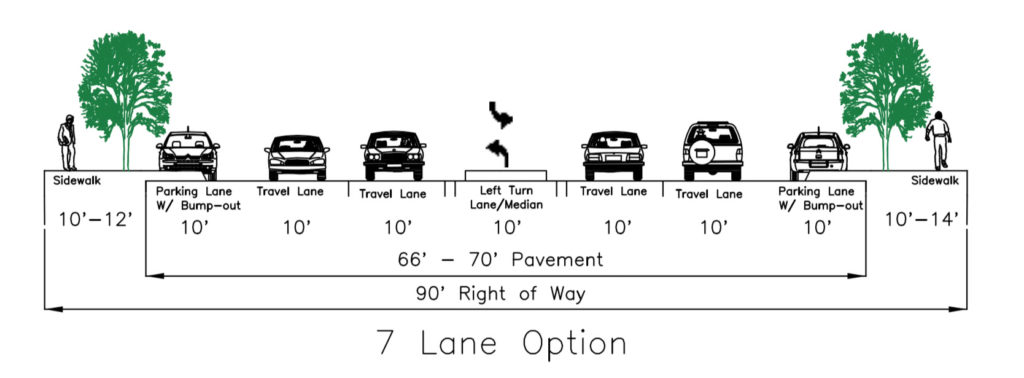
In the 1950s, Liberty Street was widened from two lanes to its current seven-lane configuration in order to funnel automobile traffic to the newly built Millcreek Expressway and Northeast Expressway, which are now known as I-75 and I-71. Hundreds of properties in Over-the-Rhine and Pendleton were purchased and demolished to accommodate the widening project, which cost $1.3 million at the time, the equivalent of $12.3 million in today’s dollars. Within years of the project’s completion, residents were complaining that the widened street was unsafe for school children to cross.
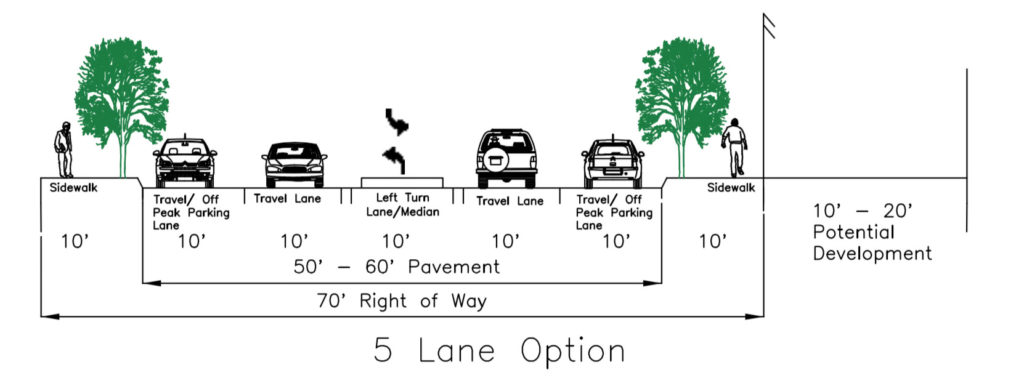
A “road diet” was proposed in the 2011 Brewery District Master Plan as a way to reconnect the Brewery District in northern Over-the-Rhine with the rest of the neighborhood. In April 2013, City Council directed the Department of Transportation and Engineering (DOTE) to begin studying the idea. DOTE hosted several community input sessions in 2015 and 2016, studied several options for improving the street, and settled on a plan to narrow the seven-lane street down to five lanes. The city presented a “final schematic design” for what became known as the Liberty Street Safety Improvement Project in October 2017.
However, in August 2018, it was revealed that city administration had “paused” the project. An August 7 memo released by then-Acting City Manager Patrick Duhaney explained that the project was paused due to concerns that a slimmed-down Liberty Street couldn’t handle the traffic headed to and from FC Cincinnati’s new West End stadium, and a funding gap due to the need to relocate a water main for the project. In a subsequent memo released on August 31, Duhaney recommended an “Administration Preferred Option” that would “scale back the project to install bump-outs at each intersection” without any reduction in the street’s width.
The “Administration Preferred Option” for Liberty Street
In October, City Council allocated more funding to the project to cover the cost of moving the water main and directed the administration to proceed with the road diet. However, it seems that city administration has began considering several new options that would keep Liberty Street at its current width. According to city documents and emails obtained by UrbanCincy, the following options now appear to now be under consideration:
The 5 Lane Option was the “final” plan presented to the Over-the-Rhine Community Council in October 2017.
The 7 Lane Option would keep Liberty Street’s current width and configuration, but add bump-outs at each major intersection, slightly reducing the crossing distance for pedestrians.
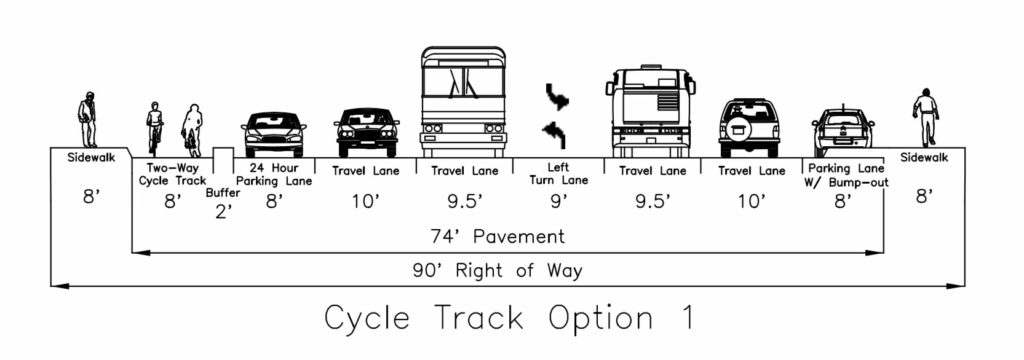
Cycle Track Option 1 would add an 8 foot wide bidirectional cycle track on one side of the street and maintain 7 lanes of automobile traffic in the configuration that exists today but with narrower lanes. Sidewalks would be narrowed to 8 feet.
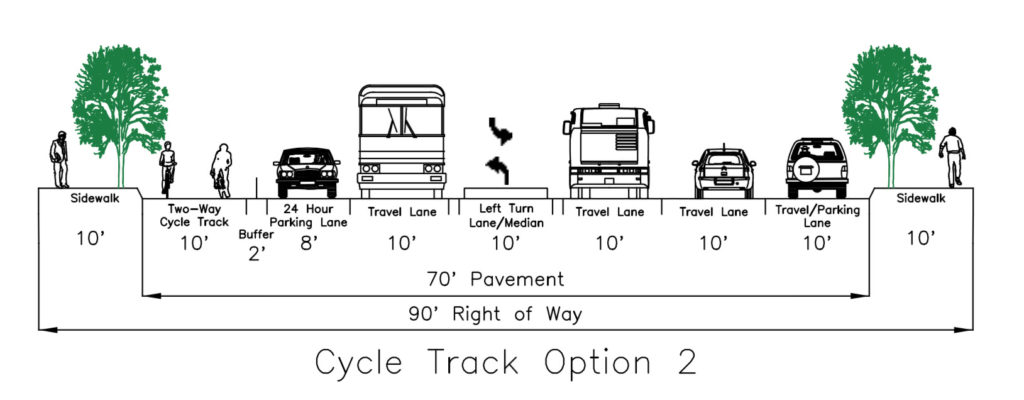
Cycle Track Option 2 would add a 10 foot wide bidirectional cycle track on one side of the street and maintain 6 lanes of automobile traffic. In one direction, the street would have two vehicle travel lanes and a full-time parking lane. In the other direction, it would have one vehicle travel lane and an “off-peak” parking lane that would convert to a travel lane during rush hour(s). (Note: In this draft document, the parking lanes appear to be mislabeled. The parking lane on the left should be labeled “Travel/Parking Lane” and the parking lane on the right should be labeled “24 Hour Parking Lane”.)
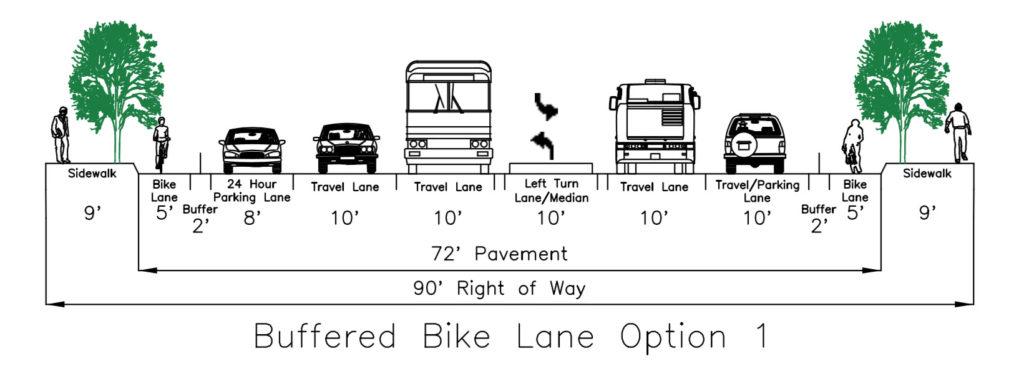
Buffered Bike Lane Option 1 would add a 5 foot wide bike lane on each side of the street, located between the sidewalk and parked cars, and maintain 6 lanes of automobile traffic. In one direction, the street would have two vehicle travel lanes and a full-time parking lane. In the other direction, it would have one vehicle travel lane and an “off-peak” parking lane that would convert to a travel lane during rush hour(s). Sidewalks would be narrowed to 9 feet.
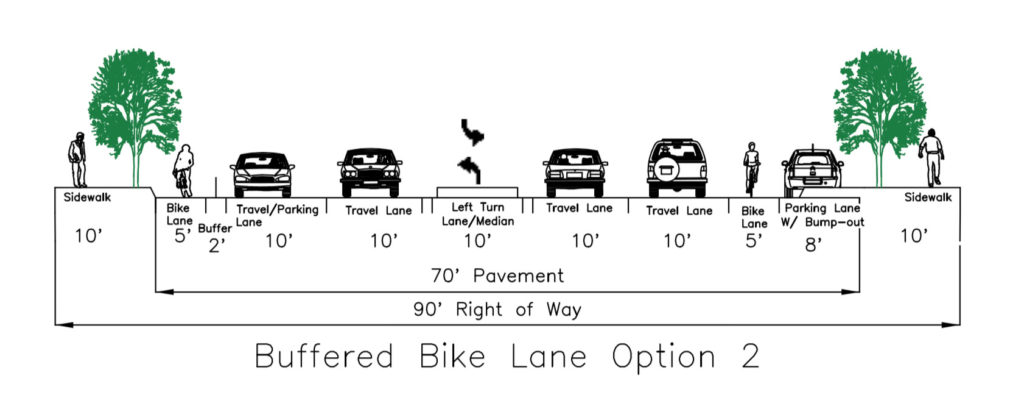
Buffered Bike Lane Option 2 is similar to the previous option, except that in one direction of travel, the bike lane and full-time parking lane have swapped positions. While this allows sidewalk bump-outs to be added on one side of the street, reducing the crossing distance for pedestrians, it is also more dangerous for cyclists, who will be riding next to fast-moving cars rather than in a protected zone between parked cars and the sidewalk.
While the 2011 Brewery District Master Plan proposed adding bike lanes to Liberty Street, DOTE didn’t spend much time studying them due to lukewarm response at the public input sessions. According to a city document, “Bikes, pedestrian, and vehicular needs, among others, were all prioritized based on data and community feedback. Bike lanes were determined to not be a high priority and were eliminated from the options very early in the process. The top priority was pedestrian safety with a focus on the long street crossings that exist today.”
The idea of adding bike lanes returned in early October 2018, when city staff began to “brainstorm different scenarios for Liberty Street that do not involve moving the water main,” according to an email sent by a city staff member. The bike lane options would allow for some safety improvements to be implemented without narrowing the total width of the street, so they wouldn’t require the water main to be moved. However, these options would not achieve the “top priority” of the original project: significantly reducing the pedestrian crossing distance and reconnecting the northern and southern halves of the neighborhood.
Now that City Council has now provided the necessary funding to move the water main and narrow the street, it would seem that the primary reason for the ongoing “pause” and re-evaluation of the project is the city administration’s desire to maintain maximum vehicular access to the new FC Cincinnati stadium in the West End. In October 2018, Mayor John Cranley dismissed what he called “conspiracy theories” that FC Cincinnati had anything to do with the decision. And while we uncovered no evidence that FC Cincinnati’s ownership asked the city to kill the road diet, it does seem that DOTE is prioritizing traffic headed to and from the stadium above other users of the street.
In an email from May 2018, one DOTE staff member explained, “We anticipate having a Event Timing Plan for the signals that will favor funneling vehicles towards the stadium prior to the game and away from after the game.” So while a larger traffic study of the downtown street grid, which primarily focuses on improvements for transit riders and pedestrians, is stuck in political gridlock, traffic signal timing changes to speed cars down Liberty Street have been fast-tracked.
Additionally, the DOTE staff member explained that “Central Parkway is not a good conductor of large event traffic” and that the city wants to “try to minimize the vehicular traffic on the N/S portion of Central Parkway as this will have a very large number of pedestrians.” This explains the city administration’s desire to close a portion of Central Parkway on game days, which would have the effect of funneling even more highway-bound traffic down Liberty Street.
What does the Liberty Street “pause” tell us about the city’s commitment to Vision Zero?
During Mayor John Cranley’s pedestrian safety announcement in January, he mentioned that Cincinnati would move forward with implementing a Vision Zero program. While few specifics were given, Vision Zero programs typically have the goal of reducing the number of traffic-related deaths and serious injuries by rethinking how streets are designed in order to prioritize all users—including pedestrians, cyclists, and transit riders—instead of designing them to move as many cars as possible, as fast as possible. Vision Zero programs often include reducing speed limits, reconfiguring overly-wide streets and intersections, and adding new crosswalks, sidewalk bump-outs, and bike lanes.
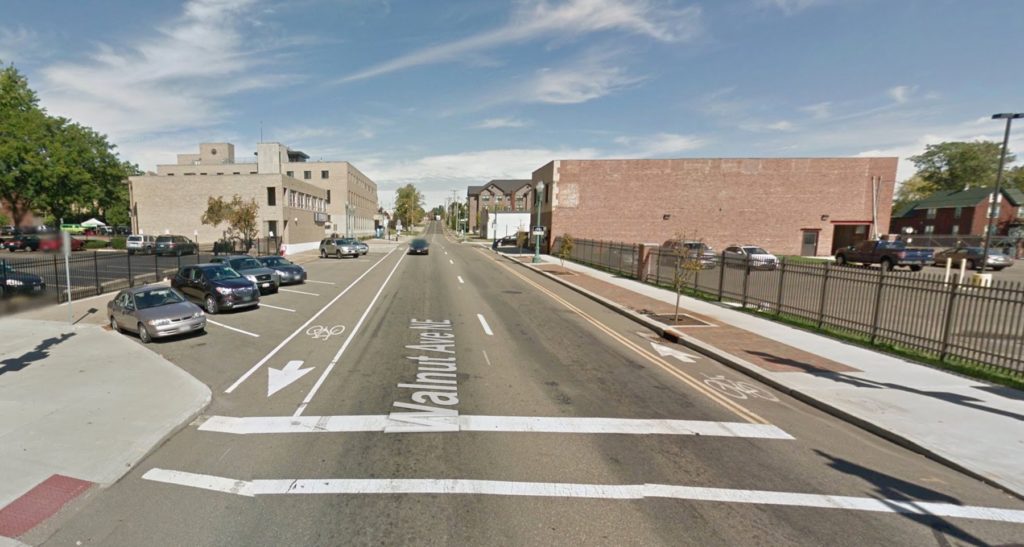
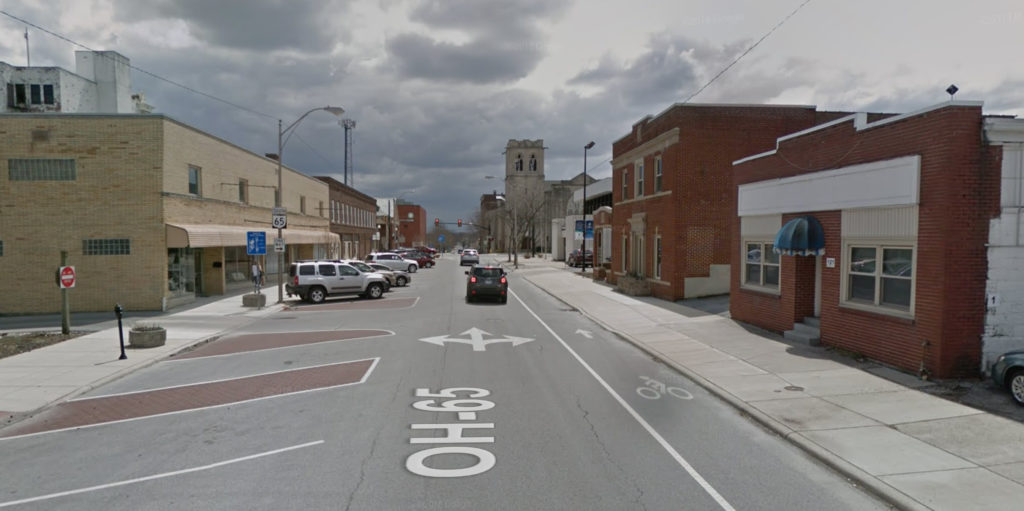
Vision Zero policies have been implemented by dozens of cities across the country and around the world, and have resulted in measurable safety improvements. New York City adopted Vision Zero in 2014 and has experienced a decrease in pedestrian fatalities for five consecutive years. The benefits aren’t limited to big cities like New York, though. Smaller Ohio cities like Canton and Lima have also incorporated Vision Zero-style traffic calming techniques into recent street redesigns.
Road diet in Canton, Ohio
Road diet in Lima, Ohio
In order for a Vision Zero policy to be effective, it can’t just be a slogan. It can’t just be a one-time expenditure of $900,000 for a handful of pedestrian safety improvements that are easy political wins. It has to be a comprehensive set of policies that require DOTE to take pedestrians, cyclists, and transit riders into consideration every time a street is designed. It requires that the city seek input from residents about changes they want to see on their streets and turn those ideas into reality. Sometimes, it will require that the city makes decisions that inconvenience drivers in minor ways—reducing speed limits in neighborhood business districts and on residential streets, increasing enforcement of traffic laws, and perhaps losing a few on-street parking spaces to add new crosswalks—in order to make streets dramatically safer for everyone.
The Liberty Street Safety Improvement Project is a slam dunk Vision Zero project. It is widely supported by neighborhood residents and has been fully funded by City Council. And yet, the city administration seems to have decided at the eleventh hour that the need to move cars to and from the new FC Cincinnati stadium as fast as possible is a higher priority than desires of residents who want a safer street and a reconnected neighborhood.
If the city implements a Vision Zero program, it will be faced with this same conflict over and over again. Neighborhood residents want a safer street with calmer traffic, but drivers want to get from Point A to Point B as quickly as possible without slowing down. With Liberty Street, the city administration has chosen to side with drivers. If this is representative of future decisions that the city administration and DOTE will make, Cincinnati’s Vision Zero program will not be successful.
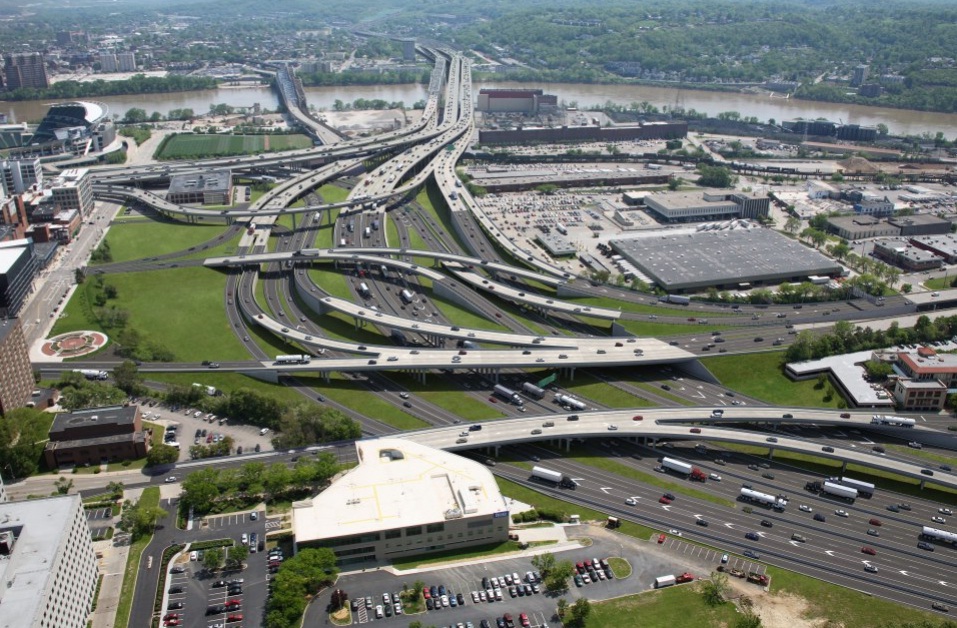
The underlying assumption of the Brent Spence Bridge project is that the level of congestion warrants relief with a new bridge and freeway expansion. The problem of congestion will be solved with new freeway capacity. However, that simple formula does not account for all the costs of the freeway expansion or the benefits not running a freeway through the urban core.
Two important pieces missing from the Brent Spence Bridge project cost/benefit analysis are the value of urban land and induced demand. As noted in a prior article, urban land is valuable. The sustained growth in Over the Rhine is local proof of the national trend that people want to live, work, and play in cities. Proponents of the bridge expansion project assume that the congestion relief is worth the price tag and loss of urban land for the next 50+ years. But what if the congestion relief is ephemeral?
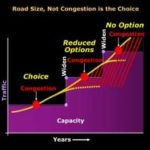
Others in Cincinnati have described induced demand. To reiterate, it is the propensity for freeway lanes to fill to capacity once they are created. New capacity creates new demand. Decreasing the cost of driving with shorter, faster commutes, increases the number of drivers. Road expansions are intended to expand capacity and reduce congestion; however, new freeway capacity quickly fills up and becomes just as congested as before.
Proposed approach to the Brent Spence Bridge, Kentucky side
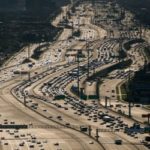
Katy Freeway in Houston Texas
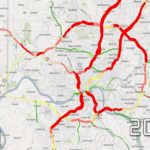
OKI Projected congestion model for 2012
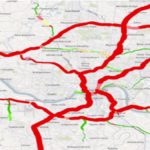
OKI future traffic model for 2039
A chart illustrating Induced Demand
There appears to be no upper limit at which enough lanes eliminate capacity. The Katy Freeway in Texas provides the case in point. First constructed in the 1960s, it was six to 8 lanes wide. A $2.8 billion expansion project finished in 2011 that expanded it to one of the widest freeways in North America at 26 lanes: At one segment each direction has 6 lanes of through traffic, 4 feeder lanes, and 3 HOV/toll lanes. Travel times decreased immediately after the expansion, and in 2012 the Katy Freeway was hailed as a success story. However, by 2014, travel times increased 30 percent during the morning commute and 55 percent during the evening commute. $2.8 billion and 18 extra lanes improved traffic for three years, then made it worse than before the project. It achieved congestion relief for less than three years.
The predicted benefits of the Kary Freeway did not last. Cincinnati should learn from that lesson and include the effects of induced demand in the Brent Spence Bridge expansion cost/benefits accounting. The previous design did not adequately analyze induced demand.
Part of the reason that the project did not include induced demand as part of the analysis is that the software used to model traffic volumes is not up to the task. The model, called Static Traffic Assignment (STA), was designed to run on computers from the 1970s. Since you are reading this article on a computer there is no need to explain how much computers have changed in that time. There have been upgrades to the STA software but it retains the same fundamental architecture. STA produces usable predictions for daily traffic volumes but not for peak demand (rush hour). Accurate predictions of peak demand are necessary to understand induced demand.
There are two problems with STA that provide inaccurate peak demand forecasts. First, STA assumes roadway segments are independent, so that a problem in road segment “A” will not impact road segment “B.” In reality, congestion in one road segment does impact adjacent segments. Second, STA allows modeled traffic volumes to exceed capacity. If the model predicts capacity beyond what a given freeway can support, the model will queue vehicles up “outside the model.” In reality, those cars queued “outside the model” are either stuck in traffic or they’ve left the freeway and are taking surface roads to work.
The interstate system is a network that seeks equilibrium. If there is congestion in the network, drivers will avoid it. If there is capacity in the system, drivers will fill it up. The current Brent Spence Bridge project was modeled with STA. STA does not look at the network holistically. It either breaks up the system in segments or moves extra traffic outside the model. The failure to look at the system holistically makes it difficult for STA to predict where induced demand will come from and how intense the demand will be.
A better model now exists to forecast traffic. Called Dynamic Traffic Assignment (DTA), it is a more sophisticated computer model designed to run on contemporary computers. DTA holistically models an interconnected network in equilibrium. If a bottleneck causes a traffic backup, DTA assumes traffic will divert to surface roads rather than move outside the model.
The 2018 CNU Transportation Summit on Highways to Boulevards featured the presentation of a recent paper on DTA. Overall, DTA is a more powerful modeling tool that can better analyze effects on complex systems. There are five vehicular bridges over the Ohio River in Cincinnati, plus the two I-275 bridges. The traffic model must accommodate the regional impact of the bridge expansion on traffic, including the effects of induced demand. This is doubly important if the Brent Spence Bridge expansion is tolled and other bridges are not.
Existing Brent Spence Bridge Approach
Planned Brent Spence Bridge Approach
A DTA model of the Brent Spence bridge project will better show the impact of additional vehicles on local streets. Civic leaders in Cincinnati and Covington should have a better accounting of how moving an additional 50,000 vehicles per day through the urban core will affect their street networks, which must be paid for with city tax dollars.
Would it make sense to spend five years building the expansion project if the congestion relief dissipated within five years? Before moving ahead with such a large and expensive project there must be a full accounting of the costs and benefits. Particularly relevant to CNU, the loss of urban land has not adequately been included in the cost of the project. The benefit of congestion relief is diminished by induced demand. There are new tools at hand to better tally up these costs and benefits. A project the size and scale of the Brent Spence bridge expansion project requires a full and transparent accounting of the costs and benefits to move forward.
This is a guest article by Chris Meyer reporting on the 2018 CNU Transportation Summit. CNU and CNU Midwest are content partners with UrbanCincy. Chris is an Architect at Hub + Weber, PLC
If you would like to have your thoughts and opinions published on UrbanCincy, simply contact us at editors@urbancincy.com.