Ensemble Theatre debuts new brand design, recommits to $6.5M capital campaign

Leadership at the Ensemble Theatre of Cincinnati (ETC) announced a renewed commitment to its $6.5 million Next Stage Capital Campaign on Monday. The announcement was coordinated with the debut of a new website and brand design intended to reaffirm the institution’s position within Over-the-Rhine.

The ETC says that the new website and brand design are an evolution of the theatre’s brand, and were developed in coordination with Cincinnati-based brand management firm LPK.


New brand design, developed by LPK, for the Ensemble Theatre of Cincinnati.

The non-profit theatre organization had been largely quiet since first announcing a multi-million capital campaign in 2008. The money, ETC officials say, will be used to expand lobby space, upgrade electrical and HVAC equipment, and add new seats and other amenities for patrons. All renovation plans have been developed with GBBN Architects and Messer Construction.

“We are thrilled that with so many improvements in the Over-the-Rhine Gateway Quarter over just the past few years, along with the renovation of Washington Park, there is so much renewed energy in the area and it makes sense to plan for ETC’s next chapter,” explained ETC’s communications and development manager, Jocelyn Meyer.

To date, ETC officials say they have raised more than one million dollars towards the campaign thanks in large part to a $1.2 million grant from the Ohio Cultural Facilities Commission.

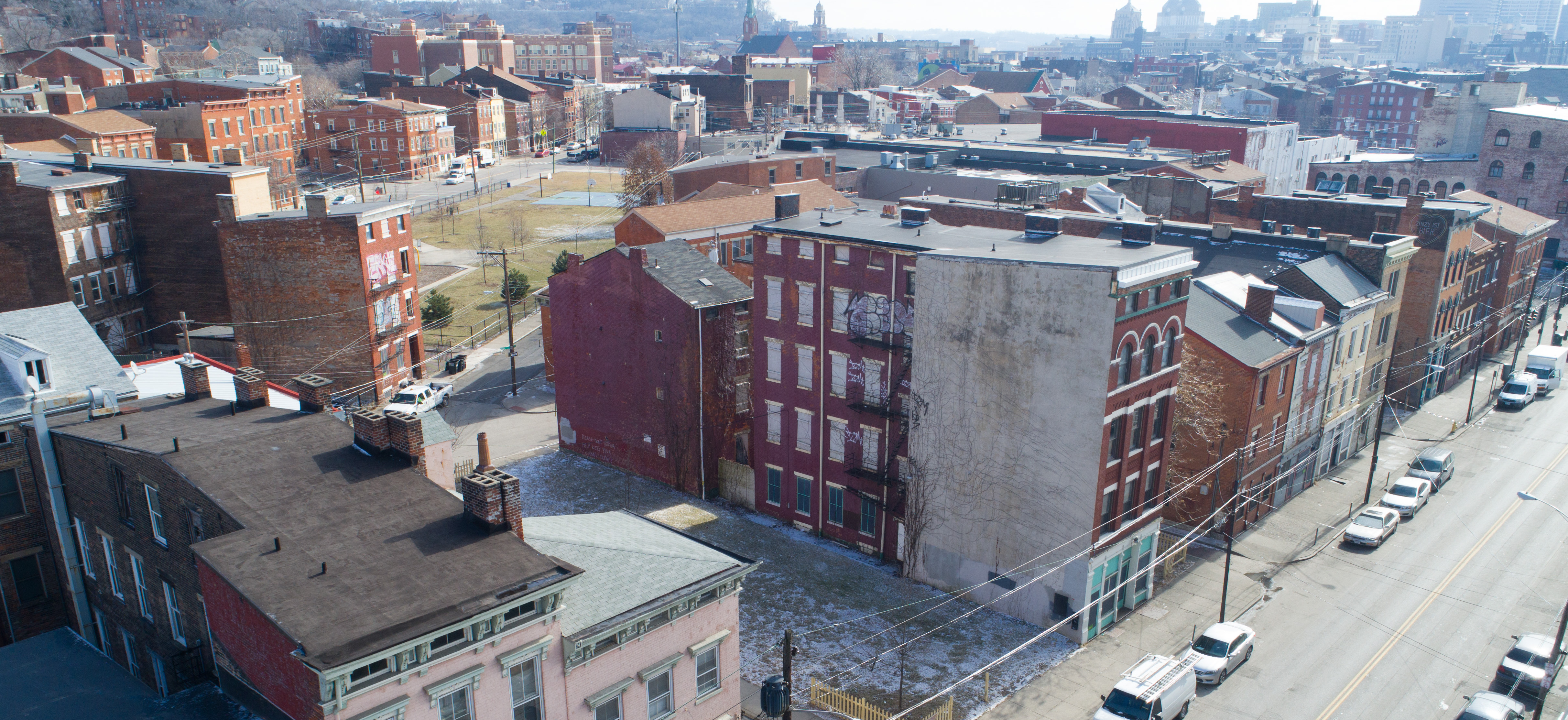
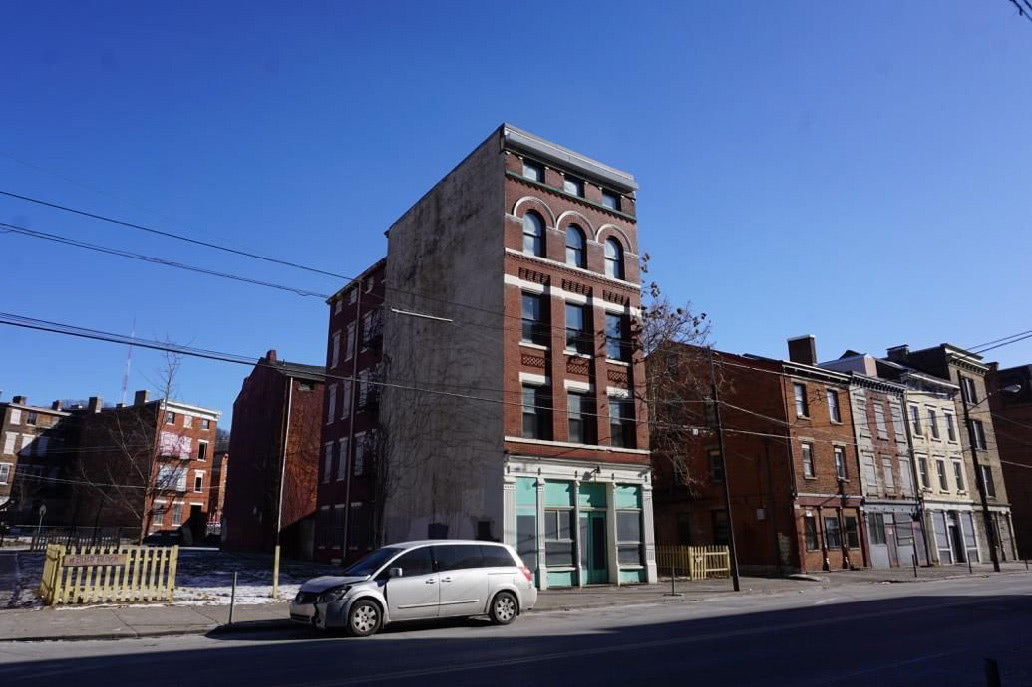
Prior to raising the rest of the money necessary to embark on its major renovations, ETC officials will repaint the building façade at 1127 Vine Street and add new banners to help distinguish the theatre along the busy Vine Street corridor.

“This will help to draw new patrons to our theatre who may not be as familiar with our performing space,” stated Meyer. “We’re truly honored to share this neighborhood with a wide variety of unique restaurants and shop…and hope this next step for Ensemble Theatre will not only propel the organization forward, but will also contribute substantially to the Gateway Quarter’s value.”

Rate of tower construction accelerated in Cincinnati in the 1960s

While 1960 to 1990 is often thought of as a low point for the architecture, planning and engineering professions for a variety of reasons, it turns out it was also one of the more active time periods in terms of construction.

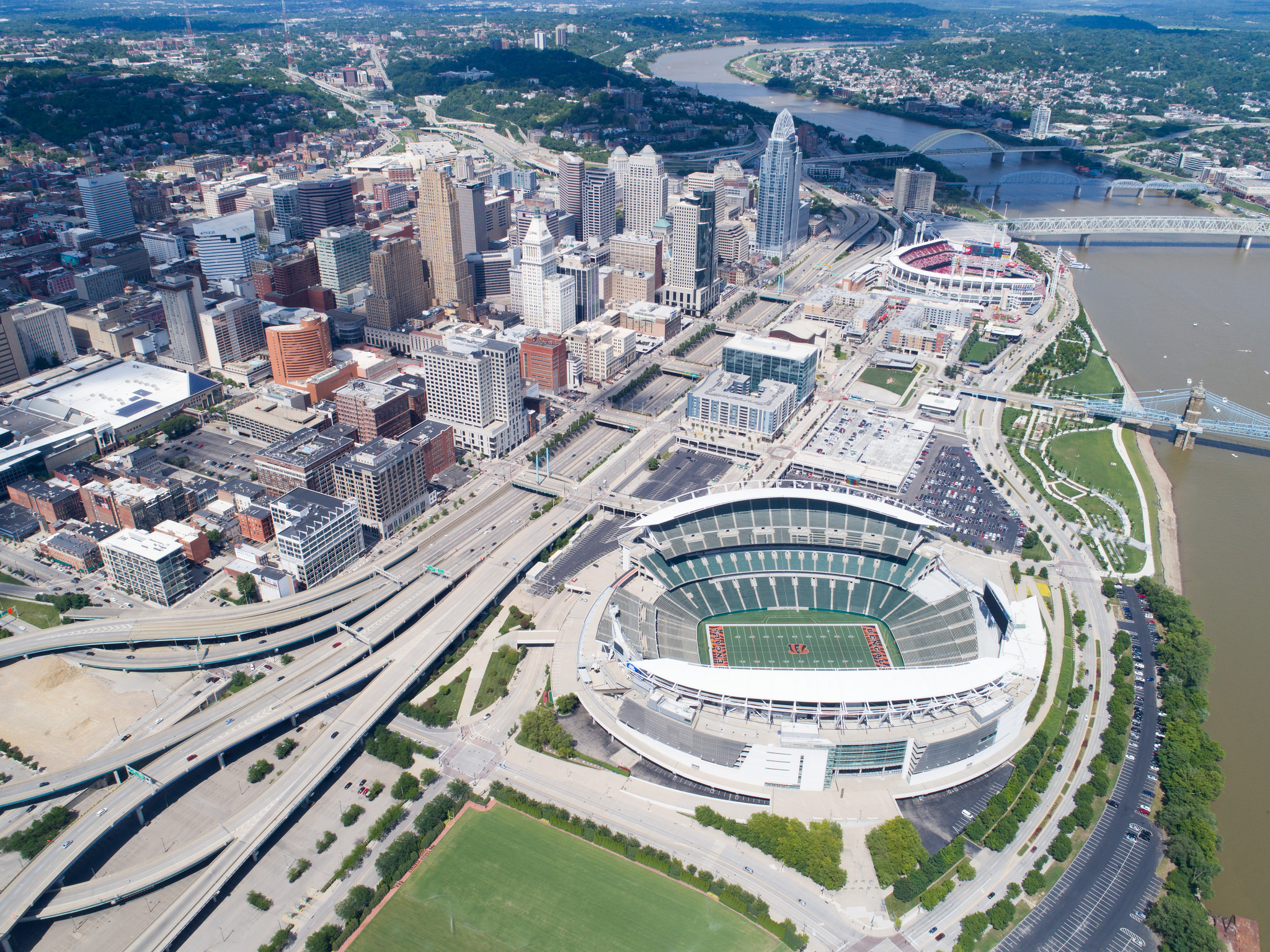
Cincinnati is well known for being an old-growth city that acquired its urban form either during the 1800s or early 20th century. But the central business district that defines the city’s skyline, and thus the region’s national and international image, was largely built during that time frame.

While researching contemporary boom periods in Cincinnati, UrbanCincy dove a little deeper into the data and broke down the construction trends for buildings over 100 feet (8-10 floors) in height. While much growth occurred during the 1800s, only three structures over 100 feet were constructed during that century – Roebling Suspension Bridge, City Hall and the Shillito Building.

There was an initial surge in construction of buildings with this minimum height from 1900 to 1929 which included the construction of 35 such structures. There was then a lull from 1930 to 1959 as global wars took their toll on domestic building projects. Cincinnati then went on a three-decade surge of high-rise construction that included 61 new towers at least 100 feet in height.

Since 1990, the trend has been fairly steady with an average of eight new towers being constructed each decade. While analyzing contemporary patterns, it appeared as if Cincinnati was on a trend to exceed that average set by the past 30 years.

The region is barely into the next decade, but two towers of more than 100 feet have already been completed including the city’s new tallest tower. There are also plans on the books to construct another six towers (TBD Hotel at The Banks, Office Tower at The Banks, dunnhumbyUSA Tower, Christ Hospital Research Tower, Children’s Hospital Research Tower, Holiday Inn Hotel & Suites) in the near future.

Additionally, there is a strong likelihood for more tower construction through other lingering development plans (SouthShore 2, Hotel at Horseshoe Casino, Ovation, One River Place).

Tower construction in this decade may indeed surpass recent averages, but the large share of new construction in Cincinnati is actually made up of low- to mid-rise structures. What do you think…has the trend towards skyscrapers begun to wear off in favor of more human-scale development?

Streetcar first step in Mayor Mallory’s regional rail transit vision

Last night Cincinnati Mayor Mark Mallory (D) shared some exciting information regarding the future of rail transportation in the Cincinnati region in his State of the City address. First he announced that Spanish-based Construcciones y Auxiliar de Ferrocarriles (CAF) had been selected to design and construct the first five streetcar vehicles for the Cincinnati Streetcar project currently under construction. Then, he revealed a conceptual vision of what the future of regional rail could look like in Cincinnati.

CAF is a well-respected international manufacturer of streetcars and light rail vehicles, and competed against four other companies who responded to the City’s request for proposals sent out in September 2011. Project officials say that representatives from the City, Metro and other transportation experts based their design selections on a combination of technical specifications, power needs, physical dimension, cost and the ability to travel up the Vine Street hill.


Mayor Mallory touted a new regional rail transit vision for Cincinnati at his seventh State of the City Address.

As city spokesperson Meg Olberding explained, “We wanted to select a company that had both previous experience with streetcars and light rail vehicles as well as was the most cost competitive. We will be the first city in the country to have these streetcars.”

The streetcar team did reportedly consider the use of battery powered streetcars, to avoid any overhead wires, but in the end decided that the electric vehicles save on cost.

One of the most important aspects of the modern streetcar vehicles is their “low floor” feature along the entire length of the streetcar. The low floor is the section of the streetcar that is most level with the curb of the streetcar station, and thus provides significant benefits for handicap accessibility, bicyclists, and people with strollers. Whereas other streetcars have only a small section that is low floor, the CAF streetcars are 100 percent low floor, meaning even greater access for people with wheeled transportation.

Project officials say that the next steps are ensuring manufacturing of the vehicles is done in the United States, and meets ‘Buy America’ standards with at least 60 percent of the materials sourced from the U.S. as well. Officials believe that the first standard has already been met since the vehicles will be built at CAF USA’s Elmira, NY facility.


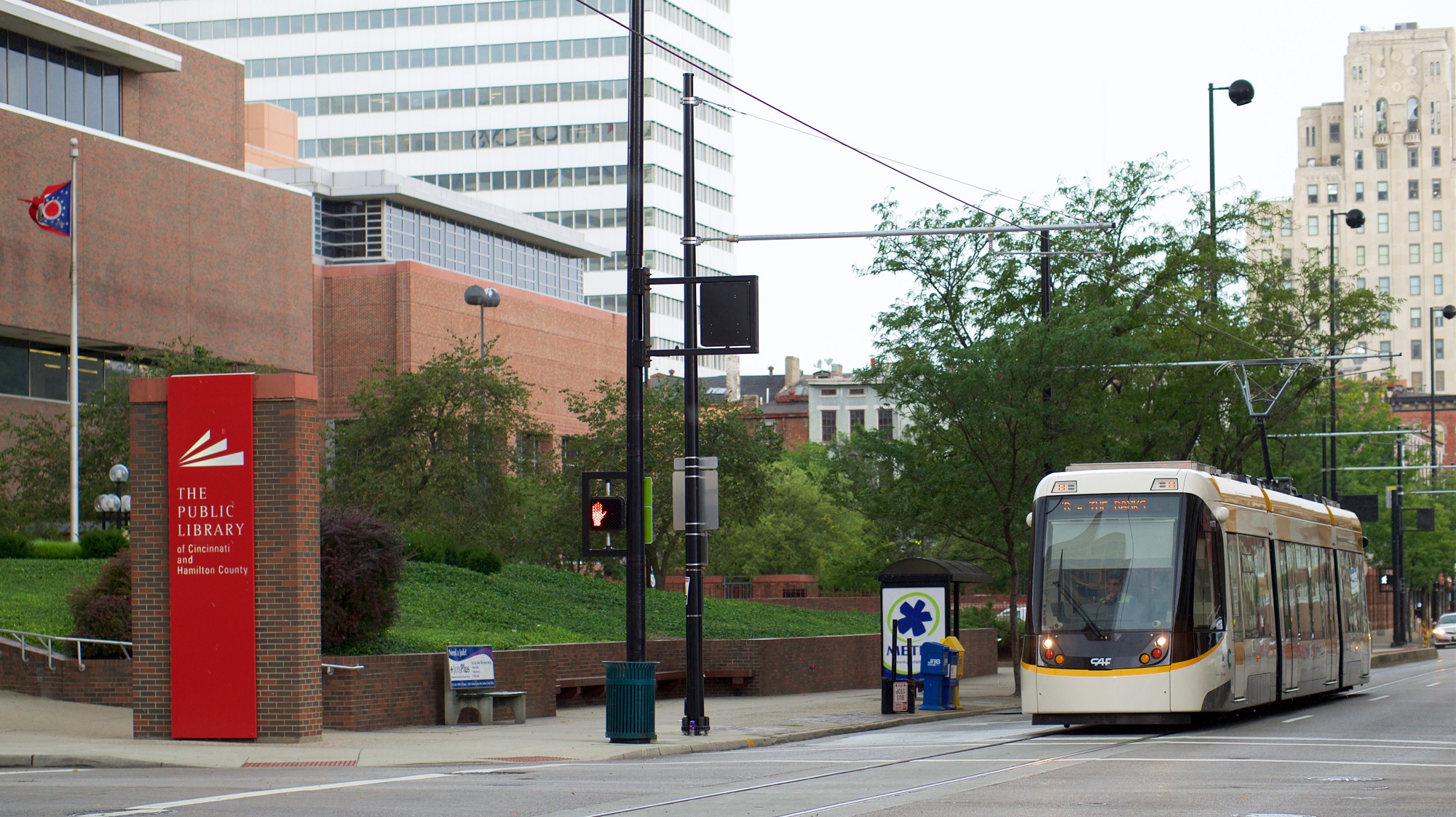
CAF USA’s modern streetcar design for Cincinnati will be the first of its kind in the United States.

Two basic paint schemes have been distributed for illustrative purposes, and city officials note that no final paint schemes have been determined.

While the mayor touted a vision for rail transit in Cincinnati during his seventh State of the City address, he also noted that the City has been actively pursuing funding for the next phase of the streetcar route to extend uptown. This includes a $1.2 million grant application under the Federal Transit Administration’s New Starts program. Should the City receive those funds, officials say work will begin on studying the appropriate alternatives for an uptown circulator route to be built after the Uptown Connector route is constructed along Vine Street.

As for light rail and commuter rail, the Mayor’s plan is looking even further down the road.

“It’s a vision of the future,” Olberding stated. “Growing our transportation options [beyond the streetcar] is a regional conversation we are willing to have.”

Mayor Mallory highlights successes, commits to transit in seventh State of the City address

Mayor Mark Mallory (D) focused on the positives during his seventh State of the City address, and he challenged Cincinnatians to get involved in projects or policies they want to see become reality.

As part of that challenge, Mayor Mallory identified a formula for success built on five elements – pride, commitment, investment, partnership and promotion.

“Every neighborhood should celebrate its own history,” Mayor Mallory urged during the roughly 47-minute address. “We need to do more to celebrate our history in order to create more pride in Cincinnati. Pride inspires people to commit to improving our city. Pride also gets people to invest in making this city a better place.”

Mallory then turned his attention towards the region’s urban core and defended why his administration focuses so much on time and energy there saying it is the economic engine for the entire region.

“There is no West Chester without downtown Cincinnati. There is no Mason without downtown,” Mallory exclaimed. “There is no sub without the urban…it all works together. A strong and healthy and vibrant downtown Cincinnati benefits the entire region.”

Mallory drove the point home by categorically identifying downtown Cincinnati as a success story which has landed several new headquarters recently, and has seen dunnhumbyUSA grow from a staff of three employees in 2003 to a projected staff of 1,000 employees in 2014.


The design of Cincinnati’s modern streetcar vehicles (coloring scheme not final).

The mayor continued by saying that the many companies and residents moving to the region’s urban core are doing so because of the investments being made by City Hall. One of the most high-profile of these investments is the Cincinnati Streetcar, which the mayor highlighted and identified a five-phase expansion plan in conjunction with two regional light rail lines.

The future phases of modern streetcar extensions include a route running from Over-the-Rhine to Uptown, a line running from Uptown to Walnut Hills, a center city loop serving Newport and Covington, and a line extending from Over-the-Rhine to Union Terminal. The two regional light rail lines would service the I-71 and I-75 corridors.

Mayor Mallory then took the opportunity to announce that Spanish-based Construcciones y Auxiliar de Ferrocarriles (CAF) will manufacture Cincinnati’s five initial modern streetcar vehicles at their United States facility in Elmira, New York.

“Before we are even finished with the first phase, we have started work on the second phase,” Mallory revealed. “I have already asked for federal funds to study which route will be used to connect to our assets in the uptown area like UC, the hospitals, the zoo, and the EPA.”

The mayor shifted directions and emphasized the importance of public safety, using recent progress in Over-the-Rhine as success stories.

“It used to be that on Sunday mornings people would come to Over-the-Rhine to buy a week’s worth of drugs,” said Mallory using the Gateway Quarter as his example. “Now, on Sunday mornings, people come to Over-the-Rhine to eat check and waffles at Taste of Belgium.”

Mayor Mallory concluded the speech by highlighting the importance of becoming a more global city to the crowd of more than 350 people.

“In China, they are talking about our emergency preparedness. In Saudi Arabia, people are looking at Cincinnati for potential business investment. In Germany, people are talking about our cutting edge efforts in the area of sustainability. And right now, all over the world, people are talking about the World Choir Games.”

“We have created an international presence, and because of that buzz, we were able to attract the World Choir Games. Make no mistake, this is the greatest opportunity to showcase the city that we have ever had…and we earned it.”

Cincinnati Mayor Mallory heralded as national leader in smart growth movement

Smart Growth America recently produced a series of video interviews with mayors from around the United States. The series, officials say, is intended to highlight prominent elected officials that are taking on leadership roles in promoting smart growth.

The first of those videos features Cincinnati Mayor Mark Mallory. In the video, Mayor Mallory discusses the need to invest in urban centers and make smart infrastructure investments that will trigger job creation and community development.

Specifically, Mayor Mallory touts the recent completion of phase one work at The Banks and ongoing revitalization success in Over-the-Rhine. The approach being taken by Cincinnati is one that intrigued officials at Smart Growth America.

“Thinking about land-use, transportation, housing, environmental, economic development and city planning, and redevelopment projects holistically can be challenging,” Thomas Madrecki from Smart Growth America told UrbanCincy. “But the rewards are that much higher, because when executed successfully, all of those pieces of the puzzle are working together.”

Madrecki says that once that initial buy-in is achieved at a local level, support for smart growth projects like the Cincinnati Streetcar becomes a better reality. Accomplishing that initial task, however, does not necessarily mean that funding and regulatory issues will not also pose problems.

“In a place like Cincinnati, I think that’s very obvious, where you have something like the streetcar take longer to get off the ground because of withdrawn funding promises,” said Madrecki. “Smart growth strategies often require upfront investments that will engender future economic gains while saving the city money on infrastructure and utility costs, but it takes money and the political will to deal with setbacks and opposition.”

Madrecki continued by saying that Mayor Mallory has shown the latter quality in spades, and has quickly become a national leader in the smart growth movement.

As Cincinnati moves forward with additional phases of development at The Banks, and additional renovation work in historic Over-the-Rhine, smart growth champions believe that even additional investment will be needed in Cincinnati’s urban core to help those respective neighborhoods reach their full potential.

One of the greatest challenges going forward for a Midwestern city like Cincinnati will be maintaining the momentum built by Mayor Mallory’s steadfast approach.

“Everyone likes to talk about the ‘next thing,’ but there has to be an element of seeing things to fruition and making sure they fully develop. When that happens and people see the economic and community payoffs, I think it will set a precedent and make future endeavors more likely to succeed right away.”

City’s latest CED designation supplies Northside with creative new growth tools

This post originally ran on CincyVoices, and was written by guest contributor James Heller-Jackson.

With its eclectic mix of locally-owned businesses, the Northside neighborhood is already known as a prime Cincinnati food, retail and arts destination in the region. Empty storefronts that would also make great restaurants have remained largely empty because of the lack of liquor license availablity- until now. On February 29, the Cincinnati City Council voted to give Northside “Community Entertainment District” status after a unanimous vote the day before by City Council’s Livability Committee. The neighborhood joins Price Hill and Pleasant Ridge with CEDs. Once the designation is in place it allows new restaurants to open with a liquor license, thus reducing startup costs by an estimated $30,000.

This is a huge win for Northside. For the last couple of years, Northside’s business district, while hanging in there in the midst of the biggest economic downturn since the Great Depression, has had to turn away small businesses wanting to open in the neighborhood, merely because of the lack of liquor licenses available and the premium $30,000-plus cost of the very few licenses that were available on the open market.

The new designation changes that game. The Northside Community Entertainment District designation gives creative tools to the Northside neighborhood to enable new growth. Rather than a business having to reach out to a broker to maybe, just maybe, find a license at a relatively huge cost, a process that often takes years, they can now call the State of Ohio directly. In Northside’s new Community Entertainment District, up to 15 additional liquor licenses are immediately available to food establishments, all at a dramatically reduced cost of $1,500, and all directly available from the State with no outside brokers involved. These licenses are not transferable. If the business with the new license were to move out of the Northside district, they would forfeit that license. These licenses are not available to a business that only wants to open a bar; these are licenses that are available only to food establishments. This is helpful for Northside and small businesses.

The original 2005 Community Entertainment District legislation was not initially geared towards anything but for-profit developers to obtain. Last year, the not-for-profit Pleasant Ridge Development Corporation could not the CED’s original application fee of $15,000. Many thanks go to Cincinnati City Councilmember Laure Quinlivan, who worked hard to change the Cincinnati municipal code to make the fee downwardly flexible, thus opening the possibility of designation to not-for-profits. This change to the fee structure allowed Pleasant Ridge to apply for the status without outside funding, making Pleasant Ridge the first Cincinnati neighborhood to apply for and win the designation.

Already, Pleasant Ridge has new businesses that wouldn’t be there if not for that designation. As well, the neighborhood of Price Hill recently won CED status, and several new businesses have either already opened or they are about to open. So far, the two neighborhoods that have won the designations have benefited immensely. Over-the-Rhine, Madisonville and Westwood have also applied for Community Entertainment District status but have not yet received it.

Northside Entertainment District Map

Northside’s new Community Entertainment District covers not just the traditional business district, it also targets a wide area south of Blue Rock Street.

The Northside Business Association (NBA) first started working with Laure Quinlivan’s city council office early last year after hearing of the possibility of Northside applying for and winning this important designation; the designation would not have been possible without Laure and her staff’s efforts. Also, Berding Surveying needs to be thanked, as they donated their services to the effort to produce the required survey and map. Once Northside’s required application package was completed, as a matter of transparency, the plan was presented at open Northside Community Council and Northside Business Association public meetings for comment. Community support was widespread, and the package was sent along to the city council’s Livability Committee for consideration.

NBA president Isaac Heintz has this to say about the designation: “The Northside Business Association pursued the entertainment district designation to provide Northside with another tool to help retain existing businesses and to attract new ones. The designation of the entertainment district can only help to continue the positive trajectory of the neighborhood and the growth of the Northside community.”


Northside’s “South Block”, along Spring Grove Avenue, is ripe for redevelopment. The Landman Building, right, was recently stabilized and environmentally remediated and is ready for build-out. The building just to the left is now a LEED Silver building with several newly-occupied residential and business condos.

The new district covers much of the existing Northside business district along Hamilton Avenue from the Ludlow Viaduct in the south to just below the Northside Library in the north. In the southern end of the district, Blue Rock Street and Spring Grove Avenue are both included, roughly from Colerain Avenue on the west side, to Crawford Avenue on the east.

There are currently a lot of existing empty storefronts and industrial spaces in the new entertainment district’s map. Residents and small business owners in the area would love to see that change. Imagine once-forlorn Northside blocks now teeming with urban life. By enabling these new licenses, the hope is to see more development in the district. This new development will include not only the new food establishments benefiting from the designation, but additional retail, arts, office and residential spaces, all serving to increase the vibrancy, diversity and uniqueness of all that is Northside.

James Heller-Jackson is a Northside resident and a member of the board for both the Northside Business Association and Northside Community Council. Pictures provided by the Northside Business Association.

Parking mandates stymy development in Cincinnati’s urban neighborhoods

Downtown Cincinnati is home to five Fortune 500 companies, three professional sports teams, local businesses, and according to the 2010 U.S. Census, about 5,300 residents. But the area is also home to more than 35,000 off-street parking spaces.

These spaces once held historic buildings but have been demolished to provide automobile parking over the years. As downtown continues its resurgance, it would be prudent for city leaders to review its outdated parking policies.

In the middle part of the 20th century, many cities, including Cincinnati, developed zoning codes with regulations dictating how many parking spaces are required for different uses. The regulations often accounted for “peak demand,” which is the amount of parking planners believed would be needed at times where demand for parking would be the greatest. For example, accounting for Black Friday-type events where parking lots are only maxed out once or twice a year.


Hundreds of brand new parking spaces in downtown Cincinnati’s Central Riverfront Garage sit unused. Photograph by Randy A. Simes for UrbanCincy.

In his article, The Trouble with Minimum Parking Requirements, UCLA professor Dr. Donald Shoup writes, “Minimum parking requirements are intended to satisfy the expected peak demand for parking at every land use–at home, work, school, banks, restaurants, shopping centers, movie theaters, and hundreds of other land uses from airports to zoos. Because the peak parking demands at different land uses occur at different times of the day or week, and may last for only a short time, several off-street parking spaces must be available for every motor vehicle.”

The demolition of buildings that are mostly historic is also a concern as downtowns struggle to build parking infrastructure that is required by code. Those demolitions, oddly enough, systematically demolish the very things that distinguished them from the suburbs and made the area an appealing destination.

In Nashville, TN, city leaders first removed parking requirements for older buildings, and then moved to remove parking requirements for all buildings in their city center.

“Requiring parking for historic structures that have never had parking is incentivizing their demolition. This puts the property owner in a really difficult position; he must either find parking for the building, demolish it or let it languish in perpetuity.” Nashville city planner, Joni Priest, told UrbanCincy. “If a property owner wants to rehab an historic building – a building that marks the character of a neighborhood and contributes to the fabric of the city – all incentives, including the elimination of parking requirements, should be considered.”

Parking mandates also increase the upfront cost to developers looking to invest in urban neighborhoods. Additional land, often still occupied by historic buildings, must be purchased in order to provide the required parking spaces at approximately $10,000 to $25,000 per space, depending on land and architectural fees. Those costs are then passed on to the consumer, making urban living or starting a small business more expensive.


Contemporary parking mandates can make it nearly impossible for developers and city planners to build neighborhoods like Over-the-Rhine any more. Photograph by Randy A. Simes for UrbanCincy.

Parking requirements also have impacts that are not quite as obvious. Increased parking capacity, in theory, increases the amount of cars in the given area and puts an added burden on downtown streets. Even though the traditional grid pattern is ideal for dispersal of traffic in urban settings, downtowns are ideally designed to accommodate people. Cities that add parking, or widen streets for automobiles, do so at the expense of pedestrians.

Even as city leaders work to implement a plan to increase downtown vibrancy through additional residential space and increased foot traffic, concern for parking punctures the debate on how to further support the urban core.

The urban parking analysis UrbanCincy conducted in 2010 identified many of these problems, but no significant action has been taken to-date aside from the reduction of parking needed to be provided along the Cincinnati Streetcar route.

City leaders need to seriously reexamine their policies on the matter, and they could get started by discussing the following three potential solutions:

  1. Eliminate Parking Mandates – As city leaders were able to do in Nashville, we believe Cincinnati leaders could do the same and remove the minimum parking requirements forced upon investors in the city’s urban core.
  2. Cap and Trade System – First proposed by UrbanCincy in 2010, this innovative system has been implemented in several European cities such as Amsterdam, Hamburg and Zurich. Regulations are designed to limit the total number of parking spaces in an urban area, and provide incentive bonuses while limiting parking. Parking spaces are created on a case-by-case basis and often involve repurposing on-street parking spaces for other uses such as community gardens or parks.
  3. Set Parking Maximums – Instead of dictating a minimum, parking requirements are capped by use or developed density. This strategy has been employed in New York City where development of parking has been limited in an attempt to reduce the impact of automobile traffic on the already densely developed island of Manhattan. Parking maximums seem to work with the availability of alternatives to driving. Therefore; if Cincinnati were to pursue this route, it should be in conjunction with the implementation of more efficient alternatives from Metro including expanding streetcar routes, light rail and bus rapid transit alternatives.

While the need for reform appears evident, a contextualized solution should be pursued by Cincinnati city officials that specifically tailors the policy to localized needs. What may be most important is offering flexibility to small businesses and investors who are looking to invest in Cincinnati’s urban core.

“Removing the parking requirements from downtown zoning allows flexibility for site-specific and program-specific solutions,” said Priest. “Flexibility is key in urban environments. As downtown becomes more comfortable for pedestrians, cyclists and transit users, new development will have the flexibility to build less parking.”