Categories
Business News

Walnut Hills tries new approach to keep its neighborhood grocery store afloat

One-by-one, Cincinnati’s urban neighborhoods are revitalizing themselves with new residents and businesses. Some of these neighborhoods, however, continue to struggle with sustaining or attracting urban grocery stores that can bring much-needed healthy food choices to their community. Walnut Hills is no different.

Walnut Hills is one of just seven, out of 52, neighborhoods in the City of Cincinnati that boast a full-scale grocery store. The Walnut Hills Kroger, located at 954 E. McMillan Street, has been in discussions with city leaders over recent years about whether it will continue operating that location. But with revitalization work sweeping through the Walnut Hills, neighborhood leaders think this serves as an opportunity.

“We understand that as a business they need to make money, and once we have done our part, and they are a profitable store, then we hope they will begin to make some of the improvements that the neighborhood would like to see,” said Kevin Wright, director of the Walnut Hills Redevelopment Foundation (WHRF) and graduate of the University of Cincinnati’s Masters of Community Planning program.


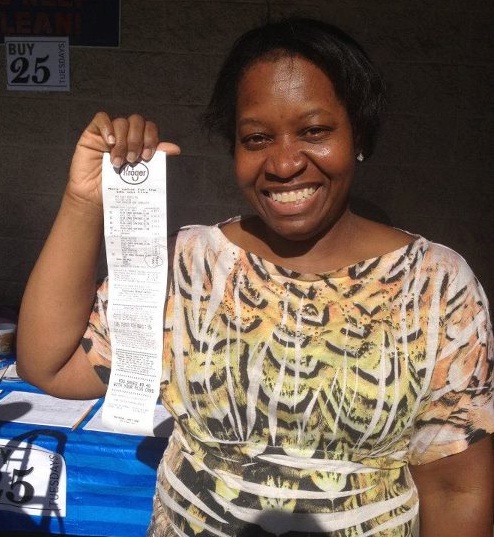
Organizers say the first Buy 25 Tuesdays event generated $2,700 in new revenue and communicated over 100 food suggestions to store management. Walnut Hills Kroger photograph provided.

Wright says that after speaking with neighborhood residents and stakeholders he found that most had a negative perception of the store. He said that the perceptions are that store has a bad food selection, and that it is unsafe to visit. The goal, he says, is to solve both of those issues through a new bi-weekly event called Buy 25.

The first Buy 25 took place on June 26, and the second was scheduled to take place on July 10, but due to the power outage organizers have postponed the next event until July 24. Those who join the Buy 25 group are encouraged to spend $25 at the store at least the two times a month that the event takes place.

Wright says that through discussions with Kroger, a neighborhood committee found out that $10,000 in additional revenue per month can put the urban grocer into the black. That breaks down to approximately 200 new customers spending $50 a month at the Walnut Hills store.

Neighborhood leaders are hoping to create a social atmosphere outside of the Kroger on Buy 25 Tuesdays by providing music, food samples, coupons, and a chance to give feedback to store management.

“This is about improving the Kroger, but it’s also about coming together as a community for a common cause,” explained Wright. “Walnut Hills is on the verge of some major redevelopment and if our residents feel like they have an ownership in that, the overall redevelopment efforts will be more sustainable.”

According to the WHRF, the first Buy 25 event brought in an additional $2,700 in revenue for the Walnut Hills Kroger. Neighborhood leaders feel like the new event is off to a good start, but are aware of the potential risks should they not be able to meet the $10,000 target over the course of each month.

“Becoming a food desert would have a profound effect on our senior and low-income population,” Wright answered in response to the possibility of the store closing. “It would also have a negative effect on our redevelopment momentum as the Kroger sits almost directly in the center of the neighborhood and its business district.”

Wright says that he fears that while the neighborhood can support grocery store, that if the Kroger were to close it would take at least three to five years to attract a new urban grocer. And having a large vacant structure at the heart of the Walnut Hills neighborhood business district for several years would create additional hurdles to ongoing redevelopment efforts taking place there.

Neighborhood leaders have not yet been told, or warned, that the Kroger may shut down, but Wright emphasized that they are trying to support the store and give it every reason to stay in the community.

Buy 25 Tuesdays take place on the second and fourth Tuesday of every month from 4pm to 8pm. Those who come are encouraged to bring a shopping list so that they can inform store management of items they were not able to purchase there.
Categories
Arts & Entertainment News

OTR Flags installation aims to unite inner-city neighborhood through art

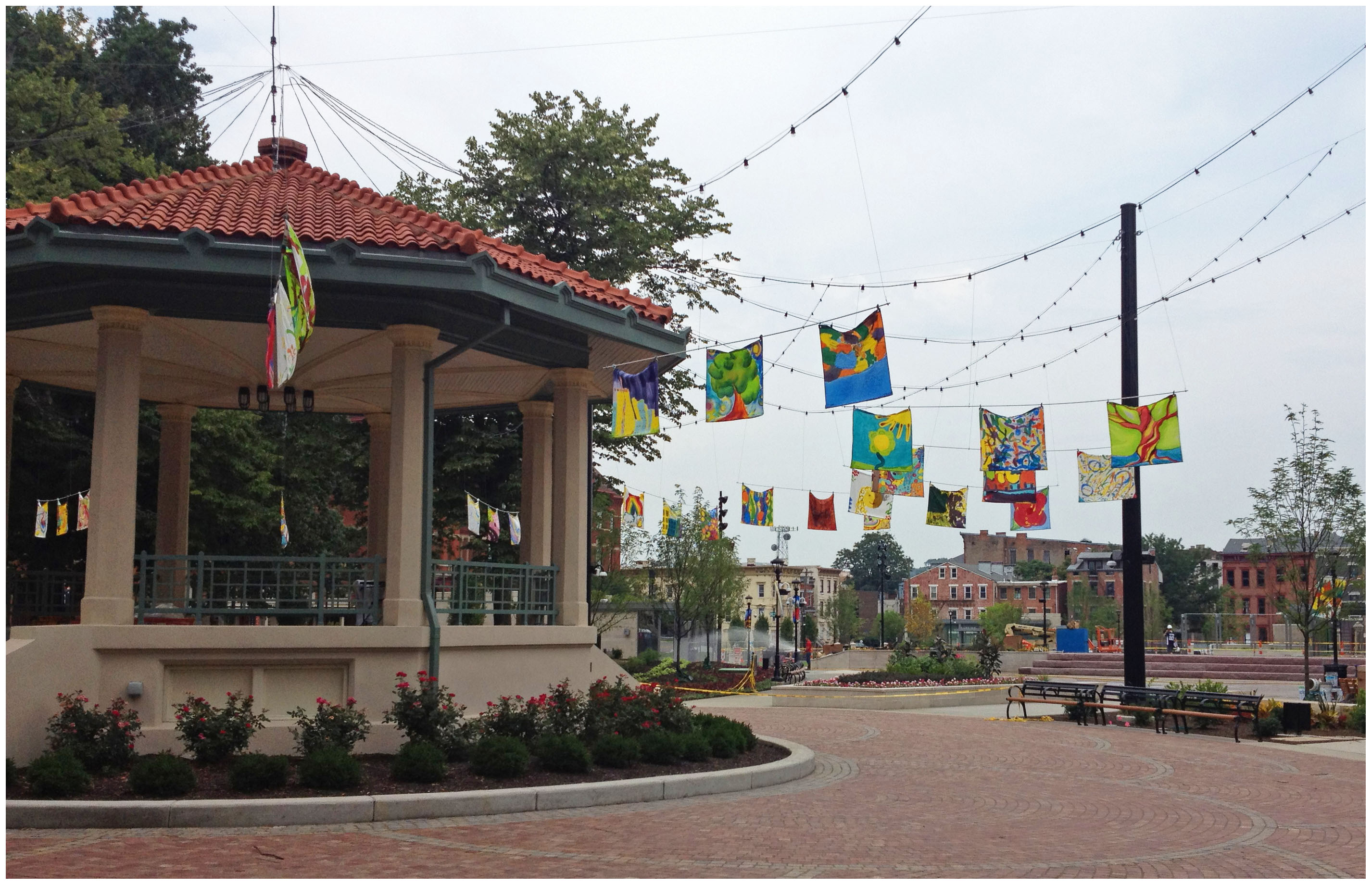
Hundreds of brightly colored squares of silk ripple in the breeze amid the trees of the newly renovated Washington Park. Each square tells a story of a person or organization somehow intertwined in the past, present, or future of the Over-the-Rhine community. Furthermore, the OTR Flags project is the first public event celebrating the re-opening of the 157-year-old park.

Though the grand reopening of the park is heralded as a triumph, it brings with it lingering memories of crime, homelessness, and drug dealing that plagued the area over recent decades. Some organizations and people had trepidation surrounding the renovation – that not everyone would get to share in the joy of the new space.


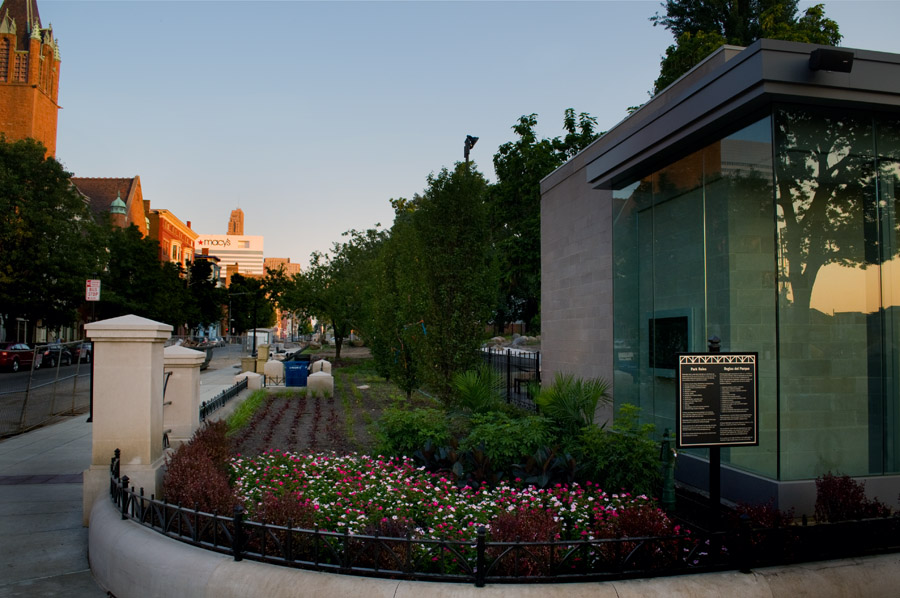
OTR Flags installation in Washington Park. Photograph by Jenny Kessler for UrbanCincy.

In an effort to help bridge the proverbial divide between old and new residents, local artist and resident Angela Morrow teamed with Joan Kaup in 2009 to create the public art project with the goal of uniting the diverse neighbors of Over-the-Rhine and encouraging communal ownership of Washington Park.

“There’s still some tension, with old residents, new residents, black and white, rich and poor,” said Morrow. “Art is a safe, positive way to create dialogue. We wanted to bring everyone together and start the healing process.”

Inspired by The Gates installation in New York City’s Central Park, the team developed a plan to unite organizations, artists, and neighbors by creating personalized silk flags to hang in Washington Park. Some 57 organizations contributed in some way – by being a media sponsor, contributing financially, or sponsoring a flag.

Morrow served as the lead artistic director, Kaup worked with development and community outreach, and Nicole Ware, CEO of Emanuel Community Center, oversaw the financials. A committee with representatives from ArtsWave, ArtWorks, Cincinnati Arts Association, 3CDC, Drop Inn Center, OTR Community Council, OTR Community Housing, Society for the Preservation of Music Hall, and YMCA met together to match 17 local artists with 30 neighborhood organizations that combined to create 26 flags.

The artists, ranging from 15-year-old Zoe Kolstaza, a student at the School for Creative & Performing Arts, to Matt Dayler of public art company Higher Level Art, were paid a stipend for their work. Each artist met with eight to ten members of their respective organization and participated in a facilitated discussion about their involvement in Over-the-Rhine.

“This isn’t a marketing ploy for companies,” Kaup explained. “The point of the flags is to tell the story of each participant.”

The final piece of the project came from public workshops where area residents could paint smaller, individual flags illustrating their involvement with the neighborhood. Workshops were held at the Drop Inn Center, Second Sunday on Main, Art Academy of Cincinnati, and Emanuel Community Center.

“At the Drop Inn Center charrette, people were so excited to be able to give something and be a part. Fifteen flags were painted that day,” Morrow told UrbanCincy. “People from the Drop Inn, from the neighborhood, even from an outside group that does ministry in Over-the-Rhine stopped by. The Drop Inn members got to show them how to paint for the first time, they got to give something back, and there was no power play. Everybody was there painting and learning together.”

More than $64,000 was raised with sponsorship money, and after expenses, an estimated $10,000 will be left over. Organizers say they plan to use the extra money to sponsor programming for Washington Park.

OTR Flags will remain on display in Washington Park through September 2012, and a reception will be held to commemorate the exhibit on July 19 at 5pm.

Jenny Kessler is a former UrbanCincy writer and now works for ArtsWave as a Communications Assistant.

Categories
News Opinion Politics

Steve Chabot Attempts to Overturn the Will of Cincinnati Voters

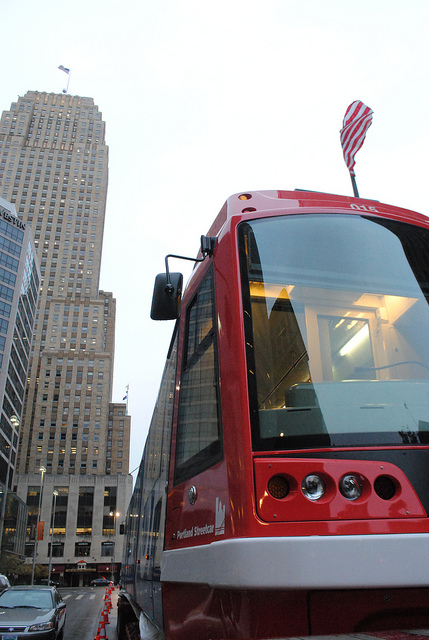
There they go again. After two failed initiatives (Issue 9 and Issue 48) to defeat fixed rail public transportation at the ballot boxes, enemies of the Cincinnati Streetcar project are once again moving to bar the city from completing what has been billed as crucial to the economic development of Over-the-Rhine and downtown. This time they found an ally at the congressional level.

Last week, Representative Steve Chabot (R), Ohio’s District One representative, and native of the west side of Cincinnati coyly inserted an amendment into the Transportation Housing and Urban Development (THUD) bill that would bar the use of federal dollars in funding any project in Cincinnati that is on a “fixed guideway” system. The bill is currently in the Senate where it will be voted on and forwarded to the President for his signature should it pass.

The amendment, which reads, “None of the funds made available by this Act may be used to design, construct, or operate a fixed guideway project located in Cincinnati, Ohio,” is designed as an attempt to stop the Cincinnati Streetcar project. The amendment’s language mirrors that of both Issue’s 9 & 48 but has even broader and more far reaching consequences than either of the two failed ballot initiatives.

According to the Federal government, a fixed guideway is defined as:

Any transit service that uses exclusive or controlled rights-of-way or rails, entirely or in part. The term includes heavy rail, commuter rail, light rail, monorail, trolleybus, aerial tramway, inclined plane, cable car, automated guideway transit, ferryboats, that portion of motor bus service operated on exclusive or controlled rights-of-way, and high-occupancy-vehicle (HOV) lanes.

This broad definition means that not only would the amendment preclude that no federal funding go towards the streetcar project but that federal funds would also be barred from being used towards any improvement of the following city projects:

  • Upgrading the city’s overcrowded freight rail system: The city has previously asked for state and federal funding to add a “fourth main” freight rail line expanding the regions freight rail capacity and reducing the impact of an existing freight rail bottleneck along the three main freight lines adjacent to the Mill Creek. The City can’t even ask for this solution if the amendment goes forward.
  • Development of the city’s Bus Rapid Transit system: SORTA and the City have been conducting studies on implementing BRT on several streets in Cincinnati including Reading Road and Montgomery Road. This amendment will make it impossible for the project to utilize much needed federal funds to buy buses and construct stops and street improvements.
  • Development of the Eastern Corridor and Wasson Line for light or commuter rail: Both of these rail lines would connect downtown to the east side of the city. Without federal funds neither project can even be studied. This includes any study on the possibility of a “Rails and trails” combined bicycle path on the Wasson Line.

This amendment is a poison pill meant to punish the progress of Cincinnati and its revitalizing urban core and overrules and ignores the will of the city electorate. It serves only the shortsighted will of vocal minority and threatens to leave our entire metropolitan region at a competitive disadvantage against other regions as we move towards a 21st century economy.

We strongly urge supporters of transportation infrastructure to write Ohio Senators Sherrod Brown (D) and Rob Portman (R) to remove this overly restrictive language from the THUD bill. Additionally, we encourage supporters of transportation infrastructure in Ohio’s First Congressional District to give Representative Chabot an earful over this callous disregard towards voters in his home district.

Happy Independence Day!

Categories
Business Development News

Washington Park to celebrate grand reopening this Friday

Those who frequently spend time in Over-the-Rhine have dealt with the reconstruction of Washington Park over the past one-and-a-half years.

The $48 million growing pains, project officials claimed, would be worth it as the renovated and expanded park would enhance quality of life while also providing 450 new parking spaces tucked neatly underground beneath the park’s new northern lawn space.


Looking south along Race Street at the nearly finished Washington Park. All Washington Park photographs were taken last week by Jake Mecklenborg for UrbanCincy.

Project and city officials will gather with the community on Friday to celebrate Washington Park’s grand reopening. The moment comes at perfect timing as the World Choir Games, and its thousands of visitors, will begin populating the center city this weekend.

New features of the park include an interactive playground, dog park, open lawn space, performance space, and interactive fountains in addition to the overall upgrades made to the rest of the existing features.

The park’s completion marks the end of an era of change for the area that began with the demolition of Washington Park Elementary School, and included the addition of the School for Creative & Performing Arts (SCPA). Those changes, when combined with the future Music Hall renovation and Cincinnati Streetcar, have led to dozens of nearby buildings being renovated into new housing and commercial space.

Those who have not visited Washington Park in some time may want to check it out during the World Choir Games. The new look and feel of the area may surprise you.

Categories
Business News

UrbanCincy launches new monthly networking event for urban professionals

On Tuesday, July 3, UrbanCincy will host the first of what will become a monthly networking event for urban professionals. The event, called URBANexchange, will take place from 5:30pm to 7:30pm on the first Tuesday of every month at the Moerlein Lager House.

URBANexchange is meant to not only engage active urban professionals, but also those who have a general interest in urbanism and want to exchange thoughts and ideas with others with similar passions. The event will be casual in nature and is meant to serve as a place to exchange ideas and build personal networks.


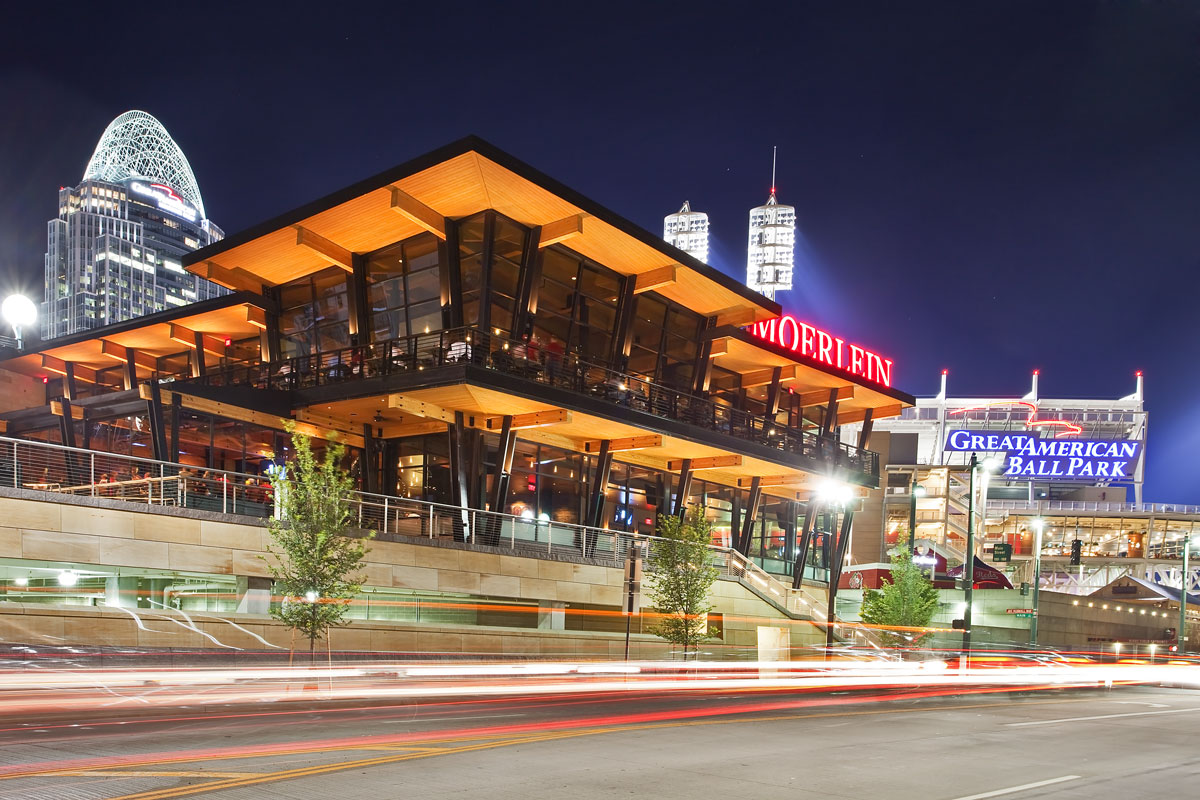
The Moerlein Lager House along Cincinnati’s central riverfront. Photograph by Cory Klein.

UrbanCincy has partnered with The Urbanists, who previously helped foster iRhine, to activate the region’s network of individuals interested in continuing the urban renaissance taking place in Cincinnati.

“In previous years the collection of engaged urbanists in Cincinnati has grown, but it has largely been focused in center city neighborhoods,” explained UrbanCincy owner, Randy Simes. “This event is meant to serve as a gathering place for urbanists throughout the region in an effort to grow that base of individuals advocating for better public policy.”

The inaugural event will take place at the Moerlein Lager House’s second-floor bar overlooking the new Smale Riverfront Park and historic Roebling Suspension Bridge. Thanks to Metro, those who sign-in will have a chance at winning four tickets to the World Choir Games’ Champions Concert on Saturday, July 14.

Future URBANexchange dates will be announced on UrbanCincy.com and through Facebook. URBANexchange is free and open to the public, and those attending are encouraged to use Metro bus service to get to the Moerlein Lager House and the World Choir Games should you be the lucky winner of the free tickets.