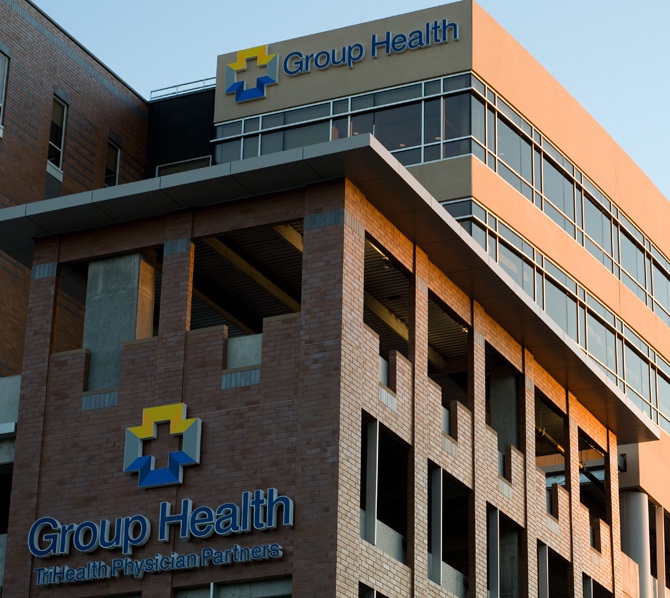
Group Health moves into new $27 million tower in Clifton

Group Health Associates is celebrating the opening of their new $27 million medical office building in Clifton today. The eight-story tower is connected to Good Samaritan Hospital at Clifton Avenue and Dixmyth Avenue. The existing building, located approximately a half-mile down the street at the corner of Martin Luther King Jr. Drive and Clifton Avenue, is scheduled to be imploded this September.

Both Group Health Associates and Good Samaritan Hospital are divisions of TriHealth, and TriHealth President and CEO, John Prout, reiterated the company’s’ commitment to servicing the urban core and contributing to Uptown’s vibrancy.

“This investment is part of TriHealth’s ongoing commitment to Uptown as a vibrant community, business center, education center, and medical hub for the region,” Prout told UrbanCincy. “And I add my thanks to all the private and public partners who helped make this a reality.”


Group Health’s new Clifton facility sits next to Good Samaritan Hospital along Dixmyth Avenue. Photograph by Jake Mecklenborg for UrbanCincy.

The 67,000-square-foot facility had been under construction since early 2011, and is considered to be state of the art. Individuals passing on the street will notice that the medical tower sits atop a five-story parking garage, but individuals using the facility will reportedly experience better access to physician specialists, a full service pharmacy and more integrated services as a result of being located on the Good Samaritan campus.

According to Group Health officials, the medical group will also begin offering neurology as a specialty and plans to add ten more physicians to round out the facilities services in September.

Construction of the new medical facility was made possible by low-cost financing from the Uptown Consortium through its Uptown Partners’ Loan Pool.

The land, however, was not readily available until the $4 million realignment of Dixmyth Avenue in 2006. Previously, the street had been located further south, with homes along its northern side. The street’s realignment made Good Samaritan Hospital’s recent expansion possible, along with the construction of the new Group Health facility.

The controversial road realignment eventually took 28 residential properties through the use of eminent domain, and was upheld in court against one hold out, Emma Dimasi. The project was seen as controversial at the time because while city officials claimed the realignment was for safety purposes, others speculated that it was to free up additional land next to the then constrained Good Samaritan Hospital site.

Just one year after the realignment of Dixmyth Avenue, in 2007, Good Samaritan commenced construction on a ten-story patient care tower.

Health care professionals say that the rapid expansion of health facilities is a response to the growing demand placed on the region’s health care system by an aging population. The issue of aging and expanding health care has been the subject of numerous studies highlighting this trend on the national and global scale. Regionally, it has justified the expansion of the hospitals in Uptown’s “Pill Hill”, including expansions at Cincinnati Children’s Medical Center and University Hospital in Corryville, and Christ Hospital in Mount Auburn.

The expanding local hospital system is offering improvements in health care services for the region’s aging population, and creating thousands of new high-paying jobs. At the same time, however, it is coming at the expense of historic neighborhoods and entire blocks of residential housing.

Such a tradeoff might be good for city coffers, but it will certainly do nothing to directly help Cincinnati’s ongoing struggle with population loss.

Germans dominate ethnic makeup of Ohio cities

What may be unsurprising to many locals, new U.S. Census numbers confirm that German-Americans make up the largest ethnic group in the Cincinnati region. Analysis shows that approximately 28% of Cincinnatians responded that have German roots, which is more than Ohio’s two other major cities (Cleveland 17%; Columbus 23%). More from The Business Journals:

German-Americans form the largest ethnic group in the United States — 45.7 million persons. But their prominence is even more striking when viewed at the local level. On Numbers has analyzed ancestry data for every metropolitan and micropolitan area covered by the U.S. Census Bureau’s 2010 American Community Survey. German-Americans are the biggest ethnic group in more than three-fifths of those markets — 580 of 942.

Cincinnati’s decades-long population loss may be stabilizing

After the Census Bureau delivered sobering population numbers to city officials as part of the 2010 Census, it now appears that Cincinnati’s population loss may finally be stabilizing. More from the Cincinnati Enquirer:

New estimates released calculate that Cincinnati now has 296,223 residents, for a decline of 0.2 percent from April 1, 2010, to July 1, 2011…The 2010 Census showed Cincinnati lost more than 10 percent of its population from 2000, falling below 300,000 people for the first time in more than a century.

Census accuracy report shakes up municipal challenges

Mayor Mark Mallory (D) has been consistent in his questioning of Census counts of Cincinnati. After winning challenges leading up to the 2010 decennial Census, city officials had reason to believe the numbers would come back better. They did not. And according to a new audit, it appears that it may have been a good move to not file a challenge of the 2010 results. More from The Atlantic:

The U.S. Census Bureau recently released the results of a post-Census analysis showing that its decennial count of the country was nearly as accurate as intended, with only a slight overcount that is not statistically significant…The agency also notes that there was no statistically significant undercount or overcount of the populations in any counties or cities of 100,000 or more people.

Metropolitan areas at the heart of America’s emerging majority-minority population

New Census data shows that the United States is well on its way to becoming a majority-minority population in the near future. In Ohio, only the Cleveland metropolitan region has more than half of those five-years-old or younger coming from a minority background, but Cincinnati and Columbus are also hoovering around the 50 percent mark. More from Atlantic Cities:

“Most of the largest metropolitan areas have already passed the minority-majority population threshold for their young populations. Indeed, 36 of the top 50 metros are in this group. Only one of the top 10, Boston, is below that threshold, with just about 34 percent of its under 5 population representing at least one minority…Many metros are far beyond the 50 percent mark, and eight metros are above 75 percent.”

Cincinnati loses 10.4% of its population over past decade according to Census Bureau

Contrary to the U.S. Census Bureau’s own annual estimates and revisions, Cincinnati and Hamilton County both lost population from 2000 to 2010. Hamilton County, Ohio’s third most populous, lost 5.1 percent of its population which is now 802,374. Meanwhile, the City of Cincinnati lost 10.4 percent of its population over the same time period.

The numbers are sobering for a mayor and city that had thought population declines were beginning to level over recent years. Cincinnati Mayor Mark Mallory even led the charge to get out higher response rates for the city, but his efforts fell well short of the 378,259 person goal with only 296,943 people counted in the city during the 2010 hard count.

During the 2010 Census count, it is estimated that only 70 percent of households responded in the City of Cincinnati which fell below the 74 percent national average. Inner city neighborhoods saw signficantly lower response rates across the state.

While the primary city in the Cincinnati metropolitan statistical area lost population, the region as a whole continued to add people. The largest percentage growth took place in Warren County which now is home to 212,693 people. Butler County also saw gains and remains the region’s second largest county with 368,130 people.

Elsewhere in Ohio every major city lost signficant population except for Columbus which grew 10.6 percent and now has 787,033 people within its city boundaries.

UrbanCincy will update this report over the coming days as we are fully able to analyze these numbers. There is a lot of data out there and we will break it all down, so stay tuned.

Cincinnati showing improvements over 2000 Census response rates

Lower Price Hill, the West End, Over-the-Rhine, Mt. Auburn, Clifton Heights and Corryville make up much of Cincinnati’s center city neighborhoods, and they also represent some of the lowest Census 2010 response rates to date. As of Monday, April 12 most of Cincinnati’s center city neighborhoods were below the 66% national average response rate while the East End, Clifton, Hyde Park, East Walnut Hills and Mt. Lookout all reporting at or above the national average.

A Census tract representing the northern portion of the West End is currently at a low 39%, while two Census tracts representing Pendleton and part of Walnut Hills have registered 43% and 42% response rates respectively. The lowest in the City of Cincinnati is Fay Apartments, an official City neighborhood and its own Census tract, at 34%. The City of Cincinnati in its entirety is at 63%, while Hamilton County has a 71% response rate making it the highest of Ohio’s five most populous counties.

Back in Cincinnati’s center city the success story is overwhelmingly the Census tracts that make up Over-the-Rhine. All four of the Census tracts there are already well above the Census 2000 response rates with two of the tracts a dramatic 21% higher already. Meanwhile, the Census tract in Over-the-Rhine that has been publicized for being one of the most difficult to count in the nation is currently at 44% which is 17% higher than the final Census 2000 tally.

“We are pleased with the appearance of an increase in participation, especially in OTR,” said Katherine Keough-Jurs, Senior City Planner with the City of Cincinnati’s Department of City Planning & Buildings who went on to note that the data collection methods differ from 2000 to 2010 and thus make the numbers more difficult to compare.

“Technically, comparing 2000 to 2010 is little bit like comparing apples and oranges,” Keough-Jurs explained. “Still, we are pleased that so far OTR is showing 40% to 53% participation rates and that some City neighborhoods are as high as 80%.”

The areas surrounding the University of Cincinnati had initially been slow to report and were initially some of the most under-performing in Cincinnati. The past week has seen a rapid increase in the number of responses in these neighborhoods with all now reporting at levels comparable to 2000 Census response rates with months still to go thanks to a 10% surge.

Cincinnati Counts workers have been hitting Cincinnati’s streets for months working to inform people about the 2010 Census. The good looking group on the right is a group of fellow Urban Planning students I knew while at the University of Cincinnati (shout out!).

The real paradigm exists when you move from the difficulties of counting center city populations to their suburban counterparts. As of April 12th, the west side community of Green Township boasted the highest response rate (83%) in the entire nation for communities with more than 50,000 people.

Census workers will continue to visit households that have yet to respond through July to help drive up those response rates before they must, by law, deliver the Census results to the President in December. Keough-Jurs notes that households with forms not turned in by Friday, April 16 may receive a visit from a door-to-door enumerator in May.

“Our 100-plus Complete Count Committee members are still working hard to get the word out that the census is simple, safe and important, and reminding people to complete and return their Census forms,” explained Keough-Jurs.

Those who have lost or have not received a form can pick up an additional form at local libraries and post offices. There are also Be Counted Centers that have forms available, and Questionnaire Assistance Centers that have helpers there to assist individuals with filling out their forms. You can find the closest Be Counted or Questionnaire Assistance Center near you online.